Dear Aunt Debbie,
Last month, you sent us Grace Lin's Starry River of the Sky, and ended your post wanting to know what we'd think of it. The verdict is in: Eleanor LOVED it, perhaps more than any other chapter book we've read in a few months. We read it very quickly, sneaking in a chapter as part of our morning reading along with a picture book for Isabel, and another chapter or two at night. (There were enough references to animals, and drawings by Lin at the beginnings of chapters, to keep Isabel somewhat engaged.)
What worked so well about this book? Part of it is the structure Lin uses in Where the Mountain Meets the Moon as well: stories within stories. The stories in Starry River offered Eleanor multiple opportunities to piece together elements of plot by herself in ways she clearly found satisfying.
At the beginning of the book, the protagonist, Rendi, is presented as a mystery. We know he's on the run, but don't know where he's going or what he's running from. He's hostile and uncommunicative, but appealing -- it's clear he's upset by something real. The mysterious guest at the inn, Madame Chang, tells stories based on Chinese mythology, including the story of WangYi and his wife, who becomes the Moon Lady. She gets Rendi to agree to tell stories in return, and when he does, it becomes immediately clear that he's telling the true story of his own father.
Or I should say: it becomes immediately clear to an adult reader. To a five-year-old, it becomes interesting, then exciting, then thrilling to spot the connections and figure out the truth. The stories invite a gentle spirit of detective work, and wind together in a satisfying puzzle-like way. When we finished, Eleanor asked immediately if we could read it again soon. Thank you!
Love, Annie

Thursday, October 25, 2012


Monday, October 22, 2012
We have a contender! I hope.
Dear Annie,
I'll definitely talk about adoption books soon. I have to sort through my shelves in the store.
I applaud you wanting to avoid the stereotypes of birth order. As a third child (girl [your mom]-boy-girl [me] family) I'm sensitive to the concept of overlooking the youngest. So take lots of pictures of him!
Last week, when I opened a shipment from Houghton Mifflin, I discovered I'd ordered quite a lot of copies of one particular picture book. Hmm, I thought, what was I thinking those many months ago when I was ordering new books? Then I re-read it, and thought, oh dear, I didn't order enough.

Sleep Like a Tiger by Mary Logue is magic. The illustrations by Pamela Zagarenski are both other-worldly and cozy, formal and wacky. The book starts with a girl wearing a crown on a scooter. She does not want to go to sleep, "even though the sun had gone away." A small tiger is walking out of the picture with a large orange ball on its back. The girl insists she isn't sleepy.
Parents appear, also wearing crowns, but clearly understanding of her situation:


The parents persuade her to brush teeth and get into bed.

She imitates each of the animals her parents talked about, circling like a whale, wriggling like a cat, and of course, like the tiger, she falls asleep. The last picture in the book is the cover illustration.
It's beautiful and lyrical, with enough bits of humor and oddity to make it special.
As you know, I'm terrible at predicting winners of the big children's book awards. But I think, I hope, I want this one to be a contender for the Caldecott medal for illustration. It's so beautiful and odd, yet also wonderfully kid-friendly. It makes me happy to read it.
Goodnight!
Love,
Deborah
I'll definitely talk about adoption books soon. I have to sort through my shelves in the store.
I applaud you wanting to avoid the stereotypes of birth order. As a third child (girl [your mom]-boy-girl [me] family) I'm sensitive to the concept of overlooking the youngest. So take lots of pictures of him!
Last week, when I opened a shipment from Houghton Mifflin, I discovered I'd ordered quite a lot of copies of one particular picture book. Hmm, I thought, what was I thinking those many months ago when I was ordering new books? Then I re-read it, and thought, oh dear, I didn't order enough.

Sleep Like a Tiger by Mary Logue is magic. The illustrations by Pamela Zagarenski are both other-worldly and cozy, formal and wacky. The book starts with a girl wearing a crown on a scooter. She does not want to go to sleep, "even though the sun had gone away." A small tiger is walking out of the picture with a large orange ball on its back. The girl insists she isn't sleepy.
Parents appear, also wearing crowns, but clearly understanding of her situation:


"Does everything in the world go to sleep?" she asked.Bats, cats, whales, bears, snails -- parents reassure her all have to sleep (the snails "curl up like a cinnamon roll inside their shell"). The girl adds the tiger to the list. We see a tiger in a Rousseau-like jungle, with a crown floating above its head. The parents kiss her goodnight.
"Yes," her parents told her.
"Our dog is sleeping right now, curled up in a ball on the couch, where he's not supposed to be."
"I'm still not sleepy," she told them.There she is, warm and cozy in her "cocoon of sheets":
"We know," they agreed.
"You can stay awake all night long."
They left her door open a crack.

She imitates each of the animals her parents talked about, circling like a whale, wriggling like a cat, and of course, like the tiger, she falls asleep. The last picture in the book is the cover illustration.
It's beautiful and lyrical, with enough bits of humor and oddity to make it special.
As you know, I'm terrible at predicting winners of the big children's book awards. But I think, I hope, I want this one to be a contender for the Caldecott medal for illustration. It's so beautiful and odd, yet also wonderfully kid-friendly. It makes me happy to read it.
Goodnight!
Love,
Deborah
Friday, October 19, 2012
Problematizing the middle child
Dear Aunt Debbie,
Thank you for the three-child-family recommendations! I've thought about Peter Pan recently at bedtime, singing "Tender Shepherd" from the stage version: "One in the meadow, two in the garden, three in the nursery, fast asleep." Something to aspire to.
 In preparation for Barleybee's arrival, my awesome brother and sister-in-law, Michael and Grace, bought Isabel a book focused on the middle child for her birthday last month. It's appropriate in two ways. First, though we didn't know it at the time, Jan Fearnley's Martha in the Middle mirrors the family structure we're going to have, with two older girls and a younger boy. Second, because of Eleanor's initial difficulty pronouncing "Uncle Michael," the girls call him Uncle Mice, and this is a book with all-mouse characters. It was a sweet, thoughtful gift.
Unfortunately, it's also one of those books that problematize a thing which is not yet a problem, and which we hope won't become one (see Julius, the Baby of the World and my problem with it, Bedtime for Frances, etc.). The premise of Martha in the Middle is that Martha doesn't like being in the middle of everything. Her older sister Clara gets praised for being "big and sensible." Her younger brother Ben gets praised for being "cutesy-wootsey." Martha feels unnoticed, uncared for, unwanted. She decides to run away, and on her journey meets a frog who expounds on all the ways that the middle is best:
They looked at the tall sunflowers. Martha nibbled on some of the sunflower seeds.
"See, the seeds are in the middle," said the frog. "That's the best bit."
Martha begins to join in on the celebration of the middle, and ends up returning home, feeling quite good about herself ("I think the middle is special") and going off to play again with her siblings.
We read the book with Isabel and Eleanor once, when it arrived, and that night I hid it. Isabel was so intent on the story, and is so interested in acting out the roles of different characters, that I fear repeated readings will give her a chip on her shoulder before Barleybee is even born. We'll keep the book in reserve, in case that's how she feels somewhere down the line, but it's not a book for now.
Wait just a second, Annie, you may be saying. The book you're hiding away sounds like it has almost exactly the same plot as Noisy Nora, the book you've been touting. It's also girl-girl-boy. Nora and Martha are both responding to feeling neglected by their parents in favor of their younger and older siblings. Both girls choose to run away as a result. For goodness sake, all the characters in both books are mice.
What's the difference? Part of it, I think, is style: Rosemary Wells's rhymes are sharp and funny, the refrain is fabulous, there's a rhythm to the book that is utterly infectious.
Here's how Wells starts out:
Jack had dinner early,
Father played with Kate,
Jack needed burping,
So Nora had to wait.
First she banged the window,
Then she slammed the door,
Then she dropped her sister's marbles on the kitchen floor.
"Quiet!" said her father.
"Hush!" said her mum.
"Nora!" said her sister,
"Why are you so dumb?"
And Wells is economical: where Fearnley's text says more about Martha's feelings directly, Wells's brief lines accompanied by illustrations of Nora's increasing frustration capture the sense of wordless freak-out I am so familiar with in my own children:


Sometimes, less is more.
I want to leave you with another Expanding Family question: can you recommend some good kids' books about adoption? There are two new lovely adopted children in our friends' lives this year, in different situations, and I'm wondering what's out there for their families.
Situation #1 (which I mentioned briefly here): a white couple who have recently adopted an African-American baby at birth. She's their only child. Bonus points if the book also includes dogs, as their family does.
Situation #2: Eleanor has a good friend, just turning 5, whose family is adopting a 1 1/2 year-old Ethiopian girl. Some of the same racial depiction questions here: white parents and older sister, black adopted child. But other questions, too: are there books out there that discuss becoming the older sibling to a little sister or brother who's not a baby?
Love, Annie
Thank you for the three-child-family recommendations! I've thought about Peter Pan recently at bedtime, singing "Tender Shepherd" from the stage version: "One in the meadow, two in the garden, three in the nursery, fast asleep." Something to aspire to.
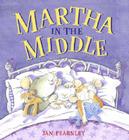 In preparation for Barleybee's arrival, my awesome brother and sister-in-law, Michael and Grace, bought Isabel a book focused on the middle child for her birthday last month. It's appropriate in two ways. First, though we didn't know it at the time, Jan Fearnley's Martha in the Middle mirrors the family structure we're going to have, with two older girls and a younger boy. Second, because of Eleanor's initial difficulty pronouncing "Uncle Michael," the girls call him Uncle Mice, and this is a book with all-mouse characters. It was a sweet, thoughtful gift.
Unfortunately, it's also one of those books that problematize a thing which is not yet a problem, and which we hope won't become one (see Julius, the Baby of the World and my problem with it, Bedtime for Frances, etc.). The premise of Martha in the Middle is that Martha doesn't like being in the middle of everything. Her older sister Clara gets praised for being "big and sensible." Her younger brother Ben gets praised for being "cutesy-wootsey." Martha feels unnoticed, uncared for, unwanted. She decides to run away, and on her journey meets a frog who expounds on all the ways that the middle is best:
They looked at the tall sunflowers. Martha nibbled on some of the sunflower seeds.
"See, the seeds are in the middle," said the frog. "That's the best bit."
Martha begins to join in on the celebration of the middle, and ends up returning home, feeling quite good about herself ("I think the middle is special") and going off to play again with her siblings.
We read the book with Isabel and Eleanor once, when it arrived, and that night I hid it. Isabel was so intent on the story, and is so interested in acting out the roles of different characters, that I fear repeated readings will give her a chip on her shoulder before Barleybee is even born. We'll keep the book in reserve, in case that's how she feels somewhere down the line, but it's not a book for now.
Wait just a second, Annie, you may be saying. The book you're hiding away sounds like it has almost exactly the same plot as Noisy Nora, the book you've been touting. It's also girl-girl-boy. Nora and Martha are both responding to feeling neglected by their parents in favor of their younger and older siblings. Both girls choose to run away as a result. For goodness sake, all the characters in both books are mice.
What's the difference? Part of it, I think, is style: Rosemary Wells's rhymes are sharp and funny, the refrain is fabulous, there's a rhythm to the book that is utterly infectious.
Here's how Wells starts out:
Jack had dinner early,
Father played with Kate,
Jack needed burping,
So Nora had to wait.
First she banged the window,
Then she slammed the door,
Then she dropped her sister's marbles on the kitchen floor.
"Quiet!" said her father.
"Hush!" said her mum.
"Nora!" said her sister,
"Why are you so dumb?"
And Wells is economical: where Fearnley's text says more about Martha's feelings directly, Wells's brief lines accompanied by illustrations of Nora's increasing frustration capture the sense of wordless freak-out I am so familiar with in my own children:


Sometimes, less is more.
I want to leave you with another Expanding Family question: can you recommend some good kids' books about adoption? There are two new lovely adopted children in our friends' lives this year, in different situations, and I'm wondering what's out there for their families.
Situation #1 (which I mentioned briefly here): a white couple who have recently adopted an African-American baby at birth. She's their only child. Bonus points if the book also includes dogs, as their family does.
Situation #2: Eleanor has a good friend, just turning 5, whose family is adopting a 1 1/2 year-old Ethiopian girl. Some of the same racial depiction questions here: white parents and older sister, black adopted child. But other questions, too: are there books out there that discuss becoming the older sibling to a little sister or brother who's not a baby?
Love, Annie
Tuesday, October 16, 2012
Families of five
Dear Annie,
I'm not so good on the Noisy Nora girl-girl-boy family structure, but here are a few classic three-child families (with thanks to the brainstorming abilities of my co-workers):
 Staying with the classics, Babar and Celeste have an instant three-child family when their first-born turns out to be triplets in
Babar and His Children. The girl is named Flora; the boys are Pom and Alexander.
Another Alexander, this one of the Terrible, Horrible, No Good, Very Bad Day, is afflicted with two big brothers.
 At breakfast Anthony found a Corvette sting Ray car kit in his breakfast cereal box and Nick found a Junior Undercover Agent code ring in his breakfast cereal box but in my breakfast cereal box all I found was breakfast cereal.
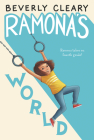
Three boys there, and on the other side of the country, three girls at the Quimbys'. The summer after Ramona's third grade year, the ultimate little sister becomes a big sister.
Ramona's World starts:
And another big favorite: Dogger, with a wonderful girl-boy-boy family. It's a story of siblings caring about each other. So I'll leave you with this lovely illustration, and I'll think of your future in Brooklyn whenever I look at it:
 Love,
Deborah
I'm not so good on the Noisy Nora girl-girl-boy family structure, but here are a few classic three-child families (with thanks to the brainstorming abilities of my co-workers):
Wendy came first, then John, then Michael.Peter Pan! (Full text here.) Mrs Darling remembers the children's last evening at home:
She had found her two older children playing at being herself and father on the occasion of Wendy's birth, and John was saying:
"I am happy to inform you, Mrs. Darling, that you are now a mother," in just such a tone as Mr. Darling himself may have used on the real occasion.
Wendy had danced with joy, just as the real Mrs. Darling must have done.
Then John was born, with the extra pomp that he conceived due to the birth of a male, and Michael came from his bath to ask to be born also, but John said brutally that they did not want any more.
Michael had nearly cried. "Nobody wants me," he said, and of course the lady in the evening-dress could not stand that.
"I do," she said, "I so want a third child."
"Boy or girl?" asked Michael, not too hopefully.
"Boy."
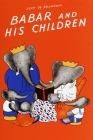 Staying with the classics, Babar and Celeste have an instant three-child family when their first-born turns out to be triplets in
Babar and His Children. The girl is named Flora; the boys are Pom and Alexander.
Another Alexander, this one of the Terrible, Horrible, No Good, Very Bad Day, is afflicted with two big brothers.
 At breakfast Anthony found a Corvette sting Ray car kit in his breakfast cereal box and Nick found a Junior Undercover Agent code ring in his breakfast cereal box but in my breakfast cereal box all I found was breakfast cereal.
Three boys there, and on the other side of the country, three girls at the Quimbys'. The summer after Ramona's third grade year, the ultimate little sister becomes a big sister.
Ramona's World starts:
Of course the baby becomes a bit more problematic as she grows, learns to spit mashed peas, screams a fair amount, and sucks up adult attention.Ramona Quimby was nine years old. She had brown hair, brown eyes, and no cavities. She had a mother, a father, a big sister named Beatrice who was called Beezus by the family, and -- this was the exciting part -- a baby sister named Roberta after her father, Robert Quimby.
"Look at her tiny fingernails," Ramona marveled as she looked at the sleeping Roberta, "and her little eyebrows. She is already a whole person, only little."
And another big favorite: Dogger, with a wonderful girl-boy-boy family. It's a story of siblings caring about each other. So I'll leave you with this lovely illustration, and I'll think of your future in Brooklyn whenever I look at it:

Deborah
Saturday, October 13, 2012
Picturing our expanding family
Dear Aunt Debbie,
That is quite a dilemma, and sounds like an excellent read, to boot. I love hearing about bookseller questions like yours, as our home library is arranged largely by what size book fits on what shelf, the vague memory of where we put a favorite book away last time, and the current pile sitting on the coffee table. Eleanor does do a certain amount of categorization in her head, however, as we recently discovered when we shared some big news with her: we're having a third child!
Baby #3 (who Isabel has named "Barleybee" in utero) is due in February. We told the girls a couple of months ago, and one of Eleanor's first reactions was to put it in literary terms:
"If it's a boy, we'll be just like Noisy Nora! I'll be Kate, and Isabel will be Nora, and Barleybee will be Jack!"
And if it's a girl?
"We'll be just like The Worry Week! I'll be Alice, and Isabel will be Allegra, and Barleybee will be Minnow! I'll change my name to Alice."
 Well, we found out earlier this week that it'll be more Noisy Nora than Worry Week around here -- Barleybee is a boy! I'm looking forward to seeing what kinds of additions he brings to our reading habits as he grows.
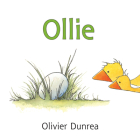
For now, things are a little like Ollie, Olivier Dunrea's lovely board book about two goslings, Gertie and Gossie, waiting for a reluctant Ollie to hatch from his egg:
Ollie is waiting.
He won't come out.
Gossie and Gertie have been waiting for weeks for Ollie to come out.
"I won't come out," says Ollie.
Ollie (in his egg) rolls all over the farmyard, refusing to come out. Gossie and Gertie chase after him for the climactic board book ending:
Gossie and Gertie sit on top of Ollie.
"Don't come out," says Gossie.
"Don't come out," says Gertie.
Ollie waits.
Then he begins cracking!
"I'm out!" he says.
We figure that's pretty much how it'll go here, too.
So I'm on the lookout for more books about three-kid families, especially ones with our upcoming two girls, one boy structure. Any suggestions?
Love, Annie
That is quite a dilemma, and sounds like an excellent read, to boot. I love hearing about bookseller questions like yours, as our home library is arranged largely by what size book fits on what shelf, the vague memory of where we put a favorite book away last time, and the current pile sitting on the coffee table. Eleanor does do a certain amount of categorization in her head, however, as we recently discovered when we shared some big news with her: we're having a third child!
Baby #3 (who Isabel has named "Barleybee" in utero) is due in February. We told the girls a couple of months ago, and one of Eleanor's first reactions was to put it in literary terms:
"If it's a boy, we'll be just like Noisy Nora! I'll be Kate, and Isabel will be Nora, and Barleybee will be Jack!"
And if it's a girl?
"We'll be just like The Worry Week! I'll be Alice, and Isabel will be Allegra, and Barleybee will be Minnow! I'll change my name to Alice."
 Well, we found out earlier this week that it'll be more Noisy Nora than Worry Week around here -- Barleybee is a boy! I'm looking forward to seeing what kinds of additions he brings to our reading habits as he grows.
For now, things are a little like Ollie, Olivier Dunrea's lovely board book about two goslings, Gertie and Gossie, waiting for a reluctant Ollie to hatch from his egg:
Ollie is waiting.
He won't come out.
Gossie and Gertie have been waiting for weeks for Ollie to come out.
"I won't come out," says Ollie.
Ollie (in his egg) rolls all over the farmyard, refusing to come out. Gossie and Gertie chase after him for the climactic board book ending:
Gossie and Gertie sit on top of Ollie.
"Don't come out," says Gossie.
"Don't come out," says Gertie.
Ollie waits.
Then he begins cracking!
"I'm out!" he says.
We figure that's pretty much how it'll go here, too.
So I'm on the lookout for more books about three-kid families, especially ones with our upcoming two girls, one boy structure. Any suggestions?
Love, Annie
Wednesday, October 10, 2012
Which shelf?
Dear Annie,
A book just arrived at the store that's posing an unusual question: on what shelf does it belong?

Dark Lord: The Early Years by Jamie Thomson opens with the main character falling onto a suburban parking lot. He calls for his lieutenant, who doesn't come; he discovers his iron-taloned Gauntlets of Ineluctable Destruction have disappeared: he has "pink, pallid and pudgy" soft hands. Police officers approach, reassuring him that an ambulance is on the way. He tries to zap them -- puny humans! -- with various spells, all of them ineffective.
So here's my problem. Our middle-grade fiction at the store is divided into two sections: one is fantasy and science fiction; the other is more realistic fiction. If the ending shows that Dirk is a regular kid with delusions, it should live on the realistic shelves. If instead he really is the Dark Lord of another planet, well, it's fantasy. And if I display it on either side of the aisle, I'm giving away the secret of the book. Right now it's on a new-arrivals display, so I'm sidestepping the question. But sooner or later, I'll need a plan.
 This theme -- mixing up florid constructs of fantasy worlds with everyday life -- is less ambiguously (but more artfully) presented in
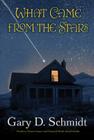
What Came from the Stars by Gary Schmidt, author of Okay for Now. I'm quite fond of his books, and this one is definitely a departure. It opens in italics, in a world sounding vaguely Middle Earth-ish:
What Came from the Stars packs more emotional punch, though. Tommy and his family are still reeling from the blow of his mother's death. Yes, it's another dead mother book, but the feelings are central to the plot; it isn't just a convenient way to remove an authority figure. Evil developers are trying to change the Plymouth seashore. Realistic chapters alternate with the high fantasy of the world of the Valorim, where underground resistance to the conquerors is growing. Bad guys are sent across the universe to find the chain, and the resistance sends a virtuous young warrior to stop him. The reader really cares about both worlds, and when Tommy and Ealgar join forces, we long for things to be right both in Plymouth and in the home of the Valorim.
And I know which side of the aisle this one belongs on.
Love,
Deborah
A book just arrived at the store that's posing an unusual question: on what shelf does it belong?
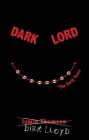
Dark Lord: The Early Years by Jamie Thomson opens with the main character falling onto a suburban parking lot. He calls for his lieutenant, who doesn't come; he discovers his iron-taloned Gauntlets of Ineluctable Destruction have disappeared: he has "pink, pallid and pudgy" soft hands. Police officers approach, reassuring him that an ambulance is on the way. He tries to zap them -- puny humans! -- with various spells, all of them ineffective.
"What's your name, kid?" asked Officer Johnson.Dirk eventually ends up living in a foster home, and in counseling. He reluctantly makes a few friends in school -- and the story goes on to an excellent ending (stay tuned for book 2). Throughout the book, one tries to figure out if this kid is the victim of a concussion and too many video games, or if what we're reading here is an interplanetary fantasy. Needless to say, I'm not going to give it away here.
The kid, for that's what he looked like, thought for a moment. He couldn't remember his name. No matter how hard he tried, he just couldn't. But he could remember what he was, and his primary title.
"Daa . . . (cough, cough). I am the Dark Lord," he said. To his horror, he realized his voice really did sound like some kind of do-gooding Elf woman or a human boy-child!
"Dirk? Did you say Dirk?"
"No! No! Dark! Dark Lord." But his voice came out wrong, weak and raspy and even more boyish than before.
"Dirk, eh? Dirk Lloyd? Where are your mom and dad, Dirk? Have you been hit by a car? Are you lost, son?"
"Mom and dad?" he sputtered, outraged. "I don't have parents, you curs -- I am the Incarnation of Evil! The World Burner! The Dark One, to name but a few of my titles! I'm not someone's little boy, you fools!"
"These computer games. It's an obsession at their age," said Officer Johnson.
So here's my problem. Our middle-grade fiction at the store is divided into two sections: one is fantasy and science fiction; the other is more realistic fiction. If the ending shows that Dirk is a regular kid with delusions, it should live on the realistic shelves. If instead he really is the Dark Lord of another planet, well, it's fantasy. And if I display it on either side of the aisle, I'm giving away the secret of the book. Right now it's on a new-arrivals display, so I'm sidestepping the question. But sooner or later, I'll need a plan.
 This theme -- mixing up florid constructs of fantasy worlds with everyday life -- is less ambiguously (but more artfully) presented in
What Came from the Stars by Gary Schmidt, author of Okay for Now. I'm quite fond of his books, and this one is definitely a departure. It opens in italics, in a world sounding vaguely Middle Earth-ish:
So the Valorim came to know that their last days were upon them. The Reced was doomed, and the Ethelim they had loved well and guarded long would fall under the sharp trunco of the faceless O'Mondim and the traitors who led them. The Valorim looked down from the high walls of the Reced and knew they would find no mercy in the dark fury of the O'Mondim massed below -- none for all they had loved.So they forge a magic chain, containing all the knowledge of the Valorim, and toss it into their sky, and on up into space. It lands in the lunchbox of Tommy Pepper of Plymouth, Massachusetts, planet Earth, on his 12th birthday. It's cool looking, he puts it on, and he starts knowing things, like that a hanorah is a kind of horn: "You play it after a victory in battle, and also after Second Sunrise on the first day of the new year." He's met with the same kind of skepticism that greeted Dirk Lloyd.
What Came from the Stars packs more emotional punch, though. Tommy and his family are still reeling from the blow of his mother's death. Yes, it's another dead mother book, but the feelings are central to the plot; it isn't just a convenient way to remove an authority figure. Evil developers are trying to change the Plymouth seashore. Realistic chapters alternate with the high fantasy of the world of the Valorim, where underground resistance to the conquerors is growing. Bad guys are sent across the universe to find the chain, and the resistance sends a virtuous young warrior to stop him. The reader really cares about both worlds, and when Tommy and Ealgar join forces, we long for things to be right both in Plymouth and in the home of the Valorim.
And I know which side of the aisle this one belongs on.
Love,
Deborah
Sunday, October 7, 2012
Bad Manners
Dear Aunt Debbie,
What a joy to see you and Lizzie today, on what would have been Grandpa's 100th birthday! I loved the combination of family read-alouds: starting the afternoon watching Lizzie read to my girls, and then reading aloud so many of Grandpa's old letters and postcards. A good day.
 I mentioned to you that, of the books you sent Isabel for her birthday, another clear favorite has emerged: Maya Makes a Mess, a Toon Book by Rutu Mordan. We have a couple of other Toon Books (both, I think, gifts from you) and I've always liked the idea of the series: easy-to-read comics aimed at kids, written and drawn by current cartoonists and graphic novelists. The series is edited by Francoise Mouly, Covers Editor of the New Yorker. On some of the early books, her husband Art Speigelman was listed as an advisor, and in looking at the website tonight, I noticed that their daughter Nadja (who I had the pleasure of teaching for a semester in high school) has written some of the titles in the series. More to check out!

 The girls like our other Toon Books: Little Mouse Gets Ready, by Jeff Smith (of the Bone series), and Silly Lilly in What Will I Be Today?, by Agnes Rosensteihl. And I like them fine, too: active, cartoony drawings, a good introduction to the idea of a story in panels. They're both a little one-note, however. Little Mouse spends the panels of his book getting ready to go to the barn, putting on one item of clothing at a time, and talking himself through it. The punchline at the end comes from his mother: "Why, Little Mouse! WHAT are you doing?...Mice don't wear clothes!" Silly Lilly's structure follows the days of the week. On each day, she chooses a role to dress up in and act out: cook, city planner, musician, etc. They're cute, just a little flat.
Maya Makes a Mess is on a whole different level. Maya begins her story at home, eating dinner with her parents, who criticize her manners repeatedly in a series of instructions both of my girls can now parrot:


Turns out, it does taste better. The Queen declares that everyone in the kingdom will now eat "as Maya showed us. But only on holidays." Maya is redeemed, and everyone is happy.
There's such a sense of loopy fun throughout the whole book. It feels like a kid's fantasy, rather than an actual invitation to bad behavior. Both Eleanor and Isabel have taken to quoting it throughout the day, and we have easily read it thirty times in the last week. I've found Isabel more than once turning the pages and examining each picture by herself on the couch. Toon into reading, indeed!
Love, Annie
What a joy to see you and Lizzie today, on what would have been Grandpa's 100th birthday! I loved the combination of family read-alouds: starting the afternoon watching Lizzie read to my girls, and then reading aloud so many of Grandpa's old letters and postcards. A good day.
 I mentioned to you that, of the books you sent Isabel for her birthday, another clear favorite has emerged: Maya Makes a Mess, a Toon Book by Rutu Mordan. We have a couple of other Toon Books (both, I think, gifts from you) and I've always liked the idea of the series: easy-to-read comics aimed at kids, written and drawn by current cartoonists and graphic novelists. The series is edited by Francoise Mouly, Covers Editor of the New Yorker. On some of the early books, her husband Art Speigelman was listed as an advisor, and in looking at the website tonight, I noticed that their daughter Nadja (who I had the pleasure of teaching for a semester in high school) has written some of the titles in the series. More to check out!

 The girls like our other Toon Books: Little Mouse Gets Ready, by Jeff Smith (of the Bone series), and Silly Lilly in What Will I Be Today?, by Agnes Rosensteihl. And I like them fine, too: active, cartoony drawings, a good introduction to the idea of a story in panels. They're both a little one-note, however. Little Mouse spends the panels of his book getting ready to go to the barn, putting on one item of clothing at a time, and talking himself through it. The punchline at the end comes from his mother: "Why, Little Mouse! WHAT are you doing?...Mice don't wear clothes!" Silly Lilly's structure follows the days of the week. On each day, she chooses a role to dress up in and act out: cook, city planner, musician, etc. They're cute, just a little flat.
Maya Makes a Mess is on a whole different level. Maya begins her story at home, eating dinner with her parents, who criticize her manners repeatedly in a series of instructions both of my girls can now parrot:

Her father asks, "What if you were eating dinner with the QUEEN?!" Immediately, the doorbell rings, and it's a royal messenger, inviting Maya to come to dinner with the Queen at once. She gets on the airplane (which has apparently landed in her backyard), still being admonished: "Put on a dress!" "No time, no time!" the royal messenger says as he reaches up to turn the propeller manually.
The palace is pleasingly royal, and Maya, seated at the Queen's right hand, is surrounded by adults in fancy dress and faced with an array of disgusting foods (Snail Salad, Stuffed Tomato, Spinach Juice) and a tremendous number of utensils. She asks for, and receives, pasta with ketchup, which she proceeds to eat with her hands. Everybody stops and stares, including the Queen.

And so they do:

There's such a sense of loopy fun throughout the whole book. It feels like a kid's fantasy, rather than an actual invitation to bad behavior. Both Eleanor and Isabel have taken to quoting it throughout the day, and we have easily read it thirty times in the last week. I've found Isabel more than once turning the pages and examining each picture by herself on the couch. Toon into reading, indeed!
Love, Annie
Subscribe to:
Posts (Atom)