In which Annie (high school teacher, mother of two young girls and a younger boy) and her aunt Deborah (children's bookseller, mother of two young women in their 20s) discuss children's books and come up with annotated lists.

Showing posts with label new baby. Show all posts

Friday, October 19, 2012

Problematizing the middle child

Dear Aunt Debbie,

Thank you for the three-child-family recommendations!  I've thought about Peter Pan recently at bedtime, singing "Tender Shepherd" from the stage version: "One in the meadow, two in the garden, three in the nursery, fast asleep."  Something to aspire to.
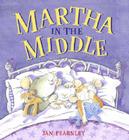
In preparation for Barleybee's arrival, my awesome brother and sister-in-law, Michael and Grace, bought Isabel a book focused on the middle child for her birthday last month.  It's appropriate in two ways.  First, though we didn't know it at the time, Jan Fearnley's Martha in the Middle mirrors the family structure we're going to have, with two older girls and a younger boy.  Second, because of Eleanor's initial difficulty pronouncing "Uncle Michael," the girls call him Uncle Mice, and this is a book with all-mouse characters.  It was a sweet, thoughtful gift.

Unfortunately, it's also one of those books that problematize a thing which is not yet a problem, and which we hope won't become one (see Julius, the Baby of the World and my problem with it, Bedtime for Frances, etc.).  The premise of Martha in the Middle is that Martha doesn't like being in the middle of everything.  Her older sister Clara gets praised for being "big and sensible."  Her younger brother Ben gets praised for being "cutesy-wootsey."  Martha feels unnoticed, uncared for, unwanted.  She decides to run away, and on her journey meets a frog who expounds on all the ways that the middle is best:

They looked at the tall sunflowers.  Martha nibbled on some of the sunflower seeds.
"See, the seeds are in the middle," said the frog.  "That's the best bit."

Martha begins to join in on the celebration of the middle, and ends up returning home, feeling quite good about herself ("I think the middle is special") and going off to play again with her siblings.

We read the book with Isabel and Eleanor once, when it arrived, and that night I hid it.  Isabel was so intent on the story, and is so interested in acting out the roles of different characters, that I fear repeated readings will give her a chip on her shoulder before Barleybee is even born.  We'll keep the book in reserve, in case that's how she feels somewhere down the line, but it's not a book for now.

Wait just a second, Annie, you may be saying.  The book you're hiding away sounds like it has almost exactly the same plot as Noisy Nora, the book you've been touting.  It's also girl-girl-boy.  Nora and Martha are both responding to feeling neglected by their parents in favor of their younger and older siblings.  Both girls choose to run away as a result.  For goodness sake, all the characters in both books are mice.

What's the difference?  Part of it, I think, is style: Rosemary Wells's rhymes are sharp and funny, the refrain is fabulous, there's a rhythm to the book that is utterly infectious.

Here's how Wells starts out:

Jack had dinner early,
Father played with Kate,
Jack needed burping,
So Nora had to wait.

First she banged the window,
Then she slammed the door,
Then she dropped her sister's marbles on the kitchen floor.

"Quiet!" said her father.
"Hush!" said her mum.
"Nora!" said her sister,
"Why are you so dumb?"

And Wells is economical: where Fearnley's text says more about Martha's feelings directly, Wells's brief lines accompanied by illustrations of Nora's increasing frustration capture the sense of wordless freak-out I am so familiar with in my own children:


Sometimes, less is more.

I want to leave you with another Expanding Family question: can you recommend some good kids' books about adoption?  There are two new lovely adopted children in our friends' lives this year, in different situations, and I'm wondering what's out there for their families.

Situation #1 (which I mentioned briefly here): a white couple who have recently adopted an African-American baby at birth.  She's their only child.  Bonus points if the book also includes dogs, as their family does.

Situation #2: Eleanor has a good friend, just turning 5, whose family is adopting a 1 1/2 year-old Ethiopian girl.  Some of the same racial depiction questions here: white parents and older sister, black adopted child.  But other questions, too: are there books out there that discuss becoming the older sibling to a little sister or brother who's not a baby?

Love, Annie

Saturday, October 13, 2012

Picturing our expanding family

Dear Aunt Debbie,

That is quite a dilemma, and sounds like an excellent read, to boot.  I love hearing about bookseller questions like yours, as our home library is arranged largely by what size book fits on what shelf, the vague memory of where we put a favorite book away last time, and the current pile sitting on the coffee table.  Eleanor does do a certain amount of categorization in her head, however, as we recently discovered when we shared some big news with her: we're having a third child!

Baby #3 (who Isabel has named "Barleybee" in utero) is due in February.  We told the girls a couple of months ago, and one of Eleanor's first reactions was to put it in literary terms:

"If it's a boy, we'll be just like Noisy Nora!  I'll be Kate, and Isabel will be Nora, and Barleybee will be Jack!"

And if it's a girl?

"We'll be just like The Worry Week!  I'll be Alice, and Isabel will be Allegra, and Barleybee will be Minnow!  I'll change my name to Alice."

Well, we found out earlier this week that it'll be more Noisy Nora than Worry Week around here -- Barleybee is a boy!  I'm looking forward to seeing what kinds of additions he brings to our reading habits as he grows.

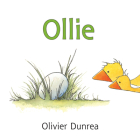
For now, things are a little like Ollie, Olivier Dunrea's lovely board book about two goslings, Gertie and Gossie, waiting for a reluctant Ollie to hatch from his egg:

Ollie is waiting.
He won't come out.
Gossie and Gertie have been waiting for weeks for Ollie to come out.
"I won't come out," says Ollie.

Ollie (in his egg) rolls all over the farmyard, refusing to come out.  Gossie and Gertie chase after him for the climactic board book ending:

Gossie and Gertie sit on top of Ollie.
"Don't come out," says Gossie.
"Don't come out," says Gertie.
Ollie waits.
Then he begins cracking!
"I'm out!" he says.

We figure that's pretty much how it'll go here, too.

So I'm on the lookout for more books about three-kid families, especially ones with our upcoming two girls, one boy structure.  Any suggestions?

Love, Annie

Monday, November 21, 2011

Fantastic stories parents tell their kids

Dear Aunt Debbie,

Julian sounds like an awesome character.  We'll have to put him on the list.  We've just run through the four linked Edward Eager books that begin with Half Magic, and are back to rereading My Father's Dragon.  The end of The Time Garden, which has the scene in which Katherine and Martha's children travel back in time and meet (and rescue) their mothers as children, was a fabulous reading experience.  As Jeff read the scene and Eleanor realized what was happening, she got incredibly excited, so much so that she started bouncing and jumping on the couch, sputtering, "Everything!  Everything!"  I can't wait for her to discover other linked fictional universes.

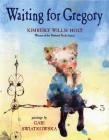
Your descriptions of Julian's tall tales made me think of a picture book which also involves tall tales and strange, elaborate drawings: Waiting for Gregory,by Kimberly Willis Holt, illustrated by Gabi Swiatkowska.  It's a book Aunt Irene and cousin Ona sent Eleanor when I was pregnant with Isabel -- a Preparing for the New Baby book, with a couple of twists.

The book begins:

Aunt Athena is expecting a baby boy.
She says we'll call him Gregory.

The picture is of Iris, the narrator, holding the rendering of Aunt Athena's pregnancy.  It gives you the sense of the lovely, odd combination Swiatkowska achieves in her illustrations: her characters have an 18th-century feel about them, and the pages are filled with intricate line drawings of ladders and angels and strange machines -- it feels a little like an artist's notebook.

Iris is eager for her cousin to be born, and curious about when it's going to happen, but no one will give her a straight answer.  "Soon, Iris, but not too soon," her father tells her.  And then the myths come: Iris's grandfather tells her Gregory will be arriving by stork; her grandmother tells her he's growing under a cabbage in her aunt's garden, her friend Lacey insists it has to do with Aunt Athena eating "a thousand chocolate-chip ice cream sundaes with sour pickles on top."  Finally, Iris asks her mother, who pulls out the most accurate information from each story (while still eliding any actual physical facts of pregnancy), and gives Iris a rough estimate.

Iris goes on in the vein of Babies Can't Eat Kimchee to imagine all the things she wants to do with Gregory:


When Gregory arrives, of course, he can't do any of those things yet, but there is the hopeful, pleased sense that some day he will.

Love, Annie


Saturday, June 5, 2010

More new baby and sibling books

Dear Aunt Debbie,

On brand-new babies:

We adore Lilly's Purple Plastic Purse (such a great book to address guilt over doing something mean and then regretting it), and read Julius, the Baby of the World soon after Isabel was born. However, we ran into the Bedtime for Frances problem: Eleanor started saying more negative things about Isabel as a consequence of reading the book than she had been on her own. We returned it to the library.

Another book you gave us in the same vein, with wonderful, realistic illustrations by Michael Emberly is Robie H. Harris's Hi New Baby!


Hi New Baby!


An older sister is less than thrilled by the appearance of her younger brother (the line Eleanor quoted from this one is "That baby is yucky!"), but quickly has some fond moments with him. One of the things I like about this one is that it's narrated by Dad, talking to the older sister in retrospect: remember when this happened?

Eleanor also really likes the book Rachel recommended in her comment, How to Be a Baby...By Me, the Big Sister. It contains some very funny lists.

On older sibling/younger sibling relationships:

As I've mentioned before, I love the treatment of sibling jealousy in A Birthday for Frances.

Rosemary Wells does siblings incredibly well. Two of our favorites (there are so many great ones) are Noisy Nora and Stanley and Rhoda (sadly, out of print).


Noisy Nora


Nora is the middle sibling, and spends the book watching her parents pay attention to her older sister and baby brother, then acting out in huge operatic ways ("First she banged the window/Then she felled some chairs/Then she took her brother's kite and flew it down the stairs!"). When all of the attention she gets is negative, she decides to run away, and everyone immediately misses her. Perhaps my favorite illustration here is Nora holding up a muffin pan in her little mouse hands, clearly about to drop it and make as much noise as she can.


Stanley and Rhoda


Stanley is a studious looking, responsible mouse, and Rhoda is his louder and far less responsible little sister. There are three stories in the book; our favorite is "Don't Touch it, Don't Look at It," in which Rhoda gets a bee sting and freaks out, while Stanley quietly calms her down.

I'll save the Max and Ruby books (NOT the ones connected with the TV show, blech) for another post. They deserve their own.

Finally, on a positive sibling note, I want to mention another gift from you:


Sisters


David McPhail's drawings of the older sister and younger sister playing together and separately have a nice pencil-sketch feel to them, and his spare text describes two girls who you feel would be fun to hang out with. It's a good Here's how we're different/ Here's how we're alike book.

Love, Annie

Thursday, June 3, 2010

Aack! New Baby!

Dear Annie,

Before I go on to new sibling books, I have one last discovery to add to the Best-Ever cover change. Remember the cover for
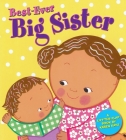
Best-Ever Big Sister
, which I thought had been unchanged? Well, guess what arrived at the store today?:

The change isn't as drastic as going from an African-American kid to blond hair and blue eyes, as they did with the brother (see 6/1 post) . But she still isn't who she used to be.

You ask about new sibling books. The Best-Evers are fine, and good for toddlers, complete with lift-the-flaps. They fall into the see-what-I-can-do category of big sibling books: reassure older sibling by celebrating his/her accomplishments, plant the idea that older child will be able to teach younger. My favorite of this type currently in print is Babies Can't Eat Kimchee, addressed quite nicely by you on 5/28.

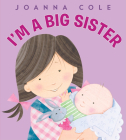
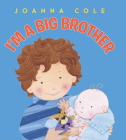
Then there are the informational books. New baby will come. Mom and Dad will go to hospital and come back. Small baby won't be able to do anything. etc. Joanna Cole (yes, the Magic School Bus person) is an author who can do those books very straightforwardly, and they can be useful to introduce the subject:
These books have also gone through a redesign: these are the re-illustrated versions of what were books with bright red or blue covers.

Then there are the I-don't-want-this-baby-here books. They're often the best literature of the lot, because they tell good stories. See especially A Baby Sister for Frances in your 5/22 post. And the favorite in our house was always
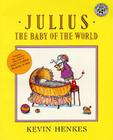
Julius the Baby of the World
by Kevin Henkes (two syllables) with the flamboyant Lilly (of the Purple Plastic Purse) in the role of obnoxious older sibling. Much of the book is her very funny but intense comments on how much she dislikes new baby Julius. In the end, she's offended by a cousin making similar criticisms, and she rises to Julius' defense. Illustrations show that the siblings become fast friends. Because Lilly's feelings are so raw, this is not the first book you want to read with your soon-to-be older sibling. But for an older child, or some months into the new baby's life, it's very funny.

One other, new last year, which doesn't quite fit any of my categories above:
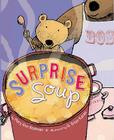
Surprise Soup
, by Mary Ann Rodman tells the story of two brothers and a father making soup for their mother as they await her arrival home with the new baby. Younger brother Kevie is constantly being put down or ignored by the older, and even Dad doesn't hear what he says -- Kevie's the only one who knows Mom's secret ingredient. All turns out well in the end, and it's a very cozy family story. Also a good reminder that life doesn't always revolve around the baby.

Friday, May 28, 2010

Book as window, book as mirror

Dear Aunt Debbie,

Sounds like a fabulous convention. From checking out your links, I'm particularly interested in reading some of Cory Doctorow's work. For the Win sounds in some ways like an updated version of Orson Scott Card's Ender's Game: applying kids' video game skill to real-world situations. I first heard about "gold farming" (sweatshop workers playing video games endlessly to get characters to higher levels, which are then sold to first-world players for real money) a couple of years ago, and find the concept both horrifying and fascinating. I'm intrigued.

I was struck by Mitali Perkins's formulation of books as "window books" or "mirror books," and started thinking this morning about which kids' books I've been reading lately would fall into each category. Then, of course, my English teacher brain kicked in, and I thought, So many of the best books, kids' lit or otherwise, are those which are both mirrors and windows. There's something in a book which allows you to identify with it deeply, and yet the book also has something to teach you outside of your own experience.

One of the first books I thought of which functions as both mirror and window for Eleanor is another of your gifts:


Babies Can't Eat Kimchee


Babies Can't Eat Kimchee, by Nancy Patz, with great energetic collage illustrations by Susan L. Roth, is perhaps my favorite How to Deal With a New Sibling book. The mirror: An older sister is faced with a new baby sister. She lists the things babies can't do (eat kimchee, spaghetti, and strawberry ice cream; dance like a ballerina; know what an elephant is), then turns it around and projects how she will help teach her little sister some of these things ("I'll teach her to lick up the drips"). When we started reading the book, just before Isabel was born, Eleanor immediately picked up on the positive formulation: I'm going to help teach my baby to walk, etc. The window: the girls in the book are Korean, and there are references to kimchee and the special dress the baby will wear on her first birthday. Both of these have prompted questions from Eleanor. The best part of the book: at the end, the older sister gets so carried away by the idea of singing songs with her little sister that she offers, "Baby, do you want me to teach you a song?" Then there's a two-page spread of a red-faced, screaming baby ("WAAAAAH! WAAAAAH!"), followed by the rueful older girl: "Well, maybe someday." We have probably acted out those last pages 150 times this year.

I remember, in my own childhood reading, identifying incredibly closely with lots of characters, to the point where their moods would influence mine as I read. What kids' books do you think functioned most as mirrors, or windows, or both, for Lizzie and Mona?

Love, Annie