In which Annie (high school teacher, mother of two young girls and a younger boy) and her aunt Deborah (children's bookseller, mother of two young women in their 20s) discuss children's books and come up with annotated lists.

Showing posts with label Hoban. Show all posts

Friday, April 3, 2015

Heroines of the month: Penderwicks, Clementine, and Frances

Dear Aunt Debbie,

We're coming out of a rough March, which culminated in a stomach flu that decimated Isabel's kindergarten class and knocked us for a loop. Through it all, we've continued to read up a storm. All three kids have gravitated recently towards reading and rereading of books with terrific, spunky heroines.

It's funny you should mention The Penderwicks in your last post. I tried reading it to Eleanor a couple of years ago, when she was still too young for it, then finished it myself and thought, eh, as you did. But Eleanor read it on her own last month, and liked it so much she asked me to read it to her again as a read-aloud. It's growing on me this time through. I like the variety in the characters of the sisters, who are Little Women-ish in some respects: Rosalind, the oldest, has a mothering/romantic Meg vibe; Skye, the second, is the rebellious one, and the one I suspect is author Jeanne Birdsall's favorite. But there the similarities begin to break down: it's Jane, the third daughter, who is the writer in the family, while Skye prefers to do math, and both are terrific soccer players. Batty, the youngest, is an animal-lover and wears butterfly wings everywhere. We've just gotten the second and third books from the library; I think we're hooked.

Isabel has for the first time found a non-graphic novel chapter book series she wants to read straight through: Clementine, by Sara Pennypacker. These books have just the right combination of elementary school suspense and relief. What will happen when Clementine cuts off her friend's hair (at her request) and then her own (to match) and colors both of their heads with marker? What will happen when she sells items that people in her building have given to charity back to other people in her building to earn money for a present for her mom?

Pennypacker's quirky sense of humor first jived with Isabel when you sent us The Amazing World of Stuart, and continues here. We never learn Clementine's little brother's name, because she refers to him by the name of a different vegetable every time he's mentioned (she got stuck with a fruit name, so why didn't he get a vegetable name to match?). In one book, Clementine goes on a shopping trip to an Asian grocer to look for new vegetable names: Mung Bean Sprout, Bok Choy. Clementine is a terrific artist, can do advanced math problems in her head, and really doesn't like pointy things. As a parent, I appreciate her family as well: Mom is an artist who wears overalls and tolerates a good amount of mess; Dad is the super of their apartment building in Boston, and they have a sweet, affectionate relationship with each other and their kids that reminds me of Anastasia's parents in Lois Lowry's series. Isabel's favorite so far is The Talented Clementine, which focuses on a talent show and Clementine's fear of having no stage-worthy talent. We have not been allowed to return any of these to the library, and our library shelf is pretty much glowing orange.

Finally, what does Will want every day? The Frances books! I wouldn't have picked these fairly long picture books for a two-year-old, but this is the kind of happy discovery that you get to make when your house is full of books for kids of all different ages at once. Will doesn't say "Frances," but refers to each of her books as "My book." (In the case of A Baby Sister for Frances, it's "My baby book.") He asks for them every day, morning, afternoon, and night. I think I could probably recite all of A Birthday for Frances from memory, and that is not a short book. I'm not sure how much of the story he's getting -- mostly, he likes to point to the characters and name them, and refer to any character who's shown smaller in the distance as "baby" -- but he wants us to read them, cover to cover.

We have read our four Frances books so many times over the last month that I went ahead and added a fifth to our bookshelves: Best Friends for Frances. My dim memory of the book was that it was about kids excluding each other because of gender, and I wasn't sure if I wanted to bring that idea into the house. Happily, the way Russell and Lillian Hoban handle the issue is lovely. Frances's best friend Albert does exclude her, first to walk around by himself and catch frogs and snakes, which she doesn't know how to do, and then to play baseball with another boy, who says it's a "boys only game." What I'd forgotten is that the story is largely about Frances realizing she can be best friends with her little sister Gloria. It turns out that Gloria knows how to catch frogs, and wants to play baseball, and the two of them get together a giant picnic and bring along two frogs in a jar, for frog races. The picnic basket attracts Albert, who realizes the error of his ways, and everyone ends up playing baseball together. The moral: anyone can be a best friend, even sisters. I'll confess that I've read the book a little louder, hoping my girls would hear it, too.

Love, Annie

Thursday, October 16, 2014

Horse books for kids

Dear Annie,

Early chapter books: we've got such a good list of them.  It's a wonderful step in a child's reading progression.

I thought I'd take up another of our reader questions, this one from guest blogger Faith.  She asked four questions, but I'm just going to start with one.  For her four girls, she wants:
 Horse books that are somewhere between Marguerite Henry and easy readers.
Billy and Blaze, getting to know each other.

I've amassed a small pile, starting with picture books, then non-fiction, and finally some early chapter books.  We've posted on this blog 632 times, so sometimes when I start writing, I just check to see if we've mentioned a particular book before.  We do have an entry about the first picture books I was going to recommend to Faith: the Billy and Blaze books, written between 1936 and 1970.  Turns out that it was a guest blog, written by none other than our own Faith.  So we have an expert here.  I'll try to find some lesser-known books.

Next there's
Fritz and the Beautiful Horses
by Jan Brett.  The people in a medieval city don't let Fritz within its walls  because they don't consider him beautiful enough.  Fritz seems little and Jan Brett-cute to me, buy hey, that's the story.  Fritz ends up saving a group of children and becoming the most popular horse in town.  Lots of nice horse pictures.

And on the more obscure end of the spectrum, Rosie's Magic Horse by the great Russell Hoban, illustrated by the equally great  Quentin Blake.  Rosie collects popsicle sticks.  When she adds a new one to her collection, it wants more from life:
"I could be something." [said the new stick]
"What?" said the old stick.
"Maybe a horse," said the new stick.
"In your dreams," said the old stick.
"We'd like to be a horse, too," said some of the other sticks.
They become a horse (named Stickerino), galloping into Rosie's dreams.  They all go off to find treasure to pay Rosie's parents' bills.  The mission is a success, and Rosie's dad wakes to find a chest of gold on the dining room table.  Lovely.

On to  chapter books, starting with
Horse Crazy
  by Alison Lester, illustrated by Roland Harvey (in the tradition of Quentin Blake).  It's a four book early-chapter series from Australia.  Two girls have adventures with different horses in each book: they're very nicely done, with much attention to horse personalities.  The books have a website with profiles of each of the horses.   The first book, The Silver Horse Switch, tells the story of a dissatisfied domestic horse trading places with a brumby -- the Australian term for a wild horse.

Another series, Horse Diaries, is up to at least 11 books now.  They're illustrated chapter books by a variety of authors, each a diary from the point of view of a horse in a different historical period.  The first is set in Iceland in 1000 A.D.   There's Vermont in the 1850s,  Austria in 1938, Nevada 1950, etc.

And then there are True Horse Stories, a Canadian series of slightly fictionalized biographies of real horses by Judy Andrekson.  Most of them are horses who have been through some form of adversity but because of a strong relationship with a human being they go on to become skilled show horses.  In
Little Squire
a very small horse and a kinda short guy both grow up separately in Ireland and come to America.  They find each other, establish a delightful man/horse friendship, and participate in jumping exhibitions around the country.  The horse has a very nice sense of humor.


I Wonder Why Horses Wear Shoes
Finishing off with two non-fiction books. There are number of this genre, at many reading levels.  They give a little history, some cautionary information about how much work goes into owning a horse, and lots of information about horses today. 
I Wonder Why Horses Wear Shoes is the reading level of a advanced early reader.  It answers 31 questions, including: Why do horses need grooming? How many kinds of horses are there? Whose horse had eight legs? (Eleanor and Isabel?) Which horses do cowhands ride?  Who sits in a sulky?  What is a chukka? I learned a few things reading it.
Eye Wonder Horses and Ponies


DK, a publisher that gets lots of mileage out of an excellent photo library, has a non-fiction series aimed at kids in the early grades called Eye Wonder.  The reading level is a little tougher than the I Wonder Why series, and the layout is excellent.  All their books open anywhere on a self-contained two-page spread  giving lots of information on whatever the topic is.  They've got one called Eye Wonder Horses and Ponies.

It does the usual topics, plus things like horse whispering, different styles of holding the reins, and feral horses -- it even devotes a paragraph to brumbies.

So there are a few horse books.  I hope some of these are new to you and the girls, Faith.  And when will they be getting horses of their own?

Love,

Deborah


Thursday, January 26, 2012

Beyond bread and jam

Dear Annie,

Well, the Newbery, Caldecott and a lot of other awards were announced by the American Library Association on Monday, and as usual, I was miles off predicting any of them. 
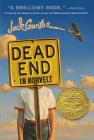
Dead End in Norvelt
by Jack Gantos won the Newbery for best children's literature.  I read half of it back when it was a mere sample copy -- am re-reading now.  Gantos is a really good writer.  I would have been happier if Jefferson's Sons or Okay for Now had won, but this one is an understandable choice.  I was quick on the trigger on ordering, though, and now have two shelves at the store full of almost all the winners and honor books.  Whew.

The categories of ALA awards have proliferated in recent years, one of the more interesting being the Theodor Seuss Geisel Award for books for beginning readers.  In the seven years they've been awarding it, Mo Willems has won two awards and two honors for Elephant and Piggie books.  They're definitely deserving, but happily this year the award went to a book that's definitely a change of pace:
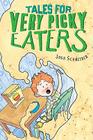
Tales for Very Picky Eaters
by Josh Schneider.
THE TALE OF THE DISGUSTING BROCCOLI
"I can't eat broccoli," said James.  "It's disgusting."
  "Maybe there's something else you can eat," suggested James's father.
  "What else is there?" asked James.
  "Well, we have dirt.  We have the finest dirt available at this time of the year, imported from the best dirt ranches in the country.
  "This dirt has been walked on by the most skilled chefs wearing the finest French boots.  
  "It has been mixed by specially trained earthworms, and it is served on your very own floor."
  "Ugh," said James.
Dad goes on to offer pre-chewed chewing gum and a sweaty sock worn by a runner "who was fed nothing but apples and cinnamon for three months before running a marathon in this very sock."  The broccoli wins. 

When James rejects mushroom lasagna, his father tells him about the hard-working troll in the basement hired especially to make mushroom lasagna.  The troll is green with fangs and wears an apron saying "Kiss the Cook." James' ubiquitous basset hound quietly sniffs the heat vent coming up from the basement.

The book has five short chapters -- my favorite is The Tale of the Lumpy Oatmeal, rejected for its lumpiness.  The oatmeal, Dad explains, regenerates every day, so that if one doesn't eat it, it gets bigger and bigger and starts eating the desserts around the house.  And because Growing Oatmeal, which now looks like The Blob, isn't a picky eater, he could spell trouble for James's dog.  The dog looks pathetically at James.  He asks for -- and gets -- another bowl of oatmeal "with fewer lumps."

The Tales are (mostly) wacky and charming with good illustrations.  The one on Repulsive Milk is a bit too preachy (builds strong bones).  The last chapter, on Slimy Eggs, turns the tables a bit and has a satisfying ending.  I know, I know: you're thinking, "Slimy eggs!  We've been there before!"  A year and a half ago you wrote about Eleanor's take-away message from Bread and Jam for Frances (the Ur-picky eater book) being to demand bread and jam all the time.  And Frances' b&j habit started with her facing down a plate of slimy eggs.  So I don't know if you want to introduce this one to your home, but its flights of fancy are definitely a hoot.

Love,

Deborah


Saturday, June 5, 2010

More new baby and sibling books

Dear Aunt Debbie,

On brand-new babies:

We adore Lilly's Purple Plastic Purse (such a great book to address guilt over doing something mean and then regretting it), and read Julius, the Baby of the World soon after Isabel was born. However, we ran into the Bedtime for Frances problem: Eleanor started saying more negative things about Isabel as a consequence of reading the book than she had been on her own. We returned it to the library.

Another book you gave us in the same vein, with wonderful, realistic illustrations by Michael Emberly is Robie H. Harris's Hi New Baby!


Hi New Baby!


An older sister is less than thrilled by the appearance of her younger brother (the line Eleanor quoted from this one is "That baby is yucky!"), but quickly has some fond moments with him. One of the things I like about this one is that it's narrated by Dad, talking to the older sister in retrospect: remember when this happened?

Eleanor also really likes the book Rachel recommended in her comment, How to Be a Baby...By Me, the Big Sister. It contains some very funny lists.

On older sibling/younger sibling relationships:

As I've mentioned before, I love the treatment of sibling jealousy in A Birthday for Frances.

Rosemary Wells does siblings incredibly well. Two of our favorites (there are so many great ones) are Noisy Nora and Stanley and Rhoda (sadly, out of print).


Noisy Nora


Nora is the middle sibling, and spends the book watching her parents pay attention to her older sister and baby brother, then acting out in huge operatic ways ("First she banged the window/Then she felled some chairs/Then she took her brother's kite and flew it down the stairs!"). When all of the attention she gets is negative, she decides to run away, and everyone immediately misses her. Perhaps my favorite illustration here is Nora holding up a muffin pan in her little mouse hands, clearly about to drop it and make as much noise as she can.


Stanley and Rhoda


Stanley is a studious looking, responsible mouse, and Rhoda is his louder and far less responsible little sister. There are three stories in the book; our favorite is "Don't Touch it, Don't Look at It," in which Rhoda gets a bee sting and freaks out, while Stanley quietly calms her down.

I'll save the Max and Ruby books (NOT the ones connected with the TV show, blech) for another post. They deserve their own.

Finally, on a positive sibling note, I want to mention another gift from you:


Sisters


David McPhail's drawings of the older sister and younger sister playing together and separately have a nice pencil-sketch feel to them, and his spare text describes two girls who you feel would be fun to hang out with. It's a good Here's how we're different/ Here's how we're alike book.

Love, Annie

Thursday, June 3, 2010

Aack! New Baby!

Dear Annie,

Before I go on to new sibling books, I have one last discovery to add to the Best-Ever cover change. Remember the cover for
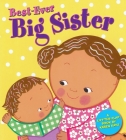
Best-Ever Big Sister
, which I thought had been unchanged? Well, guess what arrived at the store today?:

The change isn't as drastic as going from an African-American kid to blond hair and blue eyes, as they did with the brother (see 6/1 post) . But she still isn't who she used to be.

You ask about new sibling books. The Best-Evers are fine, and good for toddlers, complete with lift-the-flaps. They fall into the see-what-I-can-do category of big sibling books: reassure older sibling by celebrating his/her accomplishments, plant the idea that older child will be able to teach younger. My favorite of this type currently in print is Babies Can't Eat Kimchee, addressed quite nicely by you on 5/28.

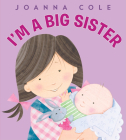
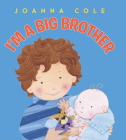
Then there are the informational books. New baby will come. Mom and Dad will go to hospital and come back. Small baby won't be able to do anything. etc. Joanna Cole (yes, the Magic School Bus person) is an author who can do those books very straightforwardly, and they can be useful to introduce the subject:
These books have also gone through a redesign: these are the re-illustrated versions of what were books with bright red or blue covers.

Then there are the I-don't-want-this-baby-here books. They're often the best literature of the lot, because they tell good stories. See especially A Baby Sister for Frances in your 5/22 post. And the favorite in our house was always
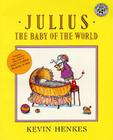
Julius the Baby of the World
by Kevin Henkes (two syllables) with the flamboyant Lilly (of the Purple Plastic Purse) in the role of obnoxious older sibling. Much of the book is her very funny but intense comments on how much she dislikes new baby Julius. In the end, she's offended by a cousin making similar criticisms, and she rises to Julius' defense. Illustrations show that the siblings become fast friends. Because Lilly's feelings are so raw, this is not the first book you want to read with your soon-to-be older sibling. But for an older child, or some months into the new baby's life, it's very funny.

One other, new last year, which doesn't quite fit any of my categories above:
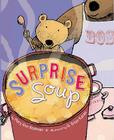
Surprise Soup
, by Mary Ann Rodman tells the story of two brothers and a father making soup for their mother as they await her arrival home with the new baby. Younger brother Kevie is constantly being put down or ignored by the older, and even Dad doesn't hear what he says -- Kevie's the only one who knows Mom's secret ingredient. All turns out well in the end, and it's a very cozy family story. Also a good reminder that life doesn't always revolve around the baby.

Saturday, May 22, 2010

Bravo for Frances

Dear Aunt Debbie,

I can't let your mention of the Frances books go by without taking a moment to wax rhapsodic about them: they are some of our absolute favorites, beloved by adults and kids alike. Russell and Lillian Hoban, the married couple who wrote and illustrated them, respectively, have a knack for depicting life for this family of badgers as both charming and realistic.

The book I remembered best from my own childhood, and the first one we bought to read to Eleanor, is A Baby Sister for Frances.


A Baby Sister for Frances


Perhaps the thing I love most about Frances is that she makes up little songs all the time, so each book is punctuated by these short rhymes that we provide tunes for while we're reading. A Baby Sister for Frances begins:

It was a quiet evening.
Father was reading his newspaper.
Mother was feeding Gloria, the new baby.
Frances was sitting under the kitchen sink.
She was singing a little song:

Plinketty, plinketty, plinketty, plink,
Here is the dishrag that's under the sink.
Here are the buckets and brushes and me,
Plinketty, plinketty, plinketty, plee.


She stopped the song and listened.
Nobody said anything.

Frances feels like her parents aren't paying enough attention to her because of Gloria. After a couple of disappointments (no raisins for the oatmeal!), she decides to run away. To under the dining-room table. Mother and Father play along, talking about how much they miss Frances as she sits listening and singing a lonely song and eating cookies, and eventually she decides to come back. (Though we got it before Isabel was in the picture, this is also a great book to give to a family expecting or just having welcomed a second child.)


A Birthday for Frances


A Birthday for Frances is also about sibling jealousy: it's Gloria's birthday, and Frances has a hard time ceding the spotlight to her sister. There's some wonderful dialogue in this one between Frances and her friend Albert about the uselessness of little sisters.


A Bargain for Frances


A Bargain for Frances is perhaps our current favorite, as it involves Frances's manipulative friend Thelma, who plays a mean trick on Frances over the purchase of a tea set. Frances thinks hard, and comes up with a really satisfying way to turn the tables on her. While the book ends happily, with friends playing together, the Hobans don't whitewash the ways kids can be mean to each other. My favorite moment in the matter-of-fact dialogue comes when Frances brings home the red plastic tea set Thelma has conned her into buying, and shows it to her sister Gloria: "'That is a very ugly tea set,' said Gloria. 'What's the matter with it?' said Frances. 'It's ugly,' said Gloria."

You mentioned Bread and Jam for Frances, which is another of our favorites, but needs a bit of a warning label if you have an impressionable child, as I do. In it, Frances only wants to eat bread and jam, and complains about all other food. Mother and Father deal with this by giving her bread and jam for every meal for a day and a half, at which point she gets tired of it and appreciates other kinds of food again (with the support of Albert, who is extremely satisfied with his own multi-part lunches). So the moral is a good one: try new food! In our house, however, what this translated to was Eleanor wanting to eat bread and jam all the time.

That leads me to the problem with Bedtime for Frances (the first Frances book, and the only one illustrated by Garth Williams). Like the others, this book has lovely moments in it: Frances has a hard time falling asleep, and one of the things she does is to make up a little alphabet song. However, she also gets out of bed multiple times, asks for and receives cake from her parents, imagines there's a tiger in her room, and is threatened with a spanking (the only time either Father or Mother comes off as punishing). We received this book recently in an awesome Easter package, and after reading it to Eleanor once (once!), she talked about there being a tiger in her room for probably two weeks. We've pulled it from the rotation.

There's one more Frances book, Best Friends for Frances. I've glanced at it in a bookstore, but never bought it, as the friend problem in it seems to involve Albert telling Frances he won't play with her anymore because she's a girl. Again, a concept I don't want to have to introduce Eleanor to just yet. Sadly, the time will come.

Love, Annie

Friday, May 21, 2010

More Chuckles & Guffaws

Dear Annie,

I love your image of Eleanor belly-laughing at The Backward Day. One of the joys of reading with kids is the surprises they can hand you.

I think it's always useful to remember that small children have -- and should be encouraged to have -- very eclectic taste. Eleanor can be captivated by a delightfully silly story like Chickens to the Rescue, then listen in fascination to The Wizard of Oz. Just like grownups, kids enjoy many different forms of writing.

A few additions to your hilarious list:

Backward Day is a New York Review of Books reprint of an out of print classic: they've been exhuming both novels and picture books from earlier eras. This month they released a delightful one: Russell and Lillian Hoban's
The Sorely Trying Day
. It's from the folks who wrote Bread and Jam for Frances and sequels, and it has that same sense of families being loving but chaotic and sometimes contentious, always with a large dose of humor. Father comes home from a Sorely Trying Day, only to discover that the children are squabbling miserably. An investigation ensues, with each wrongdoer pointing to a wrong that was previously done to them. Once that circle is closed, a new circle of apology ensues, with everyone trying to outdo the contrition of the previous apologizer. It's just really funny.

Then there's Robert Munsch, best known for The Paper Bag Princess, but he's written dozens of books. He was a pre-school teacher, and his humor is very slapstick. One of my fondest memories of picture book hilarity is of watching my spouse's loving but somewhat taciturn father reading Munsch's
Thomas' Snowsuit
to Mona when she was probably around 3 or 4. Thomas doesn't want to put on his snowsuit, and ends up in a series of confrontations (visuals: cloud of dust with hands and feet occasionally poking out) with various adults. When the dust clears, it's always the adult who's wearing Thomas' snowsuit. Mona started giggling, then laughing, then her grandfather started laughing, and he ended up stopping reading and laughing uncontrollably. The power of Munsch.

I'll toss in Katie Davis's
Who Hops
here, which appears to be a much younger book. But there's something about it that appeals to many 3 and 4 year-olds' sense of the absurd. "Who hops?/Frogs hop./Rabbits hop./Kangaroos hop./Cows hop." (picture of very startled purple cow, who on the next page thinks, "It would never work.") And it goes on from there.

A quick note on Ruth Krauss, author of The Backward Day. She also wrote the great
A Hole is to Dig
, illustrated in 1952 by the young Maurice Sendak. It's sweet and offbeat -- not hilarious, although it has its smiling moments. It's a series of definitions which aren't really, like "A hole is to dig," or "A hand is to hold." Her "a face is so you can make faces" attracted a little flack from critics, who felt Ms. Krauss was encouraging rude behavior. Ah, the Fifties.

Love,

Deborah