In which Annie (high school teacher, mother of two young girls and a younger boy) and her aunt Deborah (children's bookseller, mother of two young women in their 20s) discuss children's books and come up with annotated lists.

Showing posts with label animals. Show all posts

Tuesday, September 22, 2015

Scientific women

Dear Aunt Debbie,

Welcome back from summer! It's lovely to hear from you, and to get a glimpse of the goings-on at the National Book Festival.

You asked whether Harry Potter has made an appearance in Eleanor's life. It's interesting: several of her friends and 3rd-grade classmates have gotten very into the books, but Eleanor is holding off. Twice, she's tried starting to read the first book on her own, and each time she has stopped because she feels like it's "too scary." This from a girl who within the last year devoured all of Percy Jackson, and is two-thirds of the way through the Books of Beginning, both series which include great violence, battles, magic, and end-of-the-universe stakes. And yet there's something about Harry that she doesn't feel ready for. As we've discussed in person and you've mentioned on the blog, there's a lot of material in the later Harry Potter books that isn't really appropriate for elementary-age kids, so I'm fine with Eleanor waiting until the books click for her. I've thought about beginning it as a read-aloud, but right now most of our read-aloud time also includes Isabel, and I don't really want to start Harry Potter with an almost-6-year-old.... Ah, well. Thankfully, there's plenty of time for reading and rereading.

Isabel has started out her first-grade year by declaring that she wants to become a rock star, and that her favorite subject is science. As if by magic, two of your recent gifts chronicle female scientists who became rock stars in their fields. Both books have become huge hits over here.
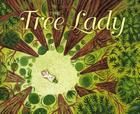
The Tree Lady, by H. Joseph Hopkins, is a picture book chronicling the life and times of Kate Sessions, the scientist and tree hunter who brought trees to the desert climate of San Diego in the early 1900s.

On each page, Hopkins positions Kate as an exception to the rules of her world:

Katherine Olivia Sessions grew up in the woods of Northern California. She gathered leaves from oaks and elms. She collected needles from pines and redwoods. And she braided them together with flowers to make necklaces and bracelets.

It was the 1860s, and girls from Kate's side of town weren't supposed to get their hands dirty. 

But Kate did.

...

When Kate grew up, she left home to study science in college. She looked at soil and insects through a microscope. She learned how plants made food and how they drank water. And she studied trees from around the world.

No woman had ever graduated from the University of California with a degree in science.

But in 1881, Kate did.

A nice proud feminist vibe throughout!

The illustrations, by Jill McElmurry, are beautifully specific: pictures of plant cells, specific (labeled!) types of leaves and desert trees, a real sense of the desert climate in the San Diego scenes.

There's enough of a story here to make it interesting, and enough scientific detail to encourage questions and further investigation.
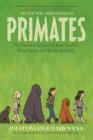


The graphic novel Primates: The Fearless Science of Jane Goodall, Dian Fossey, and Biruté Galdikas, by Jim Ottaviani and Maris Wicks, gets far deeper into the complexities and triumphs of scientific research. This is a book you can get lost in.

Primates provides a clear and well-dramatized introduction to the work and lives of these three primatologists, the first to live with and study primates for years in their natural habitats: Goodall with chimpanzees, Fossey with mountain gorillas, and Galdikas with orangutans. Each woman tells her own story in first-person, and in her own font and color, which helps keep the voices distinct. There are similarities in the stories, but the very different personalities of the researchers come through well.

The fourth voice in the book is that of Louis Leakey, the anthropologist and archeologist who gave all three women their start. He believed that women were better-suited to this kind of work: more patient, more observant. Through Leakey, the three women meet each other, so there are some nice moments of crossover.

Ottaviani and Wicks don't romanticize the details of living in the bush. You get a real sense throughout of the difficulties and privations of each woman's chosen career: leeches, trekking through forest, sitting for hours, days, weeks in observation. All three come across as passionate and unconventionally brilliant, deeply dedicated to the animals and their land.

While non-kid-friendly details are alluded to in the book -- Louis Leakey's womanizing, Dian Fossey's murder -- the stories are kept age-appropriate. It feels to me like a book that will deepen with rereading as you learn more about each woman's life from other sources.

I think that Isabel responds to the fierce determination of the women depicted here: their focus and refusal to be put off. I have a feeling there are more animals in her future.

Love, Annie


Wednesday, October 8, 2014

Animals and magic in the great early chapter books

Dear Aunt Debbie,

Your breadth of book knowledge makes me so happy. Now I'm excited to read more of the books you recommended for 13-year-old Jack!

Today I'm responding to another reader request. Chloe, a friend from college and mother of Jackson, writes:

Jackson (nearly 5) has finally been showing interest in beginning chapter books -- we've been reading Winnie the Pooh (which he seems to tolerate) and at school they just finished Charlotte's Web (which he loved). What are the great early chapter books -- that have ZERO Ninja Turtles in them -- that we can read to him? He can't read yet on his own. He is that classic boy-kid who loves superheroes as much as he loves animals...ok, maybe superheroes a little more.

Chloe, you're at a fabulous point!

Our pages of book lists (over there on the right) are a good place to start. Check out Early chapter books and the sections on "Diaper bag books" and "Short chapter books" on the Learning to read books page.

Aunt Debbie has already pointed you to My Father's Dragon, by Ruth Stiles Gannett, and some thoughts on the transition to chapter books, with its possible pitfalls (the Stuart Little problem!).

Knowing the intense love of animals going on in your house, a few specific recommendations:

The Doctor Dolittle series, by Hugh Lofting. The veterinarian Doctor Dolittle can speak and understand animal languages -- not through any kind of magic, but because he pays attention, bonds with the animals, and is open to learning from his parrot, Polynesia. Some books are narrated by 9-year-old Tommy Stubbins, who becomes Doctor Dolittle's apprentice. Bonus: chapters are short, and the animal characters are all well-drawn.

Wind in the Willows, by Kenneth Grahame. The version we love is slightly abridged, but gorgeously illustrated by Inga Moore -- pictures on almost every page. Mole, Water Rat, Mr. Badger, and the indomitable Toad of Toad Hall are vivid companions.  Right now the girls and I are reading Inga Moore's version of The Secret Garden (first time for Isabel, a re-read for Eleanor). Moore's illustrations break open books that would otherwise be inaccessible to most 5-year-olds.

The Cricket in Times Square, by George Selden, might also be a hit. The animal characters are wonderful, and, like Doctor Dolittle, it has a nice young boy as protagonist. (Also like Doctor Dolittle, there's some unfortunate racial stereotyping -- see blog posts linked above.)

Let's throw in a little magic:

The Amazing World of Stuart, by Sara Pennypacker, was one of Isabel's favorite early chapter books last year. In it, 8-year-old Stuart makes himself a cape out of 100 ties, and suddenly gains superpowers. The catch: he has a different power each day, and doesn't know what it will be.

Half Magic, by Edward Eager. This has become one of my favorite gifts to give kids in the 5-7 age range. Four siblings find a magic coin, which grants wishes -- but, it turns out, only half of what they ask for, so they have to get creative. Eager's writing is totally engaging and terribly funny. If you and Jackson like this one, he has several more in the series.

Isabel's love of superheroes has found a natural extension in the Narnia books and D'Aulaire's Greek Myths and Norse Myths. (As you may have noticed, we're on a real mythology kick over here.) If you're up for some graphic novel action, I can't say enough good things about George O'Connor's Olympians series.

Then there's always Roald Dahl, who tosses in fine sprinklings of magic and makes for a gripping read-aloud, though the undercurrent of misanthropy always turns me off a little.

Finally, two more that don't fall into either the animal or superhero/magic categories, but which we've loved as entry-level chapter books for their depiction of kids:

Jamie and Angus, by Anne Fine, focuses on the relationship between a boy (Jamie) and his stuffed Highland bull (Angus). It is fine and tender, with a nice British flavor.

Anna Hibiscus, by Nigerian storyteller Atinuke, is also wonderfully warm, and provides a window into life in an African city. Lots to enjoy and discuss.

Do let us know if any of these are a hit with Jackson!

Love, Annie


Monday, January 14, 2013

Guest blogger: Hedgehogs and Mice

Dear Aunt Debbie,

Helen Oxenbury's illustrations are so joyful!  We're Going on a Bear Hunt has inspired a number of happy moments of charging forward in our family, too.

As I charge on with my portfolios, here's our regular guest blogger Holly, mother of Eleanor's good friend Ian, on their current adventure reading:

I prefer to wait out a series -- tv, movie or book -- until it is complete and then have a wonderful binge. You would think I would have learned from the rollercoaster of emotions I feel toward George RR Martin not to dabble with unfinished series again, but we seem to have fallen for two children's series which have left us uncertain about the fates of several small mammals we've become attached to.

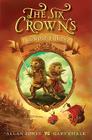
The first series is The Six Crowns by Allan Jones, illustrated by Gary Chalk. I was dubious at first because the verse that describes the titular six crowns is really lame: 
Six are they, the Badgers' crowns.
If power ye seek, they must be found.
Crystal, iron, and flaming fire --
Gather them, if ye desire.
Ice and wood and carven stone --
The power they give
Is yours
Alone.

However, once you work out the bizarre cosmology of the Sundered Lands (islands floating in air, Six Crowns of the Badgers of Power) it becomes a very fun, never a dull moment adventure quest led by a fabulously morally questionable but terrifically gutsy girl hedgehog, Esmeralda, and the reluctant homebody hero hedgehog, Trundle. Here's how she gets him what she has decided is his hero's sword:
Esmeralda came to a skidding halt, leaning back and hefting the cobblestone. She let it fly. There was a chime and clash of smashing glass, and almost before Trundle knew what was going on, she had reached in through the broken window of Honesty Skanks Gold Star Pawnshop and had grabbed hold of the sword. ... Esmeralda pushed the sword into Trundle's hands "I should have thought of this from the start! It would have saved us a lot of bother!"
There are really nasty pirates and lots of fighting and explosions. I wouldn't have thought that Ian would be able to take the scariness level but we zoomed through all three of the series that are available so far. Maybe when hedgehogs are in danger it's less of a deal breaker?
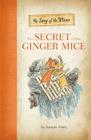
Our family fell for another furry hero in the book, The Song of the Winns: The Secret of the Ginger Mice by Frances Watts. The first book is all we can find, although it seems like the others may have come out in Australia.
The main characters are four young mice living in a world where due to a complex political backstory they find that they are sought by the Queen. The kids are allied with an underground resistance movement, FIG (Free and Independent Gerander) which would likely lead to some interesting discussions of real life politics in an older child than Ian.  What gripped him was the Huck Finn feel of the book -- two of the mice actually escape down a river on a raft. On the journey you feel you actually get to know each character and watch their relationships to each other develop. So often in kid's adventure books I find I have to differentiate the characters myself by giving one a funny voice. Even the villians are complex and interesting. This is a book I looked forward to reading every night and which Ian agreed with us upon. I look forward to Book Two and Three as well!
Holly

And love from me,

Annie

Wednesday, January 9, 2013

Guest blogger: Sleeper Hits of 2012

Dear Aunt Debbie,

I remember with great fondness Grandpa (your father) reading me The Light Princess -- is there something in it about having to cut her hair as well, or am I confusing it with another story?  In any case, sounds like the right time for us to rediscover it here.

On Monday, I collected my fabulous, time-consuming creative writing portfolios from my high school students, which means it's time for our winter round of guest bloggers!

The first is my friend Faith, a masterful blogger and writer in her own right over at The Pickle Patch and in Faith in Vermont, a regular column in the Addison County Independent, where she writes about raising her three girls in small-town Vermont after living in New York and the Bay Area.

Here she is:

Sleeper Hits of 2012: Five Books That Unexpectedly Delighted Our Family

Parents like to think that their children are exceptional – and of course, every child is exceptional, in their own special way. But I’ve been forced to admit that, when it comes to taste in reading material, my own children (three girls aged 22 months to five years) are decidedly, predictably…ordinary. On our weekly trips to the library, they head immediately for the rotating display of “Ready-to-Read” books; anything with Dora, Tinkerbell, or a Disney princess on the cover is a definite take-home. The “literary” books that I slip into our tote bag usually get a single polite listen. Even tried-and-true classics, like The Cat in the Hat, have bombed in our house.

I tend to believe, at least in the beginning stages, that any reading is good reading (within reason, of course; I draw the line at A Child’s Guide to Cooking Meth). I’m just grateful to have three children who love to read, and I’m DELIGHTED when my children love books with a literary nutritional value greater than, say, Fruit Loops. Sometimes, their choices surprise me, and these books I call “sleepers:” books in which nothing much happens, that are dated, or that have a moralizing message; books that I wouldn’t expect to attract children in an age of Fruit Loop literature. Herewith, five sleeper books that delighted our brood this year:


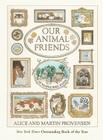
Our Animal Friends at Maple Hill Farm
by Alice and Martin Provensen. One of the best books you’ve never heard of – I certainly hadn’t heard of it, and it’s not in our local library. It was recommended by two mothers of older children, and is the most realistic and charming depiction of farm life I’ve ever read. Alice and Martin Provensen lived on Maple Hill Farm in upstate New York, and this book is a catalogue of the animals – both welcome and unwelcome – who also lived there. It’s a sleeper because it’s long (many animals live on a farm), and because it has no plot. But it’s filled with honest details – sometimes hilariously brutal – that entertain all the ages in our house. Like the understated conclusion to a page chronicling a day in the life of chickens: “A fox is carrying Big Shot [the rooster] away.” Or, following a description of some wonderful farm dogs: “Other dogs are foolish dogs who do useless, foolish things. These dogs aren’t around any more.” Or, my personal favorite, which I’ve sometimes quoted (unfortunately): “Field mice are on the pantry shelves. Why don’t they stay in the fields?”


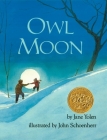
Owl Moon
, by Jane Yolen. A particular favorite of my 22-month-old, who has been known to demand ten readings in one sitting. I have no idea why, since, like Maple Hill Farm, it’s a book in which not much happens: a girl and her father walk through moonlit woods looking for owls, they see an owl, they go home. Add to that the kind of gorgeous, poetic language that would usually make my children’s eyes glaze over (“When you go owling you don’t need words or warm or anything but hope…. The kind of hope that flies on silent wings under a shining Owl Moon.”), and you have a book that seems designed to delight parents and bore children. But my toddler can’t get enough of it.


My Henderson Robot, by Matthew Swanson and Robbi Behr. You probably won’t find this book at your library or local bookstore; it’s available from Idiots’ Books, a small enterprise run by Matthew and Robbi (both college classmates of mine). Compared with the previous two books, My Henderson Robot is action-packed, but here’s the plot summary from Idiots’ Books: “In which a little girl makes a friend and does the boring, inconsequential, plot-deadening things that kids do. Not much happens.” My Henderson Robot is filled with the sort of quirky details that fill my own children’s heads, which is probably why they find it so relatable. Their favorite detail: “At night the Henderson Robot waits by my closet door to keep any monsters out. He keeps his blue eye open so I can know where he is. He shuts his red eye so it can get some rest.” I have a particular fondness for the closing lines: “We step outside. The sky is green. It is hours until lunch.” Depending on the day, this seems like a perfect description of the idyllic, endless days of childhood – or the existential despair I sometimes feel as a parent immediately following breakfast.


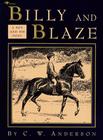
Billy and Blaze
,  by C. W. Anderson. Somehow, I am the mother of two horse-crazy girls. Horses played almost no role in my own childhood, or in my reading. Perhaps because we live in Vermont, where horses are a daily presence, my oldest daughters can’t get enough of them. The day came when they wanted to read only “horse books.” Since this isn’t my area of expertise, I turned to our wonderful children’s librarian, who said, “Well, it’s pretty dated, but try Billy and Blaze.” Thus began our relationship with Billy and his pony, Blaze. Billy and Blaze is the first of an eleven book series written between 1936 and 1970. They’re certainly dated, with illustrations in the Nancy Drew/Hardy Boys vein. We’ve read five Billy and Blaze books so far, and the stories are formulaic: Billy is riding his pony when they suddenly encounter some minor emergency (often involving a homeless dog). Boy and pony save the day with their intelligence and pluck, and Billy proclaims Blaze “the best pony in the world.” Despite their mid-century wholesome blandness and their male protagonist (usually a turn-off for my girls), the Billy and Blaze books have all merited repeat readings in our house.


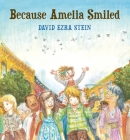
Because Amelia Smiled
, by David Ezra Stein. Published in 2012 and filled with action, Because Amelia Smiled is a sleeper because it’s the type of parent-pleasing book – beautiful message disguised as children’s literature – that I always want my children to love, but which they usually spurn. The premise is simple: “Because Amelia smiled, coming down the street…Mrs. Higgens smiled, too. She thought of her grandson, Lionel, in Mexico and baked some cookies to send him.” And so on, until Amelia’s smile has indirectly changed lives around the world.  Perhaps because the message – that doing small things with great joy can make a big difference – is somewhat subtle, hidden behind delightfully illustrated mini-narratives, this book didn’t set off my daughters’ “preachy” alarm. So for a change I get to read a book that chokes me up, and my audience is riveted.

I hope that one of these books – or another surprising treasure – delights your family in 2013. Feedback on your favorite sleepers welcome!

Faith

And love from me,

Annie


Monday, December 12, 2011

Lab rats (and mice)

Dear Aunt Debbie,

Your mention of bats being banded by humans in the Silverwing series made me think about two very different books involving animal-based lab experiments.


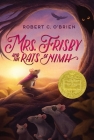
Mrs. Frisby and the Rats of NIMH
, by Robert C. O'Brien, is an action-packed adventure story.  Mrs. Frisby is a widowed mouse bringing up four mouse children, and when one of her kids is sick and she can't move him to their summer house, away from the garden plowing which endangers them, she ends up seeking help from a group of former lab rats who live under a nearby rosebush.  It turns out that these rats were bred and trained at NIMH (the National Institute of Mental Health), and have near-human intelligence and capabilities.  They've created their own functioning society, complete with siphoned electricity, but are planning to relocate to a utopian farming community (as in Watership Down, there's a certain amount of exploration of what constitutes a perfect society).  The rats help her save her son, she helps them avoid capture, and there's a scene about drugging a very scary cat.  I haven't read the book in years, and think it may be aimed at a slightly younger audience than your Watership Down-loving sixth-grader, but I remember being captivated by it.

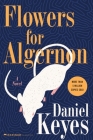
Flowers for Algernon
, by Daniel Keyes, is written from a human perspective, but features a lab mouse quite prominently.  Algernon is the mouse, the recipient of brain surgery which makes him increasingly intelligent, to the point where he becomes a kind of mouse genius, solving all possible mazes.  The story is told through the journal entries of Charlie, a mentally handicapped man in his 30s who is asked, and agrees, to undergo the same brain surgery.  His writing is at first full of misspellings, and reveals his dim awareness of much of the world around him.  After the operation, however, Charlie's intelligence increases by leaps and bounds.  He begins to understand his own history, forms complex relationships with the people around him, falls in love, and eventually gets so smart that he becomes a bit of a social outcast in the other direction: whereas once people made fun of him for his stupidity, now he makes them feel stupid.  In the second half of the book, Algernon begins to lose cognitive function, and then so does Charlie.  It's painful stuff: Charlie is at first terribly aware of his waning capabilities, then ultimately loses the capacity to remember and understand who he was under the effects of the operation.  Total tearjerker.

Both books cry to be read as metaphors for human interaction and society; both ask you to think about the results, positive and negative, of trying to change the basic parameters of our capabilities.  They stick with you, these speculative fictions.

Love, Annie

Friday, February 18, 2011

Back to baby board books

Dear Aunt Debbie,

I loved The Queen Who Couldn't Bake Gingerbread -- we've read it recently at my parents' place.  Yes, you definitely gave me Stories for Free Children. That's the first place I read "X: A Fabulous Child's Story," by Lois Gould, which Orenstein writes about in Cinderella Ate My Daughter.  I now use it to open the discussion of nature vs. nurture in my senior Women's Voices class.  It's a good read.  The other major memory I have of Stories for Free Children is a piece about Amelia Bloomer and women starting to wear pants which I remember finding fascinating.  Ironically, at the time, I was refusing to wear pants myself.  So I suppose I have my own history to look back on as I recite the mantra: this too shall pass....

With so much interesting stuff happening on the Big Kid front, I fear that Isabel's reading habits have been getting short shrift.  At 16 months, she is in love with books (she "reads" to the other babies at daycare), and extremely specific in what she will and will not let you read to her.  She refers to a number of books by name: "Munny" ("Bunny") is Home for a Bunny; "Up" is Olivia's Opposites; "Doss" ("Dogs") refers to any of the roughly 5000 board books we now have about dogs.

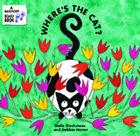
One of her latest favorites came from you: "Meow" refers to Where's the Cat?, by Stella Blackstone and Debbie Harter.  This is a wonderful book.  Each right hand page asks "Where's the cat?" and provides a clue by showing a tiny bit of ear or paw poking out from under something; when you turn the page, the wide-eyed black and white cat reveals itself in an active catlike pose: "on the chair," "up the stair," etc.  The drawings are intense and colorful.  Eleanor often joins in on reading this one too, answering every "Where's the cat?" by pointing to the right place on the page matter-of-factly: "There he is."


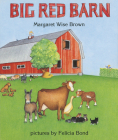
Margaret Wise Brown's Big Red Barn, illustrated by Felicia Bond, is another go-to book right now, so much so that the corners are starting to fray.  I could read pretty much anything Margaret Wise Brown writes a thousand times in a row and not get tired of it -- something about her rhythm and her simplicity which is pitch-perfect for children but never cloying.  (I just tried to refer to her as "Brown," and couldn't do it -- why is it that some authors need to be referred to by their full names?)  Here's a sample:


There was a  big pile of hay
And a little pile of hay,
And that is where the children play.

But in this story the children are away.
Only the animals are here today.

The sheep and the donkey,
The geese and the goats,
Were making funny noises
Down in their throats.

An old scarecrow was leaning on his hoe.
And a field mouse was born...

in a field of corn.

There are lots of animal noises, and, happily, dogs and cats show up a little later.  Everyone goes to sleep at night, under a big beautiful moon.

Love, Annie