In which Annie (high school teacher, mother of two young girls and a younger boy) and her aunt Deborah (children's bookseller, mother of two young women in their 20s) discuss children's books and come up with annotated lists.

Monday, August 29, 2011

Hurricane reading: Half Magic

Dear Aunt Debbie,

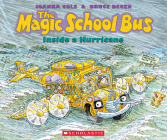
Eleanor really likes The Magic Schoolbus Inside a Hurricane -- Holly took it out of the library for Ian, and it made for great subway reading on Friday in anticipation of Irene.
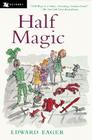
However, when it came down to the hurricane day itself, narrative won out.  We spent much of yesterday reading one of your recent gifts, Edward Eager's marvelous Half Magic.  We're close to finished with it (and I've just sneak-read ahead to the end in order to write about it tonight).  It has reduced Eleanor to hysterical giggling several times, and has terrific suspense throughout.  It does require two parents to be home at once, as the chapters are quite long, but Eleanor has been patient with us when Isabel announces, "The End!" and slams it shut.

Half Magic is the story of four siblings who find a magic coin.  Or a half-magic coin: it turns out to grant only half of what you wish for when holding it.  This twist leads to some very funny mistakes.  Martha, the youngest, wishes that their cat could talk.  Then, of course, Carrie the cat can half-talk, though she learns to express herself pretty well:

Carrie was still there, pacing the floor, lashing her tail and muttering a horrid monologue.

"Idlwidl bixbax," she was saying. "Grompaw.  Fooz!  Idjwitz! Oo fitzwanna talkwitz inna fitzplace annahoo?"

She seemed to be trying desperately to express herself.  It was agony to watch and still worse to hear.

Soon enough, the children learn to use the coin more thoughtfully, wishing for exactly twice what they want to have happen, though they still make thoughtless mistakes out of anger.  Jane (the eldest), Mark (the only boy), Katherine (the literary one, who takes them back to King Arthur's time), and Martha (the youngest and most difficult) each get a (long) chapter devoted to their adventures.  At the end of each, they learn something about themselves and about the magic powers they control.  While it's certainly a lesson each time, it doesn't feel heavy-handed, and the children retain their personalities throughout.  Well, Jane loses hers for part of a chapter, but that's another story.

You mentioned to me in Maine that Eager was influenced by E. Nesbit, who he brings up as one of the children's favorite authors early in the book.  (Have we never blogged about her?  Shocking!)  There's certainly a thematic and tonal connection between the two authors.

Eager wrote Half Magic in 1954, and set it "about thirty years ago."  This puts the children in the 1920's, though the only moment in the text where this becomes clear is when they go to see a (silent) movie and Martha is frustrated because she can't read the titles.  At a couple of moments, the 1950's era reveals itself: Mark's adventure involves an Arab described thusly: "The ragged Arab's expression was crafty, and definitely unattractive."  He turns out to be no better than he should be, but ends up rewarded rather than punished -- it's uncomfortable as a read-aloud, but not deadly.

And then there is "the children's mother," a widow who works for the local newspaper and isn't given a name until the last chapter.  She ends up with a most excellent suitor, and turns down the position of City Editor to stay home with the children, which turns out to be her heart's desire.  Of course, that's a feminist question a lot of us are still working through....

Love, Annie

After the hurricane

Dear Annie,

I know some of those September 11 books and will devote a post to them soon.  Right now, we're about to be on the road trying to get home after Hurricane Irene blasted up the I-95 corridor just before we were going to take that route home to DC.  So we're still in New England, not badly blown about, but I thought I'd do a short list of hurricane books.

Time of Wonder, by Robert McCloskey, which we've written about here (look again at those great windy illustrations!) is the first that comes to mind.  The build-up, the drama, the aftermath, complete with downed tree.
Hurricane
, by David Wiesner (whose works we've explored here and here), is another picture book which does the storm, then lingers on the fantasy world of playing in a fallen tree.
And where would a good natural phenomenon be without Ms. Frizzle?
The Magic School Bus Inside a Hurricane
gives the explanation for what's going on in Joanna Cole's usual breezy funny fact-filled style.  The bus starts as a hot-air balloon, then transforms into the airplane on the cover of the book. 

These picture books are about hurricanes which have their scary moments, but are something to get through basically unscathed.  On a much more serious level, for kids about ten and up, Dark Water Rising by Marian Hale is a fictional account of the 1900 Galveston Texas hurricane.  Wikipedia calls it the most deadly natural disaster ever in the U.S.: thousands of people died when Galveston was submerged by a hurricane.  The book follows one 16 year-old boy through a horrifying night as he watches much of the city being swept away. 

A number of books have been written -- from picture books about lost dogs to a magical/fantasy book for teens -- about Katrina, and they keep coming out.  I'm without scanner or my bookshelves right now, so can't explore that route -- but they're out there.

In the meantime, I'm off to pack the car, hit the road, and inspect the damage back home.  Am worried about all those books in the store staying dry...

Love,

Deborah

Friday, August 26, 2011

Talking to kids about difficult issues

Dear Aunt Debbie,

Your discussion of Jefferson's Sons raises a question we and our guest bloggers have touched on before (here, here, here, and here, among other places): when and how do we talk to our kids about complex, painful issues, and how do books play a part in those discussions?

This question has come up for me again most recently in relation to September 11th.  HarperCollins is putting out a new edition of with their eyes: September 11th: the view from a high school at ground zero, the play I created with my students after the World Trade Center was attacked four blocks from our school.  (I've written about it in more detail here.)

with their eyes is a YA book, aimed at an audience of high school students and above -- not the kind of thing you'd generally want to share with your 4 year old.  But with the new edition and my revised introduction have come interviews, and opportunities for me to write about the play, and the book has been out on the coffee table,  so at some point I had to explain to Eleanor what it was about.

I told her the story of September 11th very simply: that some very angry, very evil people had flown planes into two tall buildings, and the buildings had fallen down, and lots of people died.  She asked why people had done that, and I said I didn't fully know; that some people believe it's okay to hurt and kill others, but that we know it is never okay.  I told her that my students and I saw some of it, and that we had to leave our school and walk uptown when it happened, and that the play told the stories of lots of different people's experiences.  I reminded her of the tower we've seen going up at the World Trade Center site when we drive up the West Side Highway to visit my parents, and explained that that was where it happened.

Eleanor took the story in stride.  It's funny what upsets her and what doesn't -- she can process stories of great tragedy well, and then something very small will upset her deeply.  I wasn't sure how much of it she'd taken in, but about a week after our conversation, she brought it up matter-of-factly in the bath when I was talking obliquely to my mom about the play: Oh, that's about the people who flew the planes into the buildings and killed all those people.  Her tone was serious -- she knows this is heavy, real stuff even if she doesn't fully comprehend it yet.

with their eyes appeared recently on a Huffington Post list of children's books about September 11th.  I'm not familiar with any of the other titles on the list, though some of them look powerful.  Have you read any of them?  I'd be interested to hear your thoughts.

Love, Annie

Wednesday, August 24, 2011

Jefferson's Sons

Dear Annie,

One of the things I've been doing here in Maine is catching up on the new kids' books coming out in the fall.  I sometimes order books without reading them, based on the author, or the subject, or the opinion of a sales rep whom I trust.  Then I try to catch up.  I bring books with me to Maine which I suspect will be good reads -- and I picked up a quite good one this week.


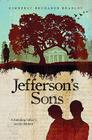
Jefferson's Sons
, by Kimberly Brubaker Bradley, imagines life at Monticello for Thomas Jefferson's slave family from 1805, when he was still president, to the 1827 slave auction after his death.  Jefferson and his slave Sally Hemings, who was Jefferson's wife's half-sister, are pretty credibly believed to have had four children who lived to adulthood.  All four eventually became free, and three ended up identifying as white.  The book portrays Hemings, who first became pregnant by Jefferson when she was a teenager, as caring for Jefferson, but also as having made deals with him that her children would be well treated as slaves and freed when they reached 21.  Bradley's Hemings raises her children -- who had seven white great-grandparents -- to expect that they will eventually "pass" as white.  One of the strongest characters in the book is Maddy (short for James Madison), who realizes fairly young that his darker skin won't give him the option his siblings take.


This book is aimed at eight to 12  year-olds. It portrays Jefferson as a distant and flawed man who won't apply his beliefs about equality to the slave population.  The concept of rape is barely in the book -- a passing reference to Sally using her influence to keep her daughter safe.  The most brutal moment is a flogging of an escaped slave, which Sally makes her children watch.  The hardest emotional moments are when Maddy's close friend James is sold away when he's 11 years old. Maddy is furious.

  After a few days Harriet [Maddy's sister] took Maddy aside.  She walked him past the garden and sat him down on an old log on the hill.  "What," she said, "do you think slavery is?"
  Maddy glared at her.  Harriet took no notice.
  "I'll tell you," she said.  "It's not having any say.  Any choice.  Not about you, not about your family, not about anything.  Forget having to work for someone.  Forget not being paid.  It's the say.  The not having any say."
  "I know that," Maddy said.
  "You act like you don't. You act like you're just now discovering what everyone else understood all along."
  Maddy searched for the words to explain.  "I thought Master Jefferson cared about Miss Edith and Joe [James' parents]," he said.  "He liked James for bringing him that bird.  I thought he wouldn't sell people he liked, not if they worked hard."
  Harriet shook her head.  "You thought wrong."
This book is about people who have no say.  It's about injustice, not about violence and brutality.
It's trying to explain the hypocrisy of one of our founding fathers to people younger than Maddy.  I don't know enough about the historical facts, but it may be pretty accurate about the Hemings children's experience.  If this were one's introduction to slavery, it would be too mild.  But as a picture of one family's experience, and a way to view Jefferson, it's a very good read.  The kind of book a teacher, or a parent, or a book group can think over for quite a while.


Love,


Deborah

Monday, August 22, 2011

The Secret Garden

Dear Aunt Debbie,

Your post about statues made me think immediately of the Secret Garden statue in Central Park's gorgeous Conservatory Garden.  It's a fine example of a statue which romanticizes its subject almost beyond recognition: yes, there's a boy playing a little flute who could certainly be Dickon, but is that sylph-like creature holding the birdbath really supposed to be sour-faced Mary Lennox?


Here, I think, is a far better depiction of Mary, at least as she first appears in the book.  She's a thoroughly unpleasant heroine at this point, a spoiled little rich girl who grew up in India with parents who didn't care about her at all.  When these parents die (Burnett loves her orphans), Mary is sent to live with her distant, rich uncle in his estate on the English moors.  The fresh air and proximity to growing things make her nicer and healthier (she talks a lot about how happy she is she's getting "fatter"; another way in which the statue gets it wrong).  And of course she discovers secrets: the secret garden of the title, which has been shut and locked since the uncle's young wife's untimely death ten years before; the secrets of the moor, as shown to her by the pure-souled, Yorkshire-voiced Dickon; the secret invalid, Colin, who turns out to be her cousin.

As you saw in Maine, Eleanor and I have recently been reading a gorgeous version of Frances Hodgson Burnett's The Secret Garden, illustrated by Inga Moore, whose Wind in the Willows we fell in love with last summer.  Her illustrations are just as good here.  Moore has a feel for the English countryside, and you can tell she's thrilled to be able to capture the specific varieties of plants and flowers Burnett mentions. 
 I'll admit, though, it's Moore's animals that get me.  Sprinkled throughout the pages are mice, squirrels, badgers and other creatures, many mentioned in the text, but some just populating the book as they would a garden.  And sometimes, Moore depicts human actions described in the text via the animals.  Here are two of Dickon's squirrels on the page where Mary examines Colin's back to prove to him that he's not developing a hump:
Burnett depicts imaginative play among children as life-giving, even holy.  In  A Little Princess (which we've also written about here and here) and The Secret Garden, she uses the term "Magic" (her capital letter) to describe Sara Crewe's vivid stories and Mary, Dickon, and Colin's belief in the life-force that makes plants and children grow healthy.  It can feel a little heavy-handed at times, but when you give yourself over to the world of the book, it really is quite beautiful.

Love, Annie

Books in bronze and stone

Dear Annie,

Your discussion of books about pretend play made me think of
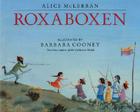
Roxaboxen
, another of those books that I'm surprised we haven't mentioned here.  It's by Alice McLerran, wonderfully illustrated by Barbara Cooney (whom we also haven't mentioned enough).

McLerran writes about a group of children who create a whole city out of rocks, boxes, and various found objects in a vacant lot in Arizona. 

Marion called it Roxaboxen. (She always knew the name of everything.)  There across the road, it looked like any rocky hill -- nothing but sand and rocks, some old wooden boxes, cactus and greasewood and thorny ocotillo -- it was a special place.
 The story pulls you into the magic of creating something from imagination, and  a group of mixed-age kids having fun with each other. It makes children want to get up and build a town.  I knew that the story was based on McLerran's mother's own experience, but it turns out that the vacant lot was a specific place in Yuma, Arizona which has now been turned into a delightful-sounding park.  It has a few benches and some signs and a lot of rocks to play with.  Visitors are encouraged to donate rocks, knowing that they'll be added to the mix of stuff used by kids who play there.

So thinking about parks led me to Grant Park in Portland Oregon, in Ramona Quimby's neighborhood.  We came upon it on our cross-country trip ten years ago, not far from where cousin Kate then lived.  It's a nice comfy city park, with playing fields and trees, and in one corner of it are three statues and some very kid-friendly fountains:
 Ramona Quimby, Ribsy, and Henry Huggins are right there, to be played with and splashed around.  Ramona is wearing her boots and seems to be in the scene where she's a kindergartner stuck in the mud in Ramona the Pest. There's even a map of the neighborhood, marking places where events in the books happened.

Coming upon one's books as a real physical places can be very satisfying. Gives you a new way to think about the book, without eclipsing the images in your mind.

Love,

Deborah

Friday, August 19, 2011

Imaginative play

Dear Aunt Debbie,

What a lovely time we had with you in Maine!  As my mom recently emailed, you have a way of making hosting large groups of family feel effortless.  And the food is so, so good.  I'm still dreaming of blueberry pie.

One of the joys of the week was, of course, having so many relatives and friends reading to Eleanor and Isabel.  It seemed like there were always several books open, and more scattered around the floor, and we've come home with a number of new goodies which I'm sure I'll be writing about in the weeks to come.

The Queen of France, which you wrote about recently, is a total hit.  Reading aloud the story of Rose, who becomes the Queen of France several times throughout the day, and her parents, who gamely play along, was so much fun.  Great to find a pink-y princess-y book it's a pleasure to reread.  And then, of course, you get to do a bad French accent, which you know I love.

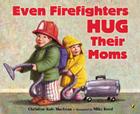
At home, we've been reading a lot of Christine Maclean's Even Firefighters Hug Their Moms, which has recently become one of Isabel's favorites.  I've mentioned before that I have mixed feelings about this book, because of the character of the mother, but it's been such a hit in our house that I think it deserves more attention.

The basic plot: a boy and his non-speaking toddler sister play a wide variety of imaginative games, turning household implements, stuffed animals, cardboard boxes, and couch cushions into all kinds of settings.  The boy is a firefighter, an EMT, a train conductor, an astronaut, etc.  In each scene, his little sister is given a smaller role: she's the assistant, or the police dog, or the train passenger.  And in each scene, mom comes in and tries to get the boy to give her a hug.  He pushes her off, and she counters with "Even firefighters (EMTs, helicopter pilots, construction workers) hug their moms."

What I love about the book: The kids are having great imaginative play.  The boy uses a pot lid as a steering wheel, makes construction vehicle gears out of golf clubs and wooden spoons, and repurposes the same four stuffed animals in every scene.  (One of Isabel's great pleasures is identifying these animals on every page: "There's the dog!  There's the pig!  There's the dinosaur!  There's the bear!")  The boy incorporates his little sister into every game; it's clear they play well together.  There's a sense of happy creative mess in the pictures -- no one minds that the "garbage truck driver" dumps a whole pile of toys down the slide and into a box.

But mom is such a wuss.  In a couple of scenes, she starts to play along: she's a train passenger, she's under the couch cushions acting like Mission Control while the boy goes to Mars.  But every single time, she brings it back to the hug.  She comes across as depressingly desperate for physical contact.  Whereas Rose's parents in The Queen of France engage in her imaginative world while they're doing other things (making dinner, mowing the lawn), the Firefighters mom seems to have no purpose in her day other than to beg her kid for a hug.  It makes you hope Dad is coming home soon.

Love, Annie