In which Annie (high school teacher, mother of two young girls and a younger boy) and her aunt Deborah (children's bookseller, mother of two young women in their 20s) discuss children's books and come up with annotated lists.

Showing posts with label Thoms. Show all posts

Friday, August 26, 2011

Talking to kids about difficult issues

Dear Aunt Debbie,

Your discussion of Jefferson's Sons raises a question we and our guest bloggers have touched on before (here, here, here, and here, among other places): when and how do we talk to our kids about complex, painful issues, and how do books play a part in those discussions?
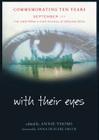
This question has come up for me again most recently in relation to September 11th.  HarperCollins is putting out a new edition of with their eyes: September 11th: the view from a high school at ground zero, the play I created with my students after the World Trade Center was attacked four blocks from our school.  (I've written about it in more detail here.)

with their eyes is a YA book, aimed at an audience of high school students and above -- not the kind of thing you'd generally want to share with your 4 year old.  But with the new edition and my revised introduction have come interviews, and opportunities for me to write about the play, and the book has been out on the coffee table,  so at some point I had to explain to Eleanor what it was about.

I told her the story of September 11th very simply: that some very angry, very evil people had flown planes into two tall buildings, and the buildings had fallen down, and lots of people died.  She asked why people had done that, and I said I didn't fully know; that some people believe it's okay to hurt and kill others, but that we know it is never okay.  I told her that my students and I saw some of it, and that we had to leave our school and walk uptown when it happened, and that the play told the stories of lots of different people's experiences.  I reminded her of the tower we've seen going up at the World Trade Center site when we drive up the West Side Highway to visit my parents, and explained that that was where it happened.

Eleanor took the story in stride.  It's funny what upsets her and what doesn't -- she can process stories of great tragedy well, and then something very small will upset her deeply.  I wasn't sure how much of it she'd taken in, but about a week after our conversation, she brought it up matter-of-factly in the bath when I was talking obliquely to my mom about the play: Oh, that's about the people who flew the planes into the buildings and killed all those people.  Her tone was serious -- she knows this is heavy, real stuff even if she doesn't fully comprehend it yet.

with their eyes appeared recently on a Huffington Post list of children's books about September 11th.  I'm not familiar with any of the other titles on the list, though some of them look powerful.  Have you read any of them?  I'd be interested to hear your thoughts.

Love, Annie

Friday, September 10, 2010

September 11th, in graphic novel and play

Dear Aunt Debbie,

Tomorrow is the ninth anniversary of September 11th, and as always happens at this time of year, I find myself thinking about it a little more than is probably healthy.  Tonight I've gone farther and done some serious rereading, both of the play I worked on with my students in the months following the World Trade Center attack and, appropriately to our conversation, of a September 11th-related graphic novel.

Art Spiegelman's In the Shadow of No Towers is a burning, furious cry from a brilliant and political cartoonist.  Spiegelman (author of the extraordinary Holocaust memoir/parental biography Maus) lives in Lower Manhattan, and on September 11th he watched the towers fall.  The book is a series of large-scale color pages, originally printed in a German newspaper, which draw on comic strips of the early 20th century and combine a wide variety of styles.  In the second half of the oversized book, Spiegelman reproduces some of the original strips which inspired him.

The pages are heterogeneous and complex, Spiegelman's attempts to make sense of his own anger and loss.  He rails against the Bush administration and what he sees as the cynical political use of the country's intense reaction to the attacks.  Perhaps this isn't the right place to write about this book: it's not a comic for kids.  But for older teenagers, with the right context, it could be a disturbing and fascinating read.

One of Spiegelman's pages depicts him and his wife, Francoise Mouly, running toward the high school where their daughter Nadja had just begun her freshman year in order to find her and take her home.  That school, Stuyvesant High School, is where I've taught since 2000.  (Nadja was in my Writers' Workshop class her junior year.)  On September 11th, I was one of the teachers evacuating the building along with our 3000 students.

In the aftermath of the attacks, after we returned to the building, I worked with a group of Stuyvesant students to create a series of interview-based monologues which became the play with their eyes.  Our inspiration came from the work of Anna Deveare Smith, whose plays Fires in the Mirror and Twilight: Los Angeles showed us how powerful the words of everyday people can be in conveying the complexity of community tragedy (in her case, riots in Crown Heights and L.A.).

Ten student actors interviewed 23 members of the Stuyvesant community -- students, faculty, and staff.  They recorded these interviews on audiotape, transcribed them word for word, including all the "like"s, "and"s, and "um"s, and arranged them on the page like poetry, with line breaks to indicate pauses.  The actors edited the transcriptions into monologues, and then performed in the character of the people they had interviewed.  The book reproduces all of these monologues, along with pictures of the student actors (taken by the immensely talented Ethan Moses, who was a senior at Stuyvesant at the time): 
Chantelle Smith as Anonymous Male Custodian
Catherine Choy as senior Owen Cornwall
I am obviously not an impartial reader here: from rehearsing these monologues over and over, editing the book, and watching other performances of the play by high schools and even a couple of repertory companies in the last several years, I know many sections by heart, and can hear the voices of the students who created each role.  Still, it's been a while since I sat down to reread the whole play.

Anna Belc as English teacher
Katherine Fletcher
One of the things that makes this form so powerful is that it is a collection of stories, and so can represent multiple and conflicting viewpoints: the intense anger of senior Max Willens, who felt his neighborhood was invaded by tourists who didn't belong in New York but snapped pictures of the wreckage; the bubbly freshman Katie Berringer talking about the pluses and minuses of having to hold classes in another school until the building could reopen; the Dining Hall worker talking about how her religious faith helped her through.  Anna Deavere Smith writes about how everyone, given the chance to talk, will say something which is poetry.  In the case of these interviewees, processing the attacks just a few months later, this was true.  Their voices came through so clearly.

Christopher Yee as sophomore Kevin Zhang
I've heard from classes who have read this book and students who have performed the play that hearing the actual words of kids their own age about what it was like to be so close to Ground Zero on September 11th made them understand the day differently.  The tiny details -- a sandwich left in a locker when students evacuated, gone moldy by the time we returned -- aren't necessarily what you think about when you think of a day as fraught with tragedy as this one was.  But they were part of the reality too.  It's important to remember.

I hope your weekend is peaceful.

Love, Annie