In which Annie (high school teacher, mother of two young girls and a younger boy) and her aunt Deborah (children's bookseller, mother of two young women in their 20s) discuss children's books and come up with annotated lists.

Wednesday, October 12, 2011

mutual memories.2

Dear Annie,

I'm back in DC, recreating the entry I wrote then lost on Sunday in Seattle.

Ah well, I knew I was pushing it with the The Day I Swapped My Dad for Two Goldfish.  I had hoped the repetition and suspense might grab.  I know what you're saying about the creepiness of McKean's drawings, although I think the startling differentness of them can engage an older child.

Your mentioning good old Odd and the Frost Giants made me realize that Odd and Wolves in the Walls have the same infrastructure.  Lucy in Wolves (or Odd in Frost Giants) is faced with family (gods) who have been summarily evicted from their homes by malevolent stronger beings.  The family (gods) dither, while Lucy (Odd), the youngest of the group, summons common sense and courage to regain the territory. 

original cover: 1902
We had a lovely small memorial service for Bob's mother on Saturday, and (unsurprisingly in this family) the subject of reading came up.  Bob's nephew Pete -- whom you may remember as the wonderful photographer at your brother's wedding last summer -- talked about reading Kipling with his grandparents.  Bob's dad read Pete the Just So Stories when he was a kid.  Pete remembers fondly returning again and again to one particular story, "The Elephant's Child."  Decades later, when his grandfather's health was failing, Pete sat by his bedside and read the story aloud to him.  At the service, Bob starting reciting the story's lilting line, "on the banks of the great grey-green, greasy Limpopo River, all set about with fever-trees,"  and his brother, Pete, and several others chimed in.  Later, my brother Al said he and his daughter Ona exchanged glances on that one, then he recited the same line to me. 

It was a time for family and friends to share memories, of course.  But there's something so satisfying about sharing words written more than a century ago that have been savored by generations of two families.  Gifts given to children that go with them through life.

Love,

Deborah

Monday, October 10, 2011

family reading -- an image

Dear Aunt Debbie,

I am drowning in work here, and Columbus Day means that tonight is really a teacher's Sunday night, so my larger ideas will have to wait.  I hope you are well, and that the memorial for Bob's mom was good.  In the meantime, here's one of my favorite images from last month's pictures -- from the evening of Isabel's birthday party, the girls being read to before bedtime by their uncle and aunt:


Isabel and Grace are reading Peek-a-boo; I'll write about what Michael was reading to Eleanor on Friday....

Love, Annie

Mutual memories.1

Dear Annie,

I'm in Seattle, writing on an unfamiliar laptop, and somehow the computer ate the post I've been working on throughout the day. Rrgh!

It was about Bob's mom's memorial service (which is why we're here) and families and books.  I'll re-create  it and post next time (too late tonight), but in the meantime, imagine a lovely day in Alaska in 1938, a log cabin, a young woman destined to become my children's grandmother, and a good book:

More soon.

Love,

Deborah

Friday, October 7, 2011

Why I don't like Neil Gaiman's picture books

Dear Aunt Debbie,

I have to admit it: I don't like the Neil Gaiman/Dave McKean picture books.  I want to like them -- I read all of Gaiman's Sandman graphic novels in college, and went on to enjoy Good Omens, his satirical collaboration with Terry Pratchett (very funny, very Douglas Adams in tone).  Eleanor and I both loved Odd and the Frost Giants; in fact, Eleanor recently asked me if there were any more books about Odd.

I think it may be largely a question of illustrations.  Gaiman's writing has a wit and warmth about it, a sense of humor that I enjoy.  Dave McKean's illustrations creep me out.

They're technically beautiful: combinations of drawing and collage and photograph, a melding of different styles, lots of dynamic movement.  But there is something very inhuman about his people: the eyes which are nothing but pupil, the shadows and angular lines.  They're not pictures I want to look at, and they're not pictures I much want Eleanor and Isabel to see either.  For me, they overwhelm Gaiman's wit.

This is true more for The Wolves in the Walls than for The Day I Swapped My Dad for Two Goldfish, which we just received from you in the most wonderful Isabel Birthday Box.  I haven't read it to Eleanor yet, but the interesting thing is that she saw it and didn't immediately ask me to, as she did ask me to read her every other book in the box. 

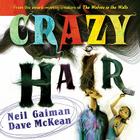
About a year ago, we took another Gaiman/McKean collaboration out of the library.  Crazy Hair is a poem, and an exercise in hyperbole:

"In my hair
Gorillas leap,
Tigers stalk,
And ground sloths sleep.
Prides of lions
Make their lair
Somewhere in my crazy hair."

The text is kind of cool.  The drawings are kind of creepy.  Eleanor had zero interest in the book -- didn't want to look at it, wouldn't even let me read it through once.  My mom looked through it and pronounced it slightly disturbing.

Perhaps we'll all feel differently when the girls get a little older, and enjoy a disturbing thrill.  For now, though, we are clearly not the Gaiman/McKean target audience.

Love, Annie

Thursday, October 6, 2011

Gaiman picture books

Dear Annie,

Ah, the two-year old world.  Ah, wolfes.

Isabel has provided me with the perfect segue to two strange and wonderful and not necessarily young-child-friendly picture books by the excellent Neil Gaiman.  We seem to have written about him only once, in relation to Norse mythology.


Wolves in the Walls
by Gaiman, illustrated by Dave McKean, starts with Lucy hearing things:
(Not a book to read at bedtime.)  Her family members dismiss her belief that there are wolves in the walls, but all three tell her, "You know what they say, if the wolves come out of the walls, then it's all over."  They finally do, in a burst of black line drawings, causing the family to flee:

(Lucy's father is a professional tuba player.)  The family huddles in the garden while the wolves party in the house.  Lucy is the only rational one of the bunch.  She sneaks back to rescue her pig-puppet, then concocts a plan for the family to return to the house and live in the walls.
"What?" said her father
"What?" said her mother.
"What?" said her brother.
"What?" said the Queen of Melanesia, who had dropped by to help with the gardening.
That's the Queen's entire participation in the book: she's a cameo.  Lucy leads the family into the walls, then in an attack on the wolves:
"Arrgh!" howled the wolves.  "The people have come out of the walls!"
"And when the people come of the the walls," shouted the biggest, fattest wolf, flinging aside the tuba, "it's all over!"
The wolves all flee and the family eventually restores order. Then Lucy starts hearing new noises...  It's creepy and fascinating and wacky.

In the process of searching for already-scanned pictures from Wolves, I came upon a site called Teaching Children Philosophy which discusses "numerous philosophical issues concerning knowledge, metaphysics, and ethics" brought up by this off-beat book.  Kind of lovely, actually.

Six years before Wolves, Gaiman and McKean collaborated on
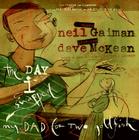
The Day I Swapped my Dad for Two Goldfish
, which I sent to you as an un-birthday present for Eleanor. It's another odd one, but higher on the purely funny end of the spectrum.

A boy's friend comes to visit with two goldfish in a bowl.  They discuss a trade, but nothing offered by the narrator is acceptable.
I thought for a bit.

Some people have great ideas maybe once or twice in their life, and then they discover electricity or fire or outer space or something. I mean the kind of brilliant ideas that change the whole world. Some people never have them at all. I get them two or three times a week.

"I'll swap you my dad," I said.

"Oh-oh,” said my little sister.
"That's not a fair swap," said Nathan. I've got two goldfish, and you've only got one dad.
 But the dad is bigger than the goldfish, so the swap is made.  When Mum comes home the kid sister rats on her brother, and both children are sent off with the goldfish to retrieve the dad.   Nathan, the goldfish boy, shows the narrator an electric guitar he has just acquired in a swap:
And of course Vashti got the dad in exchange for the guitar.  Brother and sister, bickering all the way, find that guitar girl swapped dad for a gorilla mask, and on it goes.  Finally the siblings bring a very large rabbit named Galveston to Patti's house, where the bunny is greeted with glee (including enthusiasm from the Queen of Melanesia, in another cameo).  The father is found reading his paper in the rabbit hutch and the children take him home, reading the paper all the way.

It's fun and nutty and, like Wolves,  much more visually sophisticated than your average kids' picture book.  I've never offered it to someone Eleanor's age -- I think of it as a bit older sense of humor.  But I'm curious what you guys think of it.

Love,

Deborah

Monday, October 3, 2011

"Who's that?"

Dear Aunt Debbie,

Animal Faces arrived today.  What an excellent book!  Isabel sat right down with it to examine the animals.  She opened to the page with camels:

 "Who's that?"
"That's a camel."
"Oh.  Who's that?"
"That's another camel."
"Who's that?"
"That's another camel.  They're all camels."
"Oh.  Who's that?"
 
We moved on to the seals, the rhinoceroses, the polar bears, the lions, and the foxes.

"Where's the wolfes?"
"The wolves?  I'll find them."

I found the wolves.


"Ohhhh, wolfes.  [pointing at each] One wolf, one wolf, one wolf, one wolf, one wolf, one wolf.  Aroooo!"

These two reactions -- "Who's that?" and "counting" -- are hallmarks of the reading experience with Isabel these days.  She's taken to asking us to read her fairly long picture books, books with text at a level that she doesn't get yet, and we work our way through them with her, narrating around the pictures as much as reading the actual words.

The biggest hit at the moment is our old favorite, Charles Santore's The Wizard of Oz. Isabel can identify all the characters, and explain the high points of the plot.   She's excited to dress up as Toto this Halloween (Eleanor planned out our Oz-themed costumes in March, and hasn't budged since then).  I think her repeated "Who's that?" is a way of reinforcing knowledge she already has, sometimes gaining new knowledge, and playing with the idea of testing my knowledge and getting me to come around to her point of view.

On the illustration of the Munchkins last night:


Isabel: "Those are goblins."
"No, they're Munchkins."
"Oh.  Who's that?"
"Munchkins."
"Who's that?"
"They're Munchkins."
"Who's that?"
"Munchkins."
"Who's that?"
"They're called Munchkins."
"Who's that?"
"Goblins."
Isabel, finally satisfied: "Oh."

We're loving age two around here.

Love, Annie

Sunday, October 2, 2011

Escaping the stereotype (with difficulty)

Dear Annie,

The Sambo story, stripped of its unhappy heritage, is a good story.  The imagery stays with readers for a long time.  Every few years, some brave soul attempts a new version.  In 2003, the lush artist Christopher Bing illustrated Bannerman's words with an African child in an Indian setting:
 The over-sized picture book even has tiger claw marks on the cover.  It keeps the title and the names, however, which are part of the problematic history of the story.  Sambo, Black Mumbo and Black Jumbo were names which became twisted into racist stereotypes.

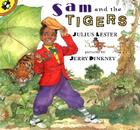
Two major figures of children's literature of the last 40+ years, Julius Lester and Jerry Pinkney, both African-American, collaborated back in 1996 on a retelling which avoided the name question by calling all the people in the book Sam and their country Sam-sam-sa-mara.  So conversations go like this: "Sam looked at Sam. Sam shrugged. Sam shrugged back...."

Sam and the Tigers: A New Telling of Little Black Sambo
creates some extra characters and broadens the humor.
 Sam had an idea of what kind of a day it was going to be, and when he saw the next Tiger coming, he took off his shoes.  "Here you go," Sam said, holding out the shoes.  
"Good deal for you. Bad deal for me.  I've got four feet.  You only got two shoes."
"Feet!" Sam exclaimed. "These are ear-shoes!"
The Tiger put them on.  "Ain't I fine!" he declared.
"You are indeed," Sam agreed.
The Tiger went on his way.
Sam didn't see any point in moving, and sure enough, along came another Tiger.
My experience as a bookseller is that this and Little Babaji are the versions most likely to appeal to customers, but even with the modern sensibility, a lot of folks are still uncomfortable. 

I finally sent off a box of birthday books for Isabel (with some sisterly additions too) today.  One of them, a picture book by Neil Gaiman, is  something I'll write about next time. 

Love,

Deborah