
In which Annie (high school teacher, mother of two young girls and a younger boy) and her aunt Deborah (children's bookseller, mother of two young women in their 20s) discuss children's books and come up with annotated lists.

Showing posts with label marc brown. Show all posts

Wednesday, February 9, 2011

On Mourning

Dear Annie,

I've just reread Nana Upstairs and Nana Downstairs by Tomie de Paola. It's so lovely: most of it is about visiting his grandmother and great-grandmother. I can see why it stayed in your memory all this time. When four year-old Tom sees that his grandmother ties her 94 year-old mother into a chair so she won't fall out, he asks to be tied into his chair too. There's a picture of them sitting side by side, tied in, both smiling. And there's a sequence of Tom watching both women fix their long white hair which brought back to me memories of Aunt Martha (your great-aunt) and her crown of white braids.  After he learns Nana Upstairs has died, Tom runs to her room, only to find it empty.
Tommy began to cry.
"Won' t she ever come back?" he asked.
"No, dear," Mother said softly.  "Except in your memory.  She will come back in your memory whenever you think about her."
I wanted to move the discussion today to books that are written specifically to help children understand the death of someone they love.  Our family is grieving for someone we love this week: Bob's mother, my children's grandma, died on Sunday.  She cared about books, and with her husband raised an amazing reader, and it seems fitting to talk about mourning.

Nana is a book one can read as a story -- as you did as a child -- but which can be useful talking about someone who's died.  After both Nana Upstairs, and years later Nana Downstairs die, Tom sees a shooting star.  "Perhaps that was a kiss from Nana Upstairs," Mother tells the young Tom.  The book gives a hint of something Bigger out there, without spelling it out.
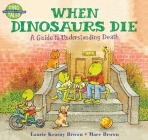
As with sex, Laurie Krasny Brown and Marc Brown have written a Very Thorough book on death:
When Dinosaurs Die: A Guide to Understanding Death
. It defines alive and dead and gives lots of examples of ways to die (after long  illness, sudden illness, accidents, as a baby, in war, "poverty, prejudice and drug abuse," and suicide).  There's a lot about missing people, about overwhelming feelings, about funerals (illustrated with one for a pet).  There are many different answers to "What Comes After Death?"  It feels like it can be just too much information.  But it does hit a lot of points.
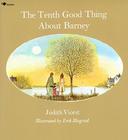
I think we've both established at some point that we're not particularly religious.  I'm fond of the treatment of heaven in Judith Viorst's
The Tenth Good Thing About Barney
. This one is about the death of a cat, and it's full of Viorst's wonderful kid-intensity. After Barney's backyard funeral, the narrator and his friend talk:
Annie said Barney was in heaven with lots of cats and angels, 
drinking cream and eating cans of tuna
I said Barney was in the ground.

Heaven said Annie, heaven.  So there!  The ground, I told her, the ground.  You don't know anything.

My father came in from the yard and took a cookie.
Big-mouthed Annie said heaven again.  I said ground.
Tell her who's right, I asked Father.  She doesn't know anything.

Maybe Barney's in heaven, my father began.  Aha, said Annie, and stuck her tongue out at me.

And maybe, said my father, Barney isn't.  What did I tell you, I said, and yanked Annie's braid.

Father made me let go.
We don't know too much about heaven, he told Annie.
We can't be absolutely sure that it's there.

But if it is there, said Annie in her absolutely sure voice,
it's bound to have room for Barney and tuna and cream.
She finished another cookie and went back home.
The beauty of Barney is that the narrator makes a list of ten good things about the departed cat.  It's an exercise people sometimes do with grieving kids.

There are other books with groups of people (or animals standing in for people) reminiscing about special moments with the person who's no longer there.  They're stories, presented as a kind of model for mourning.  I'm curious if any of our readers have had satisfactory first-hand experience with a book for their kids to help process dying.

Love,

Deborah

Thursday, October 28, 2010

Where babies come from: The Book(s)

Dear Annie,

I've been reading sex books for the under-six crowd all day.  I've narrowed it down to four candidates.

These books tend to be almost all about having babies, rather than other motivations for having sex. Some of them spend a lot of time on both perceived and real differences between boys and girls (there's some knocking down of pink/blue stereotypes).  Some of them have diagrams with cross-sections of penises and uteri.  All of them talk about pregnancy (no, the stomach and the uterus are not the same place); many of them go into fetal development.  Most of them are packing lots of information into from 30 to 58 pages.  Sometimes they're surrounding the relevant information with lots of less-so info -- e.g. a two-page spread in It's Not the Stork with a naked girl on one side and a boy on the other, seen from the back.  About 20 different body parts are labeled (hair, wrist, arm, waist, knee, thumb etc) -- and they're all the same!  But turn them around (another two-page illustration), you can label all those parts again (adding belly buttons and nipples), but look -- here's a vulva, there's penis and scrotum.

The big difference is in the how-it-happens part.  Two basic explanations:

A) Two people really love each other.  They decide to have a baby. Sperm and egg get together.  A baby grows inside the mom.  We have two candidates in this category

The one on the left was written by Joanna Cole, of Magic School Bus fame, back before she developed a sense of humor.  Most of the illustrations are photographic, including a lot of in utero photos.  Both How You Were Born and Amazing You! (by Gail Saltz) have good two-page notes to parents with lots of common sense advice.  They both label themselves as being for children ages 3 and up.  Here's the Joanna Cole explanation of conception:

The next page moves on to more about cell division.

Amazing You, whose subtitle is Getting Smart About Your Private Parts, emphasizes one's own relationship to one's body, in terms of knowing about it, being proud of it, and enjoying it discreetly.  ("It's perfectly natural to be curious about your private parts and to want to touch them.   But this is something you should do only in a private place, like your room.")  Amazing's note to parents has this advice about preschoolers and pregnancy:  "Most are not ready to hear about intercourse and do not need to know about it yet.  What they want to know is where in your body the baby grows and how it comes out." 

For those who feel their children may want to know more, we have:

B)  Penis and vagina get together, sperm transfers, baby grows.

Page to right is from It's NOT the Stork! by Robie Harris.  It's the youngest in a trilogy of what are now the staple fare of sex ed books.  It considers itself appropriate for ages four and up.  This is the 58-page one, and it's crammed with information.   Basic physiology, sexual development, conception, fetal growth, birth, different kinds of families, good touching/bad touching, and on and on.  The note to parents says your child may not want all the information in it at once, which makes sense.  Although I find it hard to imagine a voracious reader like Eleanor being willing to read anything just a few pages at a time.

The other book in this category is What's the Big Secret? Talking About Sex with Girls and Boys by Laurie Krasny Brown and her spouse Marc Brown, author of many Arthur and D.W. books.  I will admit that I approached this one a bit warily, because although they've done some other pretty good advice books (Dinosaurs Die, for example, and Dinosaurs Divorce), I really can't stand the Arthur books.  What's the Big Secret has lots of the same information as the others, a little less overwhelming than Stork, some kid-appropriate humor.  The stated message of the book is that there's nothing to be uncomfortable with here and conversation and openness is the way to go.  But every now and then there's a pretty clear message that we're uncomfortable talking about this, up to the last page, where a boy tells his father he wants to ask a question about sex and dad says, "Okay, fire away.  I'll try to answer it."  But the thought blurb above his head is saying, "Relax, take a deep breath...."  And this isn't the note to parents part: this is what you're reading to your kid.

When people come to the store looking for books about sex for their kids, I always encourage taking the time to read a fair amount before they buy.  As with anything else you teach your child, your (the parent's) feelings are going to convey strongly.  So you need something you're comfortable with.  I don't remember our using any books in the early discussions of sex with our kids.  I do remember we used the "when two people love each other they sometimes decide to have a child" line, which ultimately led to my taking my cue from Irving Berlin for the next step in the education.

There we were, driving around town as usual listening to musicals on the tape player.  The girls were maybe 5 and 6.   Ethel Merman was belting out "Doin' What Comes Naturally," from Annie Get Your Gun.  She was even singing the last verse, which I discovered today from googling has been expunged from many versions of the song:
My mother's cousin Carrie
Won't ever change her name;
She doesn't want to marry
And her children feel the same.
Sister Rose has lots of beaus
Although we have no parlor;
She does fine behind a tree
Doin' what comes natur'lly --
Doin' what comes natur'lly.
Sister Rose went right by them.  But Carrie -- wait a minute.  This information we'd given our children about mom and dad loving each other so much and wanting children together:  how does this translate over to a mother who doesn't want to marry?  How did she make the babies?  Even though they knew plenty of kids in non-traditional households, somehow it was Ethel Merman who made them ask the question.  So I told them, driving past the Potomac on a lovely evening after gymnastics class.  As with all of parenthood, sometimes you're just winging it.

Happy Birthday in advance, by the way.  Your mother, who arrives here tomorrow,  and I will celebrate it on Saturday by marching together for sanity.

Love,

Deborah