Dear Aunt Debbie,
Rachel's question is an interesting one. I haven't ever sat down and worked out hard and fast rules about this subject, but looking at my own history as a reader, as a child who was read to, and now as a parent reading to my children, I notice a few choices I've made, largely subconsciously.
Some of the first chapter books I wanted to read to Eleanor were series that I remember my parents reading to me: Narnia and Doctor Dolittle, in particular. My memories of these books, and of the intense, talking through the plot experiences I had with them, are still vivid. Reading them to Eleanor has been amazing.
So books like these are fond memories, but they're also packed with issues and ideas that can be teased out with the adult reading them; they're books that benefit from conversation and processing. The discussion of death in the Narnia books, for example, isn't something I'd want my kids going through on their own for the first time.
Even when Eleanor and Isabel learn to read, there will be books at a slightly higher reading level than they can, or will want to, pick up on their own. Some of these are classics -- a little harder to get into, at times. If it weren't for Grandpa, your father, reading me Mistress Masham's Repose, or Treasure Island, Kidnapped, and David Balfour, I don't know that I would ever have picked them up. His reading aloud of these adventure stories brought them to life for me, and strengthened the connection between us.
Some books are just better, and funnier, when read aloud. As you've written, we've read a lot of James Thurber aloud in our family over the years, and especially when shared communally, he makes me laugh so hard I cry. When Grandpa was losing his memory towards the end of his life, I'd read him Thurber stories. Even when he couldn't remember the plot of the story from the beginning to the end, he appreciated the construction of every individual sentence -- the language is so so good aloud. Years before that, I read aloud Mark Twain's The Adventures of Huckleberry Finn to Grandpa and Grandma, the summer I was 13 years old and she was dying of cancer. It was one of my favorite things about that summer. Twain lifted us all out of ourselves.
Many of the books I remember reading most voraciously on my own are those I've written about in our long discussion of good chick-lit (here, and here, and here, among other places). Books with a little more romance or even sex in them than might be really comfortable to read with your parents, books packed with dialogue, quick good reads that don't necessarily shine as literary paragons. I remember going through an entire series of Noelle Streatfeild's Shoe Books (Ballet Shoes is the first). Though I loved them, I'm pretty sure that they wouldn't have worked the same way as read-alouds -- on my own, I could whiz through them and not worry about similar storylines boring anybody.
I guess I'm ultimately not too worried about forcing my loves on Eleanor and Isabel, or spoiling their reading experience of anything in particular. There are always things I'll want to share with them, and there will be things I adored that they'll reject; there will be things they find to read on their own that I won't love as much as they do, and things I will. There will never be a lack, thank goodness, of books.
Love, Annie

Showing posts with label Thurber. Show all posts
Showing posts with label Thurber. Show all posts
Saturday, July 2, 2011


Wednesday, December 8, 2010
A storytelling list
Dear Annie,
Things aren't getting any slower at the toy/book store these days. Every time I turn around, I see huge gaps in the shelves (oh no! No more Jan Brett books! We're down to two Grinches! And today someone bought out all five of our copies of A Wrinkle in Time! Must reorder!). There are a few more irritating customers than usual: grandparents who have no idea what their grandchildren are like, people with too much money and not enough time, parents who have little interest in communicating with their kids.
 But they're definitely in the minority. There's that lovely moment of wondering, who will this person be, before I offer to help someone. A quite wonderful woman was in yesterday, to whom I sold a very fine list of books. She's the mother of a nine and eleven year-old: one of each gender. She had bought the
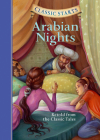
Classic Starts Arabian Nights a while ago. It's part of the series that has a Peter Pan edition you wrote about. She said her husband was stunned that she'd bring home such an abridged edition, but he started reading it with the kids and everyone really liked it. It was a little young for them, and they wanted to wander into more magical/folklorish books.
So here's what we ended up with:

Where the Mountain Meets the Moon, by Grace Lin. This was the first one I thought of. I'm surprised that I've never written about it here: it's so wonderful, and appeals to kids of many different ages. It's the story of Minli, a girl who runs away from home to find The Old Man of the Moon, who determines everyone's fortunes. She wants to ask for prosperity for her parents. They're poor farmers, but her father tells lovely folktales to his daughter. On her quest, Minli meets many characters, human and not: a talking goldfish, a wingless dragon, travelers on the road, a king. Each new character tells his or her own story, which appears in a lovely old-fashioned typeface. Lin has also done gorgeous illustrations. While Minli is searching for the solution to her family's problems, we cut back from time to time to her parents, who are missing her achingly, but they're also reassessing the role of stories in their lives. Slowly, all the internal characters' stories knit together into one story, which is the one that Minli is in. The ending has a very satisfying reunion between child and parents.
 Since we were looking at fantastical fiction, the next title that came up was
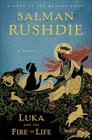
Luka and the Fire of Life, by Salman Rushdie. Luka has just been published, the sequel to Haroun and the Sea of Stories, which Rushdie wrote back in 1990. Luka was written for his younger son and tells the story of a boy who journeys through a magical world to steal and bring home the Fire of Life to revive his dying storyteller father. It's full of a magical cast, governed both by ancient rules of storytelling and by conventions of video games. Every now and then Luka must hit a gold button that appears in the air in order to save the progress he's made toward reaching the fire. It has wonderful wordplay and is beautifully written.
So there we were with two very well-written books about storytelling. How do the kids feel about scary?, I asked. They were mostly cool with that. So A Tale Dark and Grimm by Adam Gidwitz (link is to last month's blog entry), also about the role of stories in kids' lives, became the next on the list.
How about something different, the mom said. Sticking with the very good writers, we went on to A Long Walk to Water by Linda Sue Park, a very realistic story about children surviving under very hard circumstances in Sudan. She decided to take that one too.
I was ready to quit: what a satisfying list. But she wanted one more, and asked for one I thought was really special. Given that this is a family that clearly cares about language, the last book on this pile was one I loved as a kid: The Wonderful O, by James Thurber.
I hope I hear what they thought of all those books.
We miss you, Annie, but I know this is the end of the semester and an incredibly busy week for you. I hope there's some fun in all that grading.
Love,
Deborah
Things aren't getting any slower at the toy/book store these days. Every time I turn around, I see huge gaps in the shelves (oh no! No more Jan Brett books! We're down to two Grinches! And today someone bought out all five of our copies of A Wrinkle in Time! Must reorder!). There are a few more irritating customers than usual: grandparents who have no idea what their grandchildren are like, people with too much money and not enough time, parents who have little interest in communicating with their kids.
 But they're definitely in the minority. There's that lovely moment of wondering, who will this person be, before I offer to help someone. A quite wonderful woman was in yesterday, to whom I sold a very fine list of books. She's the mother of a nine and eleven year-old: one of each gender. She had bought the
 Classic Starts Arabian Nights a while ago. It's part of the series that has a Peter Pan edition you wrote about. She said her husband was stunned that she'd bring home such an abridged edition, but he started reading it with the kids and everyone really liked it. It was a little young for them, and they wanted to wander into more magical/folklorish books.
So here's what we ended up with:
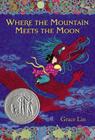
Where the Mountain Meets the Moon, by Grace Lin. This was the first one I thought of. I'm surprised that I've never written about it here: it's so wonderful, and appeals to kids of many different ages. It's the story of Minli, a girl who runs away from home to find The Old Man of the Moon, who determines everyone's fortunes. She wants to ask for prosperity for her parents. They're poor farmers, but her father tells lovely folktales to his daughter. On her quest, Minli meets many characters, human and not: a talking goldfish, a wingless dragon, travelers on the road, a king. Each new character tells his or her own story, which appears in a lovely old-fashioned typeface. Lin has also done gorgeous illustrations. While Minli is searching for the solution to her family's problems, we cut back from time to time to her parents, who are missing her achingly, but they're also reassessing the role of stories in their lives. Slowly, all the internal characters' stories knit together into one story, which is the one that Minli is in. The ending has a very satisfying reunion between child and parents.
 Since we were looking at fantastical fiction, the next title that came up was
 Luka and the Fire of Life, by Salman Rushdie. Luka has just been published, the sequel to Haroun and the Sea of Stories, which Rushdie wrote back in 1990. Luka was written for his younger son and tells the story of a boy who journeys through a magical world to steal and bring home the Fire of Life to revive his dying storyteller father. It's full of a magical cast, governed both by ancient rules of storytelling and by conventions of video games. Every now and then Luka must hit a gold button that appears in the air in order to save the progress he's made toward reaching the fire. It has wonderful wordplay and is beautifully written.
So there we were with two very well-written books about storytelling. How do the kids feel about scary?, I asked. They were mostly cool with that. So A Tale Dark and Grimm by Adam Gidwitz (link is to last month's blog entry), also about the role of stories in kids' lives, became the next on the list.
How about something different, the mom said. Sticking with the very good writers, we went on to A Long Walk to Water by Linda Sue Park, a very realistic story about children surviving under very hard circumstances in Sudan. She decided to take that one too.
I was ready to quit: what a satisfying list. But she wanted one more, and asked for one I thought was really special. Given that this is a family that clearly cares about language, the last book on this pile was one I loved as a kid: The Wonderful O, by James Thurber.
I hope I hear what they thought of all those books.
We miss you, Annie, but I know this is the end of the semester and an incredibly busy week for you. I hope there's some fun in all that grading.
Love,
Deborah
Monday, June 7, 2010
Opposites
Dear Aunt Debbie,
How lovely to read about Thurber -- I hadn't thought of those books in ages, but deeply love every one of them, not least because they remind me of Grandpa. I remember poring over the illustrations in The 13 Clocks, which are so saturated and rich. I remember the moment I got the joke in The Wonderful O about why Ophelia Oliver had to hide from society when no one was allowed to pronounce the letter O anymore. Towards the end of Grandpa's life, I remember reading him a lot of My Life and Hard Times, and even though his memory was fading and he couldn't keep track of the narrative for too long, he savored every sentence. He'd stop me and say, "He could really write." I'm going to go put Many Moons on the library list right now.
A few days ago, our friend Beth (mother of the indomitable Max) emailed to ask for recommendations on books about opposites.
The first that sprang to mind was

Olivia's Opposites
I actually like this book better than the more narrative Olivia books. (Perhaps "narrative" is the wrong word, as Ian Falconer's Olivia series sort of meander along with a partial plot that doesn't get very far before turning its attention to something else.) It's a very short board book, all black and white drawings with red accents, and has pairs of pictures of Olivia doing opposite things: "coming" and "going" on a scooter; "quiet" and "loud" involving taming a lion; "plain" and "fancy" with Olivia dressing up. Eleanor liked it early, and we've read it a lot.
Then there's the wonderful
Quick as a Cricket
I didn't even think of this as an opposites book at first -- Audrey Wood's text and Don Wood's illustrations have such personality to them. On each page, a boy compares himself to different animals with opposite characteristics: "I'm as quick as a cricket/I'm as slow as a snail. I'm as small as an ant/I'm as large as a whale." This is another one of the books we read aloud with accents ("I'm as tame as a poodle" always comes out British, while "I'm as wild as a chimp" is broad Southern). It's a great one for exploring the idea that we all contain multitudes.
Finally, I want to mention a book that has a section on opposites but is so, so much more:

Food For Thought
Saxton Freymann and Joost Elffers are crazy geniuses. On each page of this (quite long) book, they have cut and shaped different kinds of fruit and vegetables to resemble faces, shapes, and animals illustrating a variety of concepts: colors, the alphabet, numbers, and, yes, opposites. Their leek people, cauliflower and olive sheep, and bok choy fish are not to be believed.
What else do you recommend on the opposites front?
Love, Annie
How lovely to read about Thurber -- I hadn't thought of those books in ages, but deeply love every one of them, not least because they remind me of Grandpa. I remember poring over the illustrations in The 13 Clocks, which are so saturated and rich. I remember the moment I got the joke in The Wonderful O about why Ophelia Oliver had to hide from society when no one was allowed to pronounce the letter O anymore. Towards the end of Grandpa's life, I remember reading him a lot of My Life and Hard Times, and even though his memory was fading and he couldn't keep track of the narrative for too long, he savored every sentence. He'd stop me and say, "He could really write." I'm going to go put Many Moons on the library list right now.
A few days ago, our friend Beth (mother of the indomitable Max) emailed to ask for recommendations on books about opposites.
The first that sprang to mind was
Olivia's Opposites
I actually like this book better than the more narrative Olivia books. (Perhaps "narrative" is the wrong word, as Ian Falconer's Olivia series sort of meander along with a partial plot that doesn't get very far before turning its attention to something else.) It's a very short board book, all black and white drawings with red accents, and has pairs of pictures of Olivia doing opposite things: "coming" and "going" on a scooter; "quiet" and "loud" involving taming a lion; "plain" and "fancy" with Olivia dressing up. Eleanor liked it early, and we've read it a lot.
Then there's the wonderful
Quick as a Cricket
I didn't even think of this as an opposites book at first -- Audrey Wood's text and Don Wood's illustrations have such personality to them. On each page, a boy compares himself to different animals with opposite characteristics: "I'm as quick as a cricket/I'm as slow as a snail. I'm as small as an ant/I'm as large as a whale." This is another one of the books we read aloud with accents ("I'm as tame as a poodle" always comes out British, while "I'm as wild as a chimp" is broad Southern). It's a great one for exploring the idea that we all contain multitudes.
Finally, I want to mention a book that has a section on opposites but is so, so much more:
Food For Thought
Saxton Freymann and Joost Elffers are crazy geniuses. On each page of this (quite long) book, they have cut and shaped different kinds of fruit and vegetables to resemble faces, shapes, and animals illustrating a variety of concepts: colors, the alphabet, numbers, and, yes, opposites. Their leek people, cauliflower and olive sheep, and bok choy fish are not to be believed.
What else do you recommend on the opposites front?
Love, Annie
Sunday, June 6, 2010
The Bard of Columbus
Dear Annie,
The time has come to celebrate James Thurber (1894-1961), best known for his essays and cartoons for The New Yorker, but also a wonderful children’s author. He was from Columbus, Ohio, not far from Cambridge, where my father, your grandfather, grew up. Grandpa always felt an affinity for Thurber – mostly because of their shared love of language – but also for the Midwestern sensibility. Four of Thurber’s books – two fairy tales, a fable, and a memoir – are wonderful family reads with children of different ages:


Many Moons , with two editions in print, each with a different illustrator, is a read-in-one-sitting picture book. A young princess is fading away because she wants someone to bring her the moon. All the wise men of the kingdom tell the king why it’s impossible – it’s 35,000 miles away and made of molten copper, 150,000 miles away and made of green cheese, 300,000 miles away and pasted on the sky. The court jester finally asks the girl how big the moon is, and she says, “It is just a little smaller than my thumbnail, for when I hold my thumbnail up at the moon, it just covers it.” The jester gets the goldsmith to make a very small golden disk and hang it on a chain:

The 13 Clocks is a chapter book fairy tale, complete with evil duke, imprisoned princess, and disguised prince, as well as various magical characters. In the introduction to the New York Review of Books reprinted edition, Neil Gaiman calls it “probably the best book in the world.” Superlatives can always be debated, but the language and the story in this one are very special. It makes a great read-aloud because sometimes the paragraphs reveal themselves to be poetry as one reads. As in this scene, where the Golux, a magical ally of the prince, is figuring out a charm put on the commoner Hagga that turns her tears into jewels: if the tears are sad, the jewels are permanent, but tears of laughter soon dissolve.

The Wonderful O (also reprinted by NYRB) was one of my favorites as a child, although I now understand I must have been reading on my own for several years before I discovered it. It has held a special place in my brother’s heart as well, because your Uncle Al frequently wielded Captain Black’s threat: “ I”ll squck his thrug till all he can whupple is geep.” The book is the story of pirates from the black-sailed ship Aeiu taking over the peaceful island of Ooroo and banishing the use of the letter O. The book is all wordplay, with lots of lists of things permitted and banished
 And last, the perfect book to take to the beach (or wherever family vacation takes you):
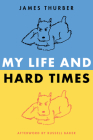
My Life and Hard Times, a thin volume of essays about Thurber’s childhood. Best known of the bunch is “The Night the Bed Fell,” one of the classic stories of American humor. I can never decide if I find that one the funniest, or “More Alarms in the Night,” which has young Jamie waking his father in the middle of the night because he has forgotten a name:
One caveat on this very funny book. I would recommend a parent reading “A Succession of Servants” on one’s own before plunging into it aloud. It’s a reminiscence about many different maids from many different ethnic groups who worked for the Thurbers. Some of the language is a century old, particularly Thurber’s rendition of black dialect. There’s nothing that screams, oh-no-can’t-do-this-one, but it would help to know what you’re getting into.
My Life and Hard Times, which was written for adults, probably works best with older kids -- maybe 9 or 10 and up. And of course grown-ups: bring it along for yourself, too.
Love,
Deborah
The time has come to celebrate James Thurber (1894-1961), best known for his essays and cartoons for The New Yorker, but also a wonderful children’s author. He was from Columbus, Ohio, not far from Cambridge, where my father, your grandfather, grew up. Grandpa always felt an affinity for Thurber – mostly because of their shared love of language – but also for the Midwestern sensibility. Four of Thurber’s books – two fairy tales, a fable, and a memoir – are wonderful family reads with children of different ages:
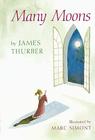
Many Moons , with two editions in print, each with a different illustrator, is a read-in-one-sitting picture book. A young princess is fading away because she wants someone to bring her the moon. All the wise men of the kingdom tell the king why it’s impossible – it’s 35,000 miles away and made of molten copper, 150,000 miles away and made of green cheese, 300,000 miles away and pasted on the sky. The court jester finally asks the girl how big the moon is, and she says, “It is just a little smaller than my thumbnail, for when I hold my thumbnail up at the moon, it just covers it.” The jester gets the goldsmith to make a very small golden disk and hang it on a chain:
“What is this thing I have made?” asked the Royal Goldsmith when he had finished it.
“You have made the moon,” said the Court Jester. “That is the moon.”
“But the moon,” said the Royal Goldsmith, “is 500,000 miles away and is made of bronze and is round like a marble.”
“That’s what you think,” said the Court Jester as he went away with the moon.
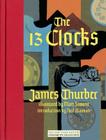
The 13 Clocks is a chapter book fairy tale, complete with evil duke, imprisoned princess, and disguised prince, as well as various magical characters. In the introduction to the New York Review of Books reprinted edition, Neil Gaiman calls it “probably the best book in the world.” Superlatives can always be debated, but the language and the story in this one are very special. It makes a great read-aloud because sometimes the paragraphs reveal themselves to be poetry as one reads. As in this scene, where the Golux, a magical ally of the prince, is figuring out a charm put on the commoner Hagga that turns her tears into jewels: if the tears are sad, the jewels are permanent, but tears of laughter soon dissolve.
“What happened on that awful day to make him value sorrow over and above the gift of laughter? Why have these jewels turned to tears a fortnight after?”
“There was a farmer from a near-by farm, who laughed,” said Hagga. “’On second thought,’ the good king said, ‘I will amend and modify the gift I gave you. The jewels of sorrow will last beyond all measure, but may the jewels of laughter give you little pleasure.’”
The Golux groaned. “If there’s one thing in the world I hate,” he said, “it is amendments.”
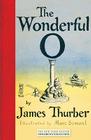
The Wonderful O (also reprinted by NYRB) was one of my favorites as a child, although I now understand I must have been reading on my own for several years before I discovered it. It has held a special place in my brother’s heart as well, because your Uncle Al frequently wielded Captain Black’s threat: “ I”ll squck his thrug till all he can whupple is geep.” The book is the story of pirates from the black-sailed ship Aeiu taking over the peaceful island of Ooroo and banishing the use of the letter O. The book is all wordplay, with lots of lists of things permitted and banished
There was great consternation on the island now for people could have pigs, but no hogs or pork or bacon; sheep, but no mutton or wool; calves, but no cows. Geese were safe as long as one of them did not stray from the rest and become a goose, and if one of a family of mice wandered from the nest, he became a mouse and lost his impunity. Children lost their ponies, and farmers their colts and horses and goats and their donkeys and their oxen.A clandestine resistance movement is organized, and of course eventually triumphs. The best way to read this book is aloud, with a child who is already a comfortable reader sitting next to you. So both of you can hear the marvels of the language, and also scan each line for the forbidden O.
 And last, the perfect book to take to the beach (or wherever family vacation takes you):
 My Life and Hard Times, a thin volume of essays about Thurber’s childhood. Best known of the bunch is “The Night the Bed Fell,” one of the classic stories of American humor. I can never decide if I find that one the funniest, or “More Alarms in the Night,” which has young Jamie waking his father in the middle of the night because he has forgotten a name:
I had been trying all afternoon, in vain, to think of the name Perth Amboy. It seems now like a very simple name to recall and yet on the day in question I thought of every other town in the country, as well as such words and names and phrases as terra cotta, Walla-Walla, bill of lading, vice versa, hoity-toity, Pall Mall, Bodley Head, Schumann-Heink, etc., without even coming close to Perth Amboy. I suppose terra cotta was the closest I came, although it was not very close.The New Jersey Turnpike has never been the same for me.
One caveat on this very funny book. I would recommend a parent reading “A Succession of Servants” on one’s own before plunging into it aloud. It’s a reminiscence about many different maids from many different ethnic groups who worked for the Thurbers. Some of the language is a century old, particularly Thurber’s rendition of black dialect. There’s nothing that screams, oh-no-can’t-do-this-one, but it would help to know what you’re getting into.
My Life and Hard Times, which was written for adults, probably works best with older kids -- maybe 9 or 10 and up. And of course grown-ups: bring it along for yourself, too.
Love,
Deborah
Subscribe to:
Comments (Atom)