In which Annie (high school teacher, mother of two young girls and a younger boy) and her aunt Deborah (children's bookseller, mother of two young women in their 20s) discuss children's books and come up with annotated lists.

Showing posts with label Linda Sue Park. Show all posts

Sunday, November 6, 2011

Linda Sue Park

Dear Annie,

It makes me happy that The Artist who Painted a Blue Horse is a hit in your family.  I love all the pictures, but wasn't sure how it would play with kids as a book.  There's a whole category of picture books which I see before they're published and I say, "It'll be great when it's a board book," and then I don't buy them as hardcover/paper page books because I can't see the appeal to older kids.  I waffled on this one, but Carle's pictures pulled me in.  I have a 3-foot tall poster of the blue horse from the cover on a wall at the store -- can be seen from quite a distance.

Maybe because business is getting busier and busier (yes, all the Christmas and Hanukkah books are on display already), I find my focus with the blog bouncing all over the place.  This week I've come back to Linda Sue Park, a wonderfully versatile author.  I've talked about A Long Walk to Water, set in the Sudan.  She's written many books, both picture books and middle-grade novels.  She even has a new Christmas book this year: The Third Gift, which taught me a lot about frankincense.
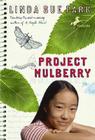
Park is Korean-American, and many of her books include Korean themes.  A Single Shard, for which she won the 2002 Newbery Award, is about a 12th century Korean potter and his apprentice.  But the one I wanted to talk about today is about a contemporary Korean-American girl:
Project Mulberry
.  There are two things that make this book engagingly out-of-the-ordinary.  First, it deals with kids' feelings about race, in age-appropriate ways.  Julia and her friend Patrick want to do a project for the state fair, and her mother (who is Korean) suggests they raise silkworms.  Julia doesn't want to be typecast as the Asian kid in her predominantly white small town, but doesn't know how to resist the silkworm idea.  "I wanted a nice normal, All-American, red-white-and-blue kind of project," she writes.

Julia also sees that her mother is uncomfortable with black people -- it embarrasses her, but any attempts to confront her mother directly get deflected.  There's a lovely scene when Patrick, Julia and her mother visit someone who they've been told might have mulberry leaves to feed to the silkworms.  He answers the door, and Julia is surprised then apprehensive to discover he's black -- worried about her mother's reaction.  The man is startled, he tells them, because he was expecting them to be white.  The book is aimed at the fourth-to-seventh grade age range, and Park presents Julia's thought processes in an empathetic way, saying out loud those things which are often unspoken.

The other lovely unusual element of the book is that between all the chapters, there's a brief two-page discussion between the author and the main character, arguing about the direction the book should go.
Me: Do you want my opinion?  I am not happy with the way things are going here.  I hate the project idea, Kenny [her brother] is driving me nuts, and I still haven't found another Connecticut.
Ms. Park: Actually, no -- I don't want your opinion.  I've written other books, and only once has a character ever talked to me.  You talk to me all the time, and I'm finding that hard to get used to.
Me: Like right now, while you're in the -- ahem -- bathroom.  Well, I don't care whether you want my opinion or not -- you're getting it.  That was a terrible chapter.
Ms. Park:  Would it help if I said I'm sorry you're having such a hard time?
Me: If you were really sorry, you'd go back and rewrite it.
Ms. Park: You're the main character.  You have to have a problem or two.  If you didn't, there wouldn't be any story.
There's a lot of negotiating about plot in these little interludes, and at one point Julia gets so angry that she refuses to participate in the discussion.

Project Mulberry is part of a genre of books which say: you're not a baby anymore; we (the authors) are going to talk to you about real stuff, and we know you'll understand it, but we're also going to remember that you're not a teenager yet.  Part of the progression.

Love,

Deborah

Wednesday, December 8, 2010

A storytelling list

Dear Annie,

Things aren't getting any slower at the toy/book store these days.  Every time I turn around, I see huge gaps in the shelves (oh no! No more Jan Brett books! We're down to two Grinches!  And today someone bought out all five of our copies of A Wrinkle in Time!  Must reorder!).  There are a few more irritating customers than usual: grandparents who have no idea what their grandchildren are like, people with too much money and not enough time, parents who have little interest in communicating with their kids.

But they're definitely in the minority.  There's that lovely moment of wondering, who will this person be, before I offer to help someone.  A quite wonderful woman was in yesterday, to whom I sold a very fine list of books.  She's the mother of a nine and eleven year-old: one of each gender.  She had bought the
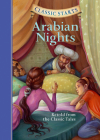
Classic Starts Arabian Nights
a while ago.  It's part of the series that has a Peter Pan edition you wrote about.  She said her husband was stunned that she'd bring home such an abridged edition, but he started reading it with the kids and everyone really liked it.  It was a little young for them, and they wanted to wander into more magical/folklorish books.

So here's what we ended up with:


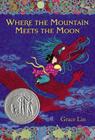
Where the Mountain Meets the Moon
, by Grace Lin. This was the first one I thought of. I'm surprised that I've never written about it here: it's so wonderful, and appeals to kids of many different ages.  It's the story of Minli, a girl who runs away from home to find The Old Man of the Moon, who determines everyone's fortunes.  She wants to ask for prosperity for her parents.  They're poor farmers, but her father tells lovely folktales to his daughter.  On her quest, Minli meets many characters, human and not: a talking goldfish, a wingless dragon, travelers on the road, a king.  Each new character tells his or her own story, which appears in a lovely old-fashioned typeface.  Lin has also done gorgeous illustrations.  While Minli is searching for the solution to her family's problems, we cut back from time to time to her parents, who are missing her achingly, but they're also reassessing the role of stories in their lives.  Slowly, all the internal characters' stories knit together into one story, which is the one that Minli is in.  The ending has a very satisfying reunion between child and parents.

Since we were looking at fantastical fiction, the next title that came up was
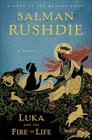
Luka and the Fire of Life
, by Salman Rushdie.  Luka has just been published, the sequel to Haroun and the Sea of Stories, which Rushdie wrote back in 1990.  Luka was written for his younger son and tells the story of a boy who journeys through a magical world to steal and bring home the Fire of Life to revive his dying storyteller father.  It's full of a magical cast, governed both by ancient rules of storytelling and by conventions of video games.  Every now and then Luka must hit a gold button that appears in the air in order to save the progress he's made toward reaching the fire.  It has wonderful wordplay and is beautifully written. 

So there we were with two very well-written books about storytelling.  How do the kids feel about scary?, I asked.  They were mostly cool with that.  So A Tale Dark and Grimm by Adam Gidwitz (link is to last month's blog entry), also about the role of stories in kids' lives, became the next on the list.

How about something different, the mom said.  Sticking with the very good writers, we went on to A Long Walk to Water by Linda Sue Park, a very realistic story about children surviving under very hard circumstances in Sudan.  She decided to take that one too. 

I was ready to quit: what a satisfying list.  But she wanted one more, and asked for one I thought was really special.  Given that this is a family that clearly cares about language, the last book on this pile was one I loved as a kid: The Wonderful O, by James Thurber.

I hope I hear what they thought of all those books.

We miss you, Annie, but I know this is the end of the semester and an incredibly busy week for you.  I hope there's some fun in all that grading.

Love,

Deborah

Sunday, November 14, 2010

Another (very different) look at Africa, another good book

Dear Annie,

I'm so glad Anna Hibiscus was a hit.   We seem to be looking to Africa these days.  Today's book, though, looks at a very different aspect of the continent.

The opportunity to read a book -- or see a movie -- having little or no idea what it's about is a rare one for me.  But the process of discovering-as-one-goes is so satisfying.  It's also how the author intended it to be.

I just had this experience with
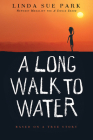
A Long Walk to Water
by Linda Sue Park.  I knew it had something to do with the Lost Boys -- thousands of homeless boys displaced by civil war in the Sudan during the '80s and '90s.  (Dave Eggers wrote an adult book, What is the What three years ago based on the life of one of the Lost Boys who ended up in the U.S. Link is to a lovely article by my spouse about the book.)   A Long Walk to Water alternates chapters told from the point of view of Salva Dut (a very real person), who flees an attack on his village in 1985, and a fictional girl named Nya in 2008, who must walk eight hours a day to fetch water for her family.  Park's book tells children  -- it's aimed at the ten-and-up crowd -- about the horrors of war, the hardships of living in a desert country, and the amazing personality of the man whose experiences are the core of the book.  And it leaves the reader with a real feeling of hope.  The ending made me cry, too -- but I'm not going to do a spoiler on this.

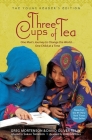
It made me think of Three Cups of Tea by Greg Mortenson, about his campaign to build schools in Pakistan and Afghanistan.  The publisher did a
young people's version of the book
, aimed at this same audience of ten and up.  It's an amazing story which carries the reader along despite the clunky writing.  With Long Walk, though, the writing is in the hands of a Newbery medal winner, and it's a quite fine book.  It's going on my might-be-a-winner list.

Love,

Deborah