In which Annie (high school teacher, mother of two young girls and a younger boy) and her aunt Deborah (children's bookseller, mother of two young women in their 20s) discuss children's books and come up with annotated lists.

Showing posts with label Rylant. Show all posts

Thursday, August 8, 2013

Hiking with kids: the secret ingredient

Dear Annie,

Eleanor is reading whole chapters on her own!  This is so great. 

We're in Maine now -- haven't made it to the Saco for canoeing yet, but are very happy to be away from city life.  Your pal and occasional guest blogger Denise posted a great question on my last post:
What are some other books like these that would inspire hiking and camping trips? My daughter is a resistant hiker though reciting/singing We're Going on a Bear Hunt always keeps her going for a little while. But we do need more inspiration for our imminent camping trip:-)
I can't think of a perfect book, but let me offer two that might help, and some advice.
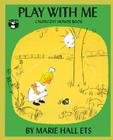


Play with Me
, by Marie Hall Ets is a sweet picture book (1955) about a girl who wanders into a meadow looking for playmates.  She meets a series of animals (grasshopper, frog, turtle, fawn, etc) who run away when she gets too close.  She eventually sits by a pond and the animals all come back.  It gives a feel of the elusiveness of animals in the wild, and of needing to act a bit differently when one is looking for them.  It's also just a lovely classic book.
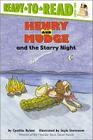
Good old Henry and Mudge come through on this topic with a camping book:
Henry and Mudge and the Starry Night
, by Cynthia Rylant.  Henry and his parents -- with, of course, his big dog Mudge -- go camping. They hike to their campsite:
They walked and walked 
and climbed and climbed.
It was beautiful.
And there's a list of what they see: fish, deer, waterfall, rainbow.  Mudge gets very fond of all the smells.  They end up sleeping under the stars.

I'm going to veer off books for a minute to offer a solution which worked real well in our family:  always hike with friends.  Slogging up that trail with mom and dad and siblings can get a little old, tiring, whine-inducing.  But add another family with kids -- with us slightly older kids were the best -- and it becomes an adventure.  Being in a new place with friends makes it all a lot more fun.  And if you're the kind of family that likes to sing a few tunes from Broadway musicals as you go, you'll be at the top of whatever you're climbing before you know it.

Enjoy your trip, Denise.

Love,

Deborah


Friday, May 17, 2013

The benefits of children reading to each other

Dear Aunt Debbie,

As Eleanor's independent reading is progressing (and she's going like a house afire!), we're starting to enjoy some of the benefits of our kids reading to us, and to each other.

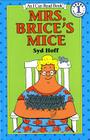
Benefit #1: Eleanor finds new authors and series she's really into.  In her classroom, Eleanor "shops for books" once a week, choosing five independent reading books at her level and bringing them back and forth to school every day.  Lately, she's been choosing multiple books by the same author, really paying attention to who's writing what she likes to read. This is how we've gotten a lot of Syd Hoff books into the house: Sammy the Seal, Danny and the Dinosaur, Mrs. Brice's Mice. She loves the cartoony drawings, and the general sense of play throughout Hoff's stories. They're a little meandering, and fun.  Henry and Mudge, who you blogged about a while back, have also become huge favorites here -- the third series by Cynthia Rylant that we've fallen in love with, after Poppleton and The High Rise Private Eyes.  Watching her gain a conscious appreciation for the work of a particular author is a joy.

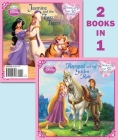
Benefit #2: Eleanor reads Isabel the crappy books I don't want to read to either of them.  As I'm home with Will full time right now, and Isabel is home with us three days a week, we're going to the library a lot. Isabel's library book picking habits are fairly indiscriminate: she stops in front of a shelf and just pulls out whatever's there, barely looking at it until we sit down to read it there or later.  What she gets most excited about are books she knows, or books with pop culture characters she recognizes.  Each visit, she picks up at least one badly-written series book: a Star Wars industry story, or a godawful Disney princess book, something either cloying or nonsensical in its narrative, and sometimes both.  Then, of course, this is the book she wants me to read to her sixteen times in the next two days.  Imagine my joy when I peeked around the corner of the kitchen into the living room a few days ago and saw Eleanor reading Isabel Rapunzel and the Golden Rule/Jasmine and the Two Tigers!  They were both totally into it, and I didn't have to be involved.

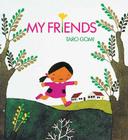
Benefit # 3: Both girls have started reading board books to Will. At three months old, Will is starting to be entertainable at times, and he's really paying attention to his two older sisters.   Among other games (painting his hands and feet with dry paintbrushes, dancing around him, putting hats on his head), they're showing him books. Eleanor caught his attention first with Pat the Bunny, that wonderful old standby with things to touch on every page. It's such an odd, pleasing, dated little book.  The next day, there was Isabel showing him My Friends, by Taro Gomi, a gentle recitation of all the things a little girl learns from the animal kingdom:

I learned to climb from my friend the monkey.

I learned to run from my friend the horse.

I learned to march from my friend the rooster.

I learned to nap from my friend the crocodile.

While all this kid reading has been going on, I've managed to find time to read Fire, Kristin Cashore's second book.  I'm in total agreement with you -- it's not nearly as good as Graceling.  Turns out that skipping it and going straight to Bitterblue was a good idea.

Love, Annie

Monday, July 9, 2012

Mellow mysteries

Dear Aunt Debbie,

I love your suggestions, and will be sure to check them out.  Our nightly vacation reading of Nancy Drew is getting Eleanor so excited that she literally cannot sit still -- she's up and down, sitting on the floor and on the arm of the chair, moving closer to and farther away from the book with the intensity of the suspense.  I look forward to more mysteries with her.

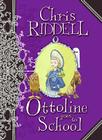
I'm realizing, thinking back on it, that a few of our favorites have also been mysteries of a comic sort, so disguised that I don't think of them as mysteries first.  I wrote a while back about the fabulous Ottoline and the Yellow Cat, by Chris Riddell; in the year and a half since we first read it, we have acquired the other two Ottoline books: Ottoline Goes to School, and Ottoline at Sea (sadly out of print).  All three books are graphic novels, extremely quirky, mysteries of a sort but mostly just tremendously, enjoyably odd.  In Ottoline Goes to School, Ottoline and her friend/caretaker/tiny hairy Norwegian bog-person, Mr. Munroe, enroll along with Ottoline's new friend Cecily in the Alice B. Smith School for the Differently Gifted.  There are very few pupils, each astoundingly rich and odd, and each with a unique pet (the son of the Invisible Man, for example, has an Invisible Dog).  Ottoline tries to determine what her Different Gift is; meanwhile, the school appears to be haunted by the ghost of the Horse of the Hammersteins, who Cecily has a lot of stories about.  While that ghost is revealed by the end not to be real, there are some friendly true ghosts who wander through the pages, and can be great fun to pick out as you go along.  The story is about neediness and friendship -- Ottoline has to navigate her new exciting friendship with Cecily, who tries to pull her away from Mr. Munroe; ultimately, Cecily's loneliness for her parents turns out to be a major cause of her unhappiness.  (A funny moral, given that Ottoline never seems to see her parents, the Roving Collectors, but oh well.)  Ottoline at Sea contains a trip to Norway, a bog monster, and a pair of "bog-goggles" you can use to see hidden pictures in the book.  Eleanor will pore over these books for long periods of time.


For the early reader set, there's the Cynthia Rylant series The High-Rise Private Eyes, more humor than mystery, as I've written about before, but pretty great.


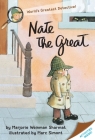
And speaking of great, let's not leave out Nate the Great, those odd little meandering books by Marjorie Weinman Sharmat.  Nate's mysteries always involve him eating a lot of pancakes, and at least in the several we've read, usually also involve slightly odd female friends and a number of cats.  The stakes are low -- a drawing disappears, and Nate figures out that his friend's little brother drew over it -- and the tone is thoughtful.

None of these make Eleanor squirm in her seat, but they do keep her interested.

Love, Annie

Friday, February 3, 2012

Lullaby for trains

Dear Aunt Debbie,

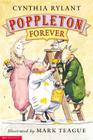
Happily, our stomach bug was not nearly as bad as Ramona's.  I have no new ideas on the stomach flu book front, but in conversation with a colleague today was reminded of two lovely Poppleton stories that have to do with being sick.  In Poppleton, there's "The Pill," in which Fillmore is sick and convinces Poppleton he has to have his pill inside a piece of cake, which results in a tremendous amount of cake being eaten.  In Poppleton Forever, it's "The Cold," in which Poppleton has a bad cold, and his friend, a llama named Cherry Sue, tries to cure him by bringing him a bowl full of oranges.  Each time he peels an orange, he sneezes, and the orange ends up across the room, in some different strange spot.

But moving away from stomachs and colds, and back to trains....

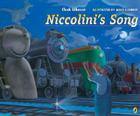
One of your gifts for Isabel in Eleanor's birthday package was the lovely Niccolini's Song,by Chuck Wilcoxen.  We've been reading it three times a day.  It's about a mild-mannered train yard night watchman, Niccolini, who is surprised one night when, after an earlier scare, a steam engine begins to talk to him.  It's worried about the next day, and having trouble falling asleep.  Niccolini sings the engine a lullaby: "a song about gentle hills, steady tailwinds, and feathers for freight."

After this first night, the other engines want Niccolini to sing to them, too.  In Wilcoxen's text, the trains come across very much like children, and Niccolini a tender father:

Niccolini knew that some of the trains were perfectly capable of falling asleep without a lullaby.  In fact, there were nights when certain engines (who felt unloved) would wake themselves up just to have Niccolini sing them back to sleep.  Niccolini didn't mind.  The words came to him easily, the tune was always the same, and it cost him nothing to bring them comfort.

One night, a harried mother walks her sleepless baby down by the train yard; the baby, too, is soothed by Niccolini's song.  The story expands: other mothers come, with other babies, in a quieting parade.  Then one night, there's a terrible wind, and so many sleepless parents and children come to be soothed by Niccolini that no one can hear them.  And so he enlists the engines to whistle his song, while he conducts.

This is a deeply gentle book.  Mark Buehner's illustrations all have the feel of dusky night, every page both detailed and dim, so you have to peer at them closely.  I love the roundedness of his forms: both the trains and Niccolini himself have depth and heft.  Here's Niccolini, early in the book, leaning to listen to the engines:


 Isabel's favorite illustrations are the ones with mothers and babies, which she likes to identify and comment on: "There's the mother.  There's her baby.  Where's the daddy?  He's home asleep."  For me, though, this is the image that sticks: Niccolini, listening for danger and ready to blow his whistle (look at the tension in his turning form), on the cusp of discovering something miraculous. 

Love, Annie

Wednesday, August 3, 2011

Henry and his big dog Mudge

Dear Annie,

Bob and I are happily settled in the house in Maine now, eagerly anticipating Lizzie's return from Spain on Friday, and your visit next week.  All that, and Mona turns 20 tomorrow!  She's far away, alas.

I started rummaging around today for good books to read with your girls and unearthed
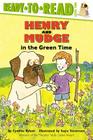
Henry and Mudge in the Green Time
by the multi-talented Cynthia Rylant. You've written about her Poppleton and High-Rise Private Eyes books; Henry and his big dog Mudge (as they're always introduced in the books) were her most important characters in our house. Henry is an only child. In the first book, his parents get him a puppy who grows into a 182-pound English Mastiff.  They lose each other, and Henry swears they'll never be apart again.  The books are structured like Frog and Toad and a number of other readers: broken up into several short chapters.

Henry and Mudge in the Green Time is three stories about summertime.  In the first, they go on a picnic, Henry doesn't see a bee who's investigating his pear, and he is stung.  "'Ow! Ow! Ow,' Henry cried," a line parroted by my girls whenever we read the story.
Henry just had to cry. He sat down beside Mudge and held on to his hurting hand and cried.
Mudge sniffed Henry's hair.
Mudge sniffed Henry's hand.
Mudge put his big nose in Henry's ear.
But Henry kept crying.
Then Mudge licked Henry's face.
Mudge liked the taste.
It was salty.
So Mudge licked Henry's face again and again and again.
Every tear that Henry cried Mudge licked away.
Henry cried, Mudge licked, and the hand hurt.  But in a while, the hand stopped hurting, Henry stopped crying, and Mudge stopped licking.
They finish the picnic and all's well.

The other stories involve Mudge getting a bath -- in which Rylant and illustrator Sucie Stevenson get the resigned misery of a soapy dog just right -- and Henry playing king-of-the-hill with his faithful dragon Mudge.

All the Henry and Mudge stories (there are 27 of them now!) involve realistic situations, with real feelings, and family and canine love.  They involve relatives visiting, lost cats, birthdays and various holidays, mud, getting sick, being scared of the dark, going to the beach, and on and on.  They're written with Rylant's deft hand, a pleasure to read.

The most recent listing I can find for a Henry and Mudge book is one that came out in 2007.  Since then, Rylant's been working on a spinoff series about Henry's cousin Annie and her pet rabbit Snowball, in which Henry and Mudge almost always play a part.  Annie showed up in a couple of H&M books, and I suspect the publisher said aha, let's market these books more directly to girls. The Annie books have phrases in their titles like "Pink Surprise," "Prettiest House," and "Teacup Club" which telegraph that they're being aimed at girls. As you know, this is one of the things about the current marketing mentality that drives me crazy.  The Henry and Mudge books have broad appeal: they talk about universal kid experiences. But then,as with Dora and countless other characters, the marketing message twists, and girl characters are pushed for girls and boy characters for boys.   

So resist the spin and enjoy the books.  We'll have Henry and Mudge in the Green Time waiting for you up here.

Love,

Deborah

Tuesday, July 6, 2010

Pippi and Poppleton

Dear Aunt Debbie,

Your thought about the age at which books become funny to a child makes me think immediately of two we've picked up recently.

The first is an example of the Stuart Little problem: remembering my own love of the book, but forgetting at what age I enjoyed it, I bought Eleanor a copy of
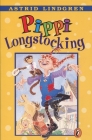
Pippi Longstocking
, by Astrid Lindgren.  Turns out that Pippi's kookiness doesn't fully translate until you've had some experience with school.  Sure, it's kind of odd that she lives with a horse and a monkey, but without the context of rules and expectations that Eleanor will understand later in childhood, the book takes too much explaining, and just isn't funny yet.  We're putting it away to try again in a few years.

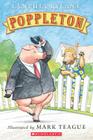
The second is a series that hits the funny bone of child and adults in this house at once: Cynthia Rylant's Poppleton. Rylant is also the author of the High Rise Private Eyes series I've written about before; her sense of humor is quirky and odd and totally pleasing, and happily, she's prolific, so there are always more books to check out.  We've read three of the Poppleton books so far; there are eight.

Poppleton is a pig who moves from the city to a small town peopled by a variety of animals: Cherry Sue, the llama next door; Fillmore, the hypochondriac goat; Hudson, a mouse who likes to go to the shore.  The stories are highly random: in our favorite in the first book, Fillmore is sick but refuses to take his pill unless Poppleton hides it in his food:

"I'll put it in the soup," said Poppleton.
"No, it has to be in something sweet," said Fillmore.
"Sweet?" asked Poppleton.
"Sweet and soft," said Fillmore.
"Sweet and soft?" asked Poppleton.
"Sweet and soft with raspberry filling," said Fillmore.
"Sweet and soft with raspberry filling?" asked Poppleton.
"And chocolate on top," said Fillmore.
"Chocolate on...Fillmore, are you talking about Cherry Sue's Heavenly Cake?" asked Poppleton.
Fillmore smiled.


This passage reduces Eleanor to giggles every time.  

Our favorite in Poppleton and Friends is titled "Dry Skin," and is entirely about Poppleton believing he has dry skin, and trying to fix it by covering himself with oil (which makes him want french fries) and honey (which makes him want biscuits).  Each book contains three stories, with brightly colored and personality-filled illustrations by Mark Teague on every page.  We are clearly going to have to read them all.

Love, Annie

Thursday, May 20, 2010

Tickling the toddler funnybone

Dear Aunt Debbie,

Before returning to toddler-book world, where I live most of the time these days, I want to mention one more YA fantasy series: the Avatars trilogy (So This Is How It Ends, Shadow Falling, Kingdom of Twilight), by Tui Sutherland. (Full disclosure: Tui and I have been friends since college, and she's already one of our main comment-writers on this blog. But they're still good books.) It's a post-apocalyptic trilogy, in which the only surviving people on earth appear to be several teenagers in different parts of the globe, each of whom has been invested with the powers of a god from a different pantheon. Sutherland clearly did a lot of research into the various beliefs and myths of cultures from around the world, and the resulting mash-up is a lot of fun to read.

And now, back to toddlers.

Last week, we took out of the library the latest book I Must Buy for Eleanor. Why? Because it cracked her up, and she made me read it four times that day and several more in the last week, and I loved it just as much. It got me thinking about what makes a toddler laugh -- I mean, really laugh, belly laugh, get so tickled by something that the laughter comes in spite of themselves. For Eleanor, right now, one of those ticklish points is the idea of opposites and things being backwards. Which is why this book is perfect.


The Backward Day


The Backward Day was written by Ruth Krauss. Before this, I knew her only as the author of The Carrot Seed; I'll be looking for more now. (Fun fact: she was married to Crockett Johnson, who illustrated The Carrot Seed and wrote the Harold and the Purple Crayon books.) It's a simple, short story about a little boy who wakes up and decides it's backward day. He explains to himself, helpfully, "Backward day is backward day." After putting on his clothes backwards (underwear on the outside), he goes downstairs backwards, and sits backwards at the table. When his parents and little sister come in, instead of making fun of him, each of them sizes him up and joins him in backwardness. It doesn't last long. Warning to parents: Eleanor has started making us read the book backwards to her now, too.

Then there's humor via banter and wordplay, as in the Cynthia Rylant series The High-Rise Private Eyes.


The Case of the Desperate Duck


The first of these we discovered (and still our favorite), is The Case of the Desperate Duck, which includes the line, "Hello, I'm Mabel. Let me show you to your table." (Ha! This started one of our first discussions of rhyme, too.) The private eyes are a raccoon named Jack and a rabbit named Bunny. Bunny is smart, Jack is distractable, and they have quirky personality traits throughout. We only read a few books in the series, but the plots seem generally to revolve around theft, and be resolved when the thief apologizes and explains that he didn't do it on purpose. No major crimes here.

Finally, here are two wacky books that you sent Eleanor in the last year or so, both of which remain in heavy rotation.


Monsieur Saguette and His Baguette


We've discovered that Frank Asch's tale of a baguette used for a wide variety of purposes (to rescue a cat from a tree, to rescue a baby from a crocodile, to lead a parade in lieu of a baton, etc.) is especially funny when you read Monsieur Saguette's lines in a very bad French accent. We often provide different accents for the other characters (a construction worker, a robber, a little girl) as well. This book has a blithe spirit.


Chickens to the Rescue


Chickens to the Rescue, by John Himmelman, tells the story about all the things that go wrong on a farm during the course of a week ("On Monday, Farmer Greenstalk dropped his watch down the well."). After each mishap, a giant cloud of chickens flies in and fixes whatever's wrong, and you get to yell "Chickens to the Rescue!" The pictures in this one are awesome, and it makes a great group read-aloud.

Love, Annie