In which Annie (high school teacher, mother of two young girls and a younger boy) and her aunt Deborah (children's bookseller, mother of two young women in their 20s) discuss children's books and come up with annotated lists.

Monday, January 30, 2012

Stomachaches -- a sign of gluttony

Dear Aunt Debbie,

Thanks for the well-wishes -- after being completely knocked out for two days, I'm feeling much better, and we had a terrific celebratory weekend for Eleanor.  (We got your birthday box tonight, and have only opened part of it -- what a treasure trove!)

Coming off of this stomach bug, and watching family and friends fall prey to it and its cousins in the last couple of weeks, I'm surprised that I can't think of any good stomach flu picture books either.  It's such a common childhood ailment.  Maybe illustrators think it's too gross?  Colds and flus provide picture-friendly runny sore noses, but no one wants to draw their favorite bunny hunched over the toilet or reaching for a bucket over the side of the bed?

The only stomachache books that come to mind are about overeating: stomachache as a punishment for gluttony.  There's Eric Carle's The Very Hungry Caterpillar, who overeats (at a fairground?) on Saturday, has a terrible stomachache, then eats a "nice green leaf" on Sunday (repent, caterpillar!) and feels much better.  Only then does he get to be a butterfly.

Then there's this wonderful weird old book I had as a kid (out of print now, of course): Mother Mother I Feel Sick Send for the Doctor Quick Quick Quick.
It's the brainchild of Remy Charlip (of Fortunately and Paper Bag Players fame) and Burton Supree, and you can get a sense of its pleasing wackiness from the title.

It's the story of a fat little boy who has a bad stomachache.  His mother races him to the doctor, who throws him under a sheet and begins to pull all kinds of things out of him -- apparently, this boy has eaten everything in the house, from food to furniture to a birdcage with a live bird in it.

The drawings are all done in silhouette, and the book provides instructions for how to act it out as a shadow play, which I remember thinking was a cool idea, though I don't think we ever actually did it.  Vintage Kids' Books My Kid Loves has a nice entry on it, with more of the evocative silhouette drawings.

So again, not really sickness, just compulsive overeating.  But perhaps a book that would make a sick kid feel better anyhow?

Love, Annie

Sunday, January 29, 2012

Wheezles and sneezles

Dear Annie,

A dad asked the other day for a picture book to read to a sick child about being sick.  Specifically, she had a stomach flu and he wanted a book about tummy aches.  As you know, I love odd requests that force me to rummage through infrequently visited corners of my brain, but the tummy ache brought me up short on this one.

The subject of illness in books seems appropriate this weekend, though, because (as regular readers may have guessed) you've been both sick and hosting Eleanor's birthday festivities.  I hope you're feeling better.  I have no stomach ailment books to offer, but given the season, here's a sampling of colds.  The main take-away in cold books is that they're eased by friendship -- and they're contagious.


Bear was sick, very very sick.
His eyes were red.  His snout was red.
His throat was sore and gruffly.
In fact, Bear was quite sure no one
had ever been as sick as he.

So starts  
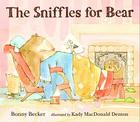
The Sniffles for Bear
by Bonnie Becker -- the latest in her quite good Mouse and Bear books.  Mouse is aggressively cheerful and friendly; Bear is glum and stand-offish.  In this one, Bear dramatizes his cold into being reason to write up a will, and Mouse's glee at being in line to inherit roller skates hastens the process of Bear's recovery.  Mouse then ends up with the cold.

In 
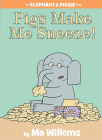
Pigs Make Me Sneeze!
our pal Gerald of the Elephant and Piggie series lets loose a series of sneezes that send pig flying in various directions (she eventually appears on-page with a helmet).  He surmises that he must be allergic to pigs and bids her a sneezy sad farewell.  A feline doctor eventually sets him straight, and he galumphs back to his pal: "Piggie! Piggie! Great news! I HAVE A COLD!"  Which, of course, Piggie has already caught.

We've talked about
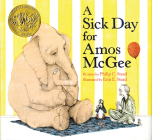
A Sick Day for Amos McGee
by Philip Stead when it won the Caldecott Medal last year.  It's the lovely and gentle story of a zookeeper's animals taking the bus to come see him when he's home sick with a cold. They all understand they have to let him take naps, and they play gently with him.
"I'm too tired to run races today," said Amos to the tortoise.  "Let's play hide-and-seek instead."  
The tortoise hid inside his shell.
Amos hid beneath the covers.
The animals all spend the night, and there's a plan for all to head back to the zoo in the morning.

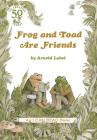
No list of friendship through adversity could be complete without good old Frog and Toad by Arnold Lobel.  An excerpt from
Frog and Toad are Friends
:
One day in summer Frog was not feeling well.
Toad said, "Frog, you are looking quite green."
"But I always look green," said Frog.  "I am a frog."
"Today you look very green even for a frog," said Toad.
"Get into my bed and rest."
So I hope you've been resting up, dear Annie, and are getting better soon.

Love,

Deborah

Thursday, January 26, 2012

Beyond bread and jam

Dear Annie,

Well, the Newbery, Caldecott and a lot of other awards were announced by the American Library Association on Monday, and as usual, I was miles off predicting any of them. 
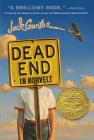
Dead End in Norvelt
by Jack Gantos won the Newbery for best children's literature.  I read half of it back when it was a mere sample copy -- am re-reading now.  Gantos is a really good writer.  I would have been happier if Jefferson's Sons or Okay for Now had won, but this one is an understandable choice.  I was quick on the trigger on ordering, though, and now have two shelves at the store full of almost all the winners and honor books.  Whew.

The categories of ALA awards have proliferated in recent years, one of the more interesting being the Theodor Seuss Geisel Award for books for beginning readers.  In the seven years they've been awarding it, Mo Willems has won two awards and two honors for Elephant and Piggie books.  They're definitely deserving, but happily this year the award went to a book that's definitely a change of pace:
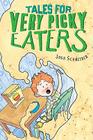
Tales for Very Picky Eaters
by Josh Schneider.
THE TALE OF THE DISGUSTING BROCCOLI
"I can't eat broccoli," said James.  "It's disgusting."
  "Maybe there's something else you can eat," suggested James's father.
  "What else is there?" asked James.
  "Well, we have dirt.  We have the finest dirt available at this time of the year, imported from the best dirt ranches in the country.
  "This dirt has been walked on by the most skilled chefs wearing the finest French boots.  
  "It has been mixed by specially trained earthworms, and it is served on your very own floor."
  "Ugh," said James.
Dad goes on to offer pre-chewed chewing gum and a sweaty sock worn by a runner "who was fed nothing but apples and cinnamon for three months before running a marathon in this very sock."  The broccoli wins. 

When James rejects mushroom lasagna, his father tells him about the hard-working troll in the basement hired especially to make mushroom lasagna.  The troll is green with fangs and wears an apron saying "Kiss the Cook." James' ubiquitous basset hound quietly sniffs the heat vent coming up from the basement.

The book has five short chapters -- my favorite is The Tale of the Lumpy Oatmeal, rejected for its lumpiness.  The oatmeal, Dad explains, regenerates every day, so that if one doesn't eat it, it gets bigger and bigger and starts eating the desserts around the house.  And because Growing Oatmeal, which now looks like The Blob, isn't a picky eater, he could spell trouble for James's dog.  The dog looks pathetically at James.  He asks for -- and gets -- another bowl of oatmeal "with fewer lumps."

The Tales are (mostly) wacky and charming with good illustrations.  The one on Repulsive Milk is a bit too preachy (builds strong bones).  The last chapter, on Slimy Eggs, turns the tables a bit and has a satisfying ending.  I know, I know: you're thinking, "Slimy eggs!  We've been there before!"  A year and a half ago you wrote about Eleanor's take-away message from Bread and Jam for Frances (the Ur-picky eater book) being to demand bread and jam all the time.  And Frances' b&j habit started with her facing down a plate of slimy eggs.  So I don't know if you want to introduce this one to your home, but its flights of fancy are definitely a hoot.

Love,

Deborah


Monday, January 23, 2012

Storytelling and dragons

Dear Aunt Debbie,

I love Atinuke -- we read Anna Hibiscus' Song on repeat this weekend -- and look forward to her new series.  The video makes me think about storytellers we used to see perform when I was a kid: dramatic, hold the room in the palm of your hand performers who could stretch a story out in the best possible way.

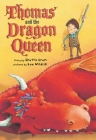
Tonight I'm returning to dragons in the company of a storyteller: Shutta Crum, the author of Thomas and the Dragon Queen.  I mentioned this book briefly post-Christmas: a gift for Eleanor from my father-in-law, who somehow found a book containing both a Princess Eleanor and a baby sister named Isabel.  Perfection!

Eleanor adored Thomas -- we sped through the chapters, which are nice and short, punctuated with illustrations by Lee Wildish.  There's a lot to like in the book: an appealing hero, an episodic adventure, accurate medieval detail about arms and armor, dragons and other monsters, female characters with the names of the children in my family.  In terms of structure and tone, however, it's an uneven read.

Holly wrote so well last week about adult vs. child expectations of a narrative: as grownups reading to our kids, we want to pick books that are the right level of scary and suspenseful, not too dark just yet, but exciting.  We know that the heroes and heroines of children's books will be okay; we know what to expect.  Or do we?

Thomas and the Dragon Queen does not seem like a dark book.  Early on, you get to know not only small, unprepossessing Thomas, but also his small, unprepossessing friend Jon, who works in the stables, and the king's great horse, Heartwind, and the good old reliable donkey, Bartholomew.  It is love for these animals that introduces Princess Eleanor to the plot: she comes to the stables to feed Heartwind and Bartholomew in secret.  Towards the end, the dragon queen, Bridgoltha, is revealed to be the mother of twelve baby dragons, who has kidnapped Princess Eleanor to be their nursemaid.  All the dragons can talk (one of them in a mildly annoying cutesy way), and things with Bridgoltha are worked out via diplomacy and bargaining rather than violence.  This seems like one kind of book.

And yet.  The story takes place in a kingdom under siege: though it's never fully explained who is attacking and why, all of the able-bodied men of the kingdom are fighting at its borders.  Thomas only becomes a squire, and then a knight, because there aren't many adults around.  The king knights Thomas, then feels guilty about it and follows him in his quest to rescue Princess Eleanor; on the way, both parties fight a giant swamp monster with tentacles and many mouths.  Thomas defeats him, in a cool and complicated plot twist.  When he awakes, he finds out from Jon that when the king's party was attacked, everybody but the king and Jon died.  Including Heartwind.  Reading this aloud to Eleanor, I was taken aback -- what kind of story is this?  But no time to dwell on the deaths: in the next section, Thomas has to get across a body of water to Bridgoltha's island, and there is a several page long episode in which he rescues a baby dolphin from a bunch of floating debris.  A baby dolphin?  After you just killed off Heartwind?  Tonally, it's odd.

When I read in the author bio that Crum is a professional storyteller, among other things, I wondered whether part of what I was responding to in the book was the episodic nature of oral storytelling.  You don't tell a novel -- you tell sections, stories, tales.  Perhaps I should think about Thomas and the Dragon Queen in that light, as a group of linked short stories.  None of this seemed to cause any narrative dissonance for Eleanor.  As a parent, however, I know what to expect from a narrative, and I want to trust the narrator who's leading me and my child through the forest. 

Love, Annie

Sunday, January 22, 2012

Village life

Dear Annie,

Thanks to Holly for her How to Train Your Dragon guest entry.  It's a fun series, and plays into my prejudice that British writers are often just better with language.  Even when they're talking about dragon snot.

Today, though, I'm going in another direction.
On the continent of Africa, you will find my country.  In my country there are many cities, all with skyscrapers, hotels, offices.  There are also many smaller towns, all with tap water and electricity and television.  Then there is my village, where we only talk about such things.
Atinuke, author of the wonderful Anna Hibiscus books (see here, here and here) is introducing us to new territory.  She has said she wrote about Anna Hibiscus because when she moved from Nigeria to England, she met too many people who thought all Africans lived in mud huts in lion-infested jungles.  Anna Hibiscus is a middle class girl in a large, prosperous urban family -- Atinuke wanted to bring the reality of her own African life to children elsewhere.

She's started a new series, The No. 1 Car Spotter.  It's set in a village that makes me think of your brother's Peace Corps time in Mauritania.  Most of the men of the village have gone to cities to find work, leaving mothers, children and grandparents to raise crops and get them to market. The boy narrator's full name is Oluwalase Babatunde Benson, "but everybody calls me No. 1.  The No. 1." The superlative stands for his prowess at spotting and identifying cars:
  Who can help spotting cars when the road runs directly past the village?  It is what we men do.
  Grandfather, sitting under the iroko tree in the center of the village, shouts, "Firebird!"
  Uncle Go-easy, waist-deep in the river, pulling in his nets, shouts, "Peugeot 505!"
  Tuesday and Emergency, clearing the bush for a new field, hear an engine and shout, "Mercedes 914!"
  Coca-Cola and I, high in the palm trees collecting nuts, shout, "Aston Martin DB5!"
(Kind of makes one think of my car-obsessed brother, your Uncle Al, who would be right at home with these guys.)  The stories are about No. 1's little community and how they use the few resources they have  imaginatively.  A junked car is converted into a cattle-drawn wagon when the town's only wooden wagon falls apart.  Wheelbarrows given by the NGO man "to improve life in the village" end up in the city where No. 1's father uses them for a delivery business -- and the earnings from the business bring happy changes to the village. 

Atinuke's language is always so lovely to read -- and her story-telling turns out (not surprisingly) to be wonderfully high-energy.  Here's the beginning of the book, story-teller style:

Love,

Deborah

Friday, January 20, 2012

Guest blogger: Adventure and peril in early chapter books

Dear Aunt Debbie,

It was an unexpected pleasure to read Grandpa's letter on trains.  Made me miss him all over again.  Thank you.

Classes end for the semester on Monday, so although I'll still be knee-deep in grading during finals week, I'll be back to blogging then.  Here's our last guest blogger for this round: my good friend Holly, mom of Eleanor's friend Ian, who has written for us before about outer space and map books:

I’ve just finished The Hunger Games, and it is no great testament to my cleverness to say that from the beginning I had high expectations that the heroine would survive, despite seemingly insurmountable odds to the contrary. However, for Ian, who is four and a half, reading books where a beloved character is in peril usually brings tears and certainty that they will die, despite all our best arguments and assurances. It reminds me of Eleanor worrying that the bad guy would win at the end of the Muppet Movie. How cool to be so new at all this that you really don’t know how it all turns out!

Maybe it sounds a bit cruel that I inflict this kind of suspense on my sensitive boy, but believe me he loves nothing better than a good swordfight. Also, if I have to read one more Beverly Cleary book, I’ll cry.

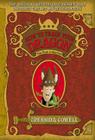
One of the first chapter books where we drag Ian onward a bit was How to Train Your Dragon, by Cressida Cowell. The antihero, Hiccup, heir to the Viking Hooligan tribe, and his hapless friend Fishlegs, manage to be in danger of certain death on every page. The following is typical:

“I mean,” continued Fishlegs, “so far today we have narrowly escaped being 1. Torn to pieces by Skullions. 2. Eaten by Cannibal Outcasts. 3. Burned to death on board ship. 4. Drowned at the bottom of the ocean. … And now here we are, trapped in an inaccessible underground cavern facing DEATH BY SLOW STARVATION. … It’s just been a REALLY BAD day.”

Throughout the eight (yes, even the existence of sequels fails to reassure Ian) books they encounter dragons and villians each more [superlative] than the last. I was almost dissuaded from reading them by opening randomly to a page involving a character named SnotFaced Snotlout. There is a bit of gross out going on but the stories are fast paced, the characters flawed and charming and despite the swords, explosions, dragon fire, daring escapes and narrowly averted apocalypses no lives are lost (except one dragon -- I admit we edited that a bit).

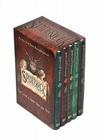
The other series with great illustrations, fun characters and constant danger that we sailed through with Ian is The Spiderwick Chronicles, by Tony DiTerlizzi and Holly Black. Twin brothers and their older sister (who is amazingly cool) discover a Field Guide to the Fantastical World Around You. It opens up a dangerous and exciting world co-existing with our own where goblins, ogres and faeries try to gain control of the powerful book. Carried forward by the beautiful illustrations, we literally read straight through the series in a matter of days, despite one of the main characters being abducted by goblins and hung from a tree, etc. A few goblins do die actually, but I think I skipped that sentence -- kids don’t seem to bothered when bad guys die, but I sort of am. The future of the world is at stake, of course. Luckily, Mallory, the big sister, has a sword and the twins are brave and clever.

And you’ll have to take my word for it, everything turns out ok.

Thank you, Holly!

Love, Annie

Wednesday, January 18, 2012

Guest blogger smiling down on us

Dear Annie,

I took Mark's train post to heart and ordered All Aboard ABC for the store. Thanks, Mark!  It sure is an odd mix of grainy stock photos and those hurried train detail shots, some with the little red car that Mark talked about.  Sometimes finding those little oddities and wondering about the photographer with the rented car can give a parent a little something extra when s/he's on the thirtieth reading of "Grade Crossing."

Right around three years old is when a lot of kids get into focused (sometimes obsessive) interests -- and there are lots of books that cater to the big ones.  You Can Name 100 Trucks is one of my favorite titles in that category. Forget about plot, let's just get to the lists.  A lovely combination of 100 train cars, beautiful art, and good writing is Crossing,  this poem by Philip Booth illustrated by Bagram Ibatoulline.  It's many pages of paintings of a 100-car freight train winding through the countryside.  And yes, you can count them with your kids and sure enough, there are 100.  The link is to Alibris -- the book is out of print, alas.

All this thinking about train writing turned my thoughts to my father, your grandpa, who was of course  a writer.  His professional writing was direct mail: letters that sold mostly books.  In 1974, shortly before he left American Heritage, where he had worked for many years, he wrote a letter selling a history of trains.  I thought I'd invite grandpa's ghost to be a guest blogger, because he sure could conjure up a train:
Dear Reader: 

If you're old enough and lucky enough, you can remember lying in bed as a child and hearing, far off, the whistle of a steam locomotive as it pounded through the night. The wail was hoarse, mournful, inimitable. And once upon a time it was a siren song for any youngster. 

You could imagine the engineer, red bandana round his neck, eyes riveted on the gleaming rails ahead, wind-blown and ruddy in the glow from the open fire door. You envied oh, how you envied the impossibly glamorous travelers in the spruce train behind, eating five-course feasts in the spotless dining car, ice tinkling in their wine buckets. Or snug in their berths behind swaying green curtains in the long Pullmans, each car lettered with its name. "Someday," you told yourself, "Someday..." It was magic. 

Someday, lackaday. Such high-style overland travel is almost gone, as someone has said, with the wind. But as all of us who remember can tell all of us who were a bit too young, railroads were once magic carpets for Americans. The miraculous iron horse changed our modes of life more radically than any mechanical device before or since, from steel plows to airplanes.
The rest of the letter is here.  Dad would get a kick out of knowing two 21st century three year-old boys who care a lot about trains.

Love,

Deborah