In which Annie (high school teacher, mother of two young girls and a younger boy) and her aunt Deborah (children's bookseller, mother of two young women in their 20s) discuss children's books and come up with annotated lists.

Sunday, September 11, 2011

Good authors, more good books

Dear Annie,

Such good choices of books about school!  I would add two to your list -- one from each author you mention:

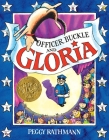
Officer Buckle and Gloria
by Peggy Rathman is a hilarious send-up of boring elementary school assemblies.  Officer Buckle speaks to kids on safety tips and puts them to sleep with his delivery. One day he brings along Gloria, a dog who has wandered into the police station.  Gloria is a natural ham, acting out the oblivioius Officer Buckle's safety tips behind his back.  "Never leave a thumbtack where you might sit on it," inspires Gloria to jump in the air with a pained expression on her face.  The audience loves her, and Officer Buckle becomes hugely popular.  He discovers what she's been doing when a news crew does a story on them. "Do not go swimming during electrical storms," he says, while Gloria fluffs her fur in a shocked-looking way and the kids cheer.  Officer Buckle is hurt and offended and stops his speaking tours.  All comes out right in the end, with the two remaining fast friends.

I tend to discourage this one as a book for pre-schoolers because knowing what an assembly is makes it so much funnier.  But it's a good laugh for anyone.


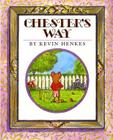
Chester's Way
, by Kevin Henkes, isn't a school story, but it's the book that introduces the indomitable Lilly. Chester and Wilson have a very quiet friendship filled with charmingly rigid habits.  It makes them both happy, in a quiet sort of way.  Then the flamboyant Lilly moves into the neighborhood.  They can't handle her at all, until her over-the-top behavior scares some bullies away from the quiet boys.  They all become fast friends:
She goes on to the plastic purse, which may be her best moment, and Lilly's Big Day, which disappointingly emphasizes her overbearingness and leaves out her conscience.  And of course good old Lilly is the big sister in Julius the Baby of the World.

Both these authors put lots of thought, skill and humor into all the illustrations, offering new discoveries on many re-readings.  A delight.

All this talk of school somehow has made my mind wander to math.  Will post on two good stories about math next time.

Love,

Deborah

Friday, September 9, 2011

School books

Dear Aunt Debbie,

Perhaps I'm looking in the wrong direction by asking about first day of school books which depict school as something to look forward to rather than to fear.  As you say about community involvement in your post about The Concrete Lorry, maybe the idea that school is a positive thing is best absorbed through a good story.

Two good school stories we've been rereading lately come from authors we've written about regularly: Peggy Rathmann (Good Night, Gorilla; 10 Minutes Till Bedtime), and Kevin Henkes (Julius, the Baby of the World, Kitten's First Full Moon, A Good Day).

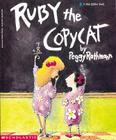
From Rathmann: Ruby the Copycat.  Ruby is a new girl in Miss Hart's class, with Rathmann's trademark fuzzy hair and lit-up face (see the unspecifically gendered child in 10 Minutes Till Bedtime.  Or the gorilla.).

The book covers Ruby's first week of class.  She's seated behind Angela, "the girl with the pretty red bow in her hair," and is so entranced by her that Ruby can't help but copy everything Angela does: she goes home for lunch and returns with a bow in her own hair, tells the class that she, too, was just flower girl at her sister's wedding, and essentially plagiarizes a poem that Angela writes.  Angela is at first flattered, but becomes increasingly upset by Ruby's attention.  Miss Hart gently intervenes, and after a little backsliding, Ruby is encouraged to claim her own interests and act like herself.  School is the social environment where all of this plays out, and the influence of peers is clear.  Miss Hart is a warm and accepting presence, who ultimately helps Ruby shine in the eyes of her classmates.  Eleanor is very much into the social dynamics of the story, and Isabel loves to point out the pictures of cats on the wall.

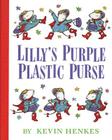
From Henkes: Lilly's Purple Plastic Purse.  We've mentioned Lilly before, but have not yet given this book its due.  Lilly, who appears in several other books as well, is a confident, outspoken, dramatic child (well, mouse).  She begins this story in deep adoration of her teacher, Mr. Slinger, who does seem pretty cool:

Mr. Slinger was as sharp as a tack.
He wore artistic shirts.
He wore glasses on a chain around his neack.
And he wore a different colored tie for each day of the week.
Instead of "Greetings, students"
or "Good morning, pupils," 
Mr. Slinger winked and said, "Howdy!"

For a while, inspired by his coolness and the rainbow-striped shirt Mr. Slinger wears in one illustration, I thought Henkes was subtly indicating that Lilly's favorite teacher is gay.  I was wrong: in Lilly's Big Day, he marries a female teacher at the school, and Lilly lobbies hard to be their flower girl.  (I'll admit, I was a little disappointed.)

Lilly gets a new, awesome purple plastic purse, shiny jingly quarters, and sparkly sunglasses one weekend, and brings them in to school to show off.  She can't keep quiet about them, and Mr. Slinger confiscates them until the end of the day.  Lilly is furious, and draws a mean picture of Mr. Slinger, sneaking it into his bag at the end of the day.  Of course, he leaves her a very sweet note in her returned purse, and she feels TERRIBLE. This is why it's a good book to help discuss guilt over doing something which hurts someone else's feelings.  Lilly apologizes, and draws a new picture.  Her mom writes Mr. Slinger a letter, and her dad bakes cheese balls to bring in. All is forgiven, but the feelings are deeply felt.

School here is exciting, social, and full of learning.  It's Lilly's main focus throughout the book: the first sentence is "Lilly loved school."  All the adults, teacher and parents, are understanding but firm -- no one makes excuses for Lilly, and they help her make amends.  Henkes also has a nice comic-book-like way of drawing some of the pages, with multiple images and lots of little throwaway dialogue lines or captions in the pictures.  It's a fun book to peruse -- way too long for Isabel to sit through at the moment, but one of Eleanor's favorites.

So it's back to school for us all!

Love, Annie

Wednesday, September 7, 2011

Community in action

Dear Annie,

Here we are, back to school once again.  Mona flew off to her junior year in college today; Lizzie's already in her second week of classes.  Eleanor's in a new pre-school.  And you must be in full swing at Stuyvesant. 

I've had a nice little reminder of the store's connection to its community in the past week.  Our local  middle school assigned a book on the first day which I was able to order quickly.  Someone posted on a school listserv that we had it, and we've had a parade of folks coming in to buy it.  It's very satisfying to have that connection to a nearby school and its parents.

So I've been thinking about community and neighbors, and yet another Shirley Hughes book seems appropriate here.  Four of them, actually, collected into Tales of Trotter Street, currently out of print, alas.  Each story focuses on a different family living on the same block, but members of the other families have minor parts.  I've written about one of them, Angel Mae, which is both a Christmas book, and (since you asked) the only book that pops into my head which presents school as part of life, rather than an anxiety-provoking task.

The Trotter Street Tale that was read and re-read in our house was The Big Concrete Lorry.  It's about the five-person Patterson family, who decide to add a room onto their house rather than move to a bigger house away from Trotter Street.  They shop for plans, buy supplies, and, with the neighbors' help, dig a foundation.  The next day, when they're still recovering from all the digging, the Jiffy Ready-Mix Concrete Co. lorry appears:
Out jumped jolly Joe Best.  "Load of concrete you ordered!" he called cheerfully.
"Not this morning, surely?" said Mum.  "I'm sure we didn't. . . "
But it was too late.  Jimmy had already pulled a lever and the big drum poured out a load of concrete, all in a rush.  Slop!  Slurp! Dollop!  Splosh! Just like that!  It landed in a shivering heap right outside the Pattersons' front door.
The concrete has to make it to the foundation in the back yard of the rowhouse before it sets.  Dad wakes up.  Mum starts wheeling loads through the house, and the kids run for the neighbors:


Everyone runs to help, there's a frenzied paragraph of "labouring and struggling," and the concrete gets moved.  A small hill remains on the front sidewalk: "it was great for sitting on and racing cars down.  And if you climbed up and stood on the top, you could see right to the very end of Trotter Street!"

So here's to neighbors and helping each other out: one of those lessons best absorbed in the context of a good story.

Love,

Deborah

Monday, September 5, 2011

Odd Couples

Dear Aunt Debbie,

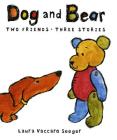
One of the books we came back with from Maine has gotten me thinking about odd couples: children's books with pairs of characters in them who complement, enjoy, and sometimes enrage each other.  We've written about several of them before: Frog and Toad, George and Martha, Elephant and Piggie.  The Dog and Bear books, by Laura Vaccaro Seeger, fall firmly into this category.


Dog is a somewhat manipulative dachshund, and Bear is a good-natured stuffed animal who he hangs out with.  There's no sense of the two of them living with any people -- they're just on their own, hanging out.

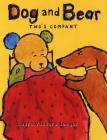
The book you gave us is the second volume of the Dog and Bear series: Dog and Bear: Two's Company.  Each book contains three stories, and the first one in this volume establishes character immediately:

"I am very angry with you, Bear.  I am running away."
"All right, Dog.  Go ahead."
"I am packing my bones."
"You do that."
"I am packing my sticks."
"Of course you are," said Bear.
"I am packing all my toys."
"Don't forget this one," said Bear.

Throughout, Bear gazes at Dog with a slightly woeful expression.  He lets Dog pack up and head for the door, then quietly invites him back for ice cream.  All is resolved.

I like the fact that there's no explanation of why Dog was mad at Bear in the first place.  As in Spinky Sulks (though on a far less intense level), we're thrust into the action mid-argument.  Both of my girls responded to the characters immediately.

So here's a question: Eleanor is starting a new school this week, and I've glanced at a few "first day of school" type books at the library to see if they'd be worth picking up.  All of them that I've seen, however, start from the assumption that the first day of school is something to be feared.  This isn't how Eleanor feels, and I don't want to give her the idea that school is something she should be worried about, so I've largely avoided them.  Do you have any favorite first day of school books that don't have that tone?

Love, Annie

Sunday, September 4, 2011

More Magic

Dear Annie,

I wanted to react to a couple of things that have dashed by in recent weeks.  I suspect you've finished Half Magic by now -- I'm so glad you all enjoyed it.  There are six more books in Edward Eager's Tales of Magic, written from 1954 to 1962, and in all he acknowledges his reverence for/debt to the writing of E. Nesbit (yes, yes - we have to write about her!).

I loved your quote from the talking cat chapter, but I still haven't figured out what "Idlwidl bixbax. Grompaw.  Fooz!" mean.  There's one more book about Martha, Jane, Mark, and Katharine,
Magic by the Lake
. In one scene, the children are lost in a sort of magic fog on a desert island and are rescued by another group of children who seem to be in the same magic. Two of the other books -- Knight's Castle and The Time Garden -- are about Martha and Katharine's children.  There's a lovely scene in one of them where the cousins go into a sort of magical fog on a desert island and find and rescue another group of children there.  They all go on their separate ways.

Then there's your entry on editing out too-disturbing stuff as one is reading aloud.  It's true, we keep coming back to this.  In an ideal world, we'd all have time to vet books before reading them to kids, but after the picture book stage, that's next to impossible.  And it's so hard to predict what will just go right by a child, and what will be traumatic. 

You talked about your friend Cyd reading one of the All-of-a-Kind Family books with Rebekah, and her sister writes about the books wonderfully in Even in Australia.  This is not the first time I've felt I should re-visit that series.  A lot of people have a special spot in their hearts for them.  I read the first book once with our girls.  The turn of the last century Lower East Side is very well portrayed.  I remember liking some of it, but recoiling at some of the heavier gender stereotypes.  There was a chapter in which the excitement had to do with a contest among the sisters about who could dust the best/fastest.  And for me the strongest image of the book was of the father crying at the end because he was so thankful he finally had a son.  Heaven knows I've spent plenty of time saying that attitudes about women have changed, but it still was a hard scene to explain to my daughters.  Cyd and/or Rachel, I'll go back and re-read, but feel free to jump in here...

Love,

Deborah


Saturday, September 3, 2011

Selective editing

Dear Aunt Debbie,

Seeing those images from Fireboat of the planes heading toward the towers, I'm not sure if I'M ready to read it with Eleanor yet. Both of the books you write about in depth, though, do seem like good possibilities in the near future.

A propos of this topic, I was talking to my friend Cyd a few days ago about the selective editing we are sometimes tempted to do as parents when reading to our children books which are mostly fabulous but contain one or two highly disturbing moments.  I've written about reading Betsy-Tacy to Eleanor for the first time and eliding the death of Tacy's baby sister (on second reading, we talked about it ahead of time and read it with the full text, and Eleanor seemed totally capable of handling it).

Cyd, mother of three girls, is currently reading the All-of-a-Kind Family series to her eldest, Rebekah.  I remember the series dimly from my own childhood -- it's about a family of five girls living on the Lower East Side at the turn of the century -- but I don't think it made as much of an impression on me as it did on Cyd's family.  (Here's her sister, writing about it on one of our favorite blogs, Even in Australia.)

When the mother of a boy in one of the later books gets sick and is in the hospital, Rebekah got terribly worried about her, and asked about her welfare every night when Cyd sat down again with the book: "Is she going to be okay?  Will she get well?"  In Sydney Taylor's text, the mother dies, and the family goes to live with their social worker.  Cyd felt that this would crush Rebekah, talked it over with her husband, and had the mom get well and go to live with the social worker with the rest of the family.

As we talked, Cyd and I both felt mixed about this -- when is it time to reveal the harsh truths  that are part of life, and when is it still time to protect your child from what she will inevitably learn later?

I feel like this is a question we keep coming back to, and that there's no one good answer.

Love, Annie

Thursday, September 1, 2011

9/11 books for young children

Dear Annie,

It's lovely seeing you as a co-blogger in the New York Times today, writing about responding to 9/11 with your high school students.  I'm sorry I've never seen with their eyes performed, although one of the best meetings of Lizzie's and my mother-daughter book group was when you came to talk about it.

Last week, you brought up the issue of talking about 9/11 with Eleanor, who's four and a half, and asked about a Huffington Post list of kids' and YA books on the subject.  I'm familiar with most of them -- they cover a wide age range.  I was surprised the list didn't include Art Spiegelman's In the Shadow of No Towers for teens, or Mordecai Gerstein's The Man Who Walked Between the Towers (I know, it's about the beginning of the towers, not their end, but it still belongs).  Two of the youngest books on that list are particularly interesting.

I really like Maira Kalman's
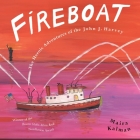
Fireboat: The Heroic Adventures of the John J. Harvey
, but it would be a very hard one to read with most young children.  I wonder if it would work for you and Eleanor, given that she's aware of what happened.  The book tells the story of a Depression-era New York City fireboat which was decommissioned in 1995 and bought by a group of friends who lovingly restored it ("They repaired the 2 propellers ... They repaired the holes with steel plates... They scraped barnacles...").

Then there's one page that's all black, with white lettering:

But then on September 11, 2011 something so huge and horrible happened that the whole world shook....

[detail of a two-page spread]
 Two airplanes crashed into the Twin Towers.
CRASHED, CRASHED, CRASHED into these two strong buildings.

The sky filled with fire and smoke.
The buildings exploded and fell down to the ground.
Many people were hurt.  Many lives were lost.
After these stunning two-page spreads, the story goes back to the friends who own the John J. Harvey, who rushed to the boat  and volunteered to help.  The lower Manhattan water pipes were badly damaged, and the fireboat ended up pumping river water to the firefighters on land to pour onto the wreckage for four days.  It ends feeling a bit like the plucky little boat that could still help out.

On a completely different note is another book which comes at the events from an oblique angle: 14 Cows for America, by Carmen Agra Deedy.  It's a moving reminder of the powerful feelings generated by the attacks.  The book tells the true story of a young Maasai man who was studying medicine in the U.S. on September 11.  When he returns home to his village in Kenya, he talks about the attacks.  The villagers decide to give the U.S. a gift to express their deep sympathy: 14 cows, highly prized by the Maasai.  The U.S. ambassador eventually comes to the village to accept the gift, and the village says it will keep the herd for the Americans.  It's lovely and moving, a good way to talk about loss and caring.  The final line of the story:
Because there is no nation so powerful it cannot be wounded, nor a people so small that they cannot offer mighty comfort.
Love,

Deborah