In which Annie (high school teacher, mother of two young girls and a younger boy) and her aunt Deborah (children's bookseller, mother of two young women in their 20s) discuss children's books and come up with annotated lists.

Saturday, September 25, 2010

Inanimate objects with personality

Dear Aunt Debbie,

We await the birthday box of books with great anticipation!
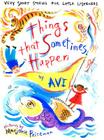
A Flock of Shoes sounds wonderful.  There's something so appealing about giving personalities to inanimate objects.  Yesterday afternoon, Eleanor and I were having ice cream cones in the playground (and giving the eager Isabel licks from a spoon), and I was reminded of one of your gifts to us: the book Things That Sometimes Happen: Very Short Stories for Little Listeners, by Avi, with illustrations by Marjorie Priceman.

There are a lot of wonderful things about this book: the nine very short stories with simple, imaginative, funny plots; Priceman's vivid, sweeping gouache paintings.  There are animals (a hippopotamus who wants to buy a new car), and people (a little boy who makes himself small so he can run between the raindrops to get his mother some bread from the store), and there are some wonderful inanimate objects, each of which wants nothing more than to be of use.

In "The Story of the Glass of Water and the Elephant," the Glass of Water complains about having no one to drink him: "'I do wish,' the Glass of Water said to himself, 'I do wish somebody would drink me.  A Glass of Water needs to have somebody to drink the water or it is no good.'"  Happily, the Glass of Water meets a thirsty Elephant, and it all works out.

"The Black Crayon" begins: "A Black Crayon was feeling very unhappy because nobody used him very much.  All the other crayons, the red crayon, the blue crayon, all the different ones, were getting shorter and shorter.  But the Black Crayon was staying very much the same size."


He convinces a Little Girl to draw a picture of the nighttime, with lots of black, and everyone is happy.  The fate of "The Melting Ice Cream Cone" is not as rosy: though he wants to be eaten, he melts while two bears argue over who should take the first lick.  I love the sense in all three stories that everyone just wants to fulfill their role in life.

I can't write about Things That Sometimes Happen without mentioning the story "Going to Work," in which a Little Boy agrees to take his Papa's place at the office when his Papa has to stay home sick with a cold.  The description of an adult workplace is both clearly simplified and totally accurate: "After his Mama had made him a lunch, the Little Boy went to work.  When he got to work, he sat at a desk and said yes and no to a lot of people.  Then he picked up the telephone and spoke to some more people.  Then he looked at some papers.  Every once in a while he had some coffee."  Yep, that's pretty much how it goes some days.

Love, Annie

Wednesday, September 22, 2010

Migrating in style

Dear Annie,

Ah, bedtime reading.  Such a lovely time.  Such a challenge to exhausted parents. We had the luxury of two parents at home at most bedtimes, so we would alternate which parent put which child to bed each night.  Before the days of chapter books, the deal was two picture books, then bed.  That of course led to lots of negotiation.  A reading of Grumpy Bird is considerably shorter than, say, A Baby Sister for Frances.  And two Frances-length books could put off sleep for quite a while.  Once the girls were in chapter book mode, each would have her own bedtime-specific book.  Because we stuck to the policy of parental units alternating nights, each of us would end up reading every other chapter of a lot of books.  Part of our post-child-bedtime conversation would involve briefing each other on what happened in books we were particularly fond of.  What I remember about single-parent nights was starting in Mona's room (she being a year and a half younger) and reading to both of them, then tucking Mona in and continuing upstairs to Lizzie's room.  Definitely harder.

Our box of birthday books left Washington today, heading to you in time for Isabel's birthday.  There are books for both of your girls, of course.  And because today is the first day of fall, I'm going to give you a preview of one of them.  It's
A Flock of Shoes
, by Sarah Tsiang, from the same Canadian publisher that brought us The Paper Bag Princess. 

Abby has wonderful pink and brown flip-flops with lime green trim which she wears very happily all summer long.  As cooler weather approaches, Abby refuses to relinquish them, just adding socks to keep warm.  But one day, as she's swinging high, first one sandal falls off, then the other:

They join a V-formation of summer shoes flying south.  Abby's mom gives her cool boots, but she's slow to bond with them, instead thinking of what her sandals are doing.  There's a postcard with a picture of the flip-flops in beach chairs on the sand: "Thought about your heels today.  We miss you to the bottom of our soles."  Abby finally becomes fond of the boots, but when warm weather comes, they stomp off to a northbound train, just as the sandal population is winging its way north.  Her pair finds her: "They were rested and fat, grown just wide enough for Abby's feet."

I love this book.  Have sent it to both of my daughters in college, and am going to make it the centerpiece of my fall books display.  Hey, leaves can fall any year -- but how often do shoes migrate?

Love,

Deborah

Monday, September 20, 2010

Birthday books and bedtime reading routines

Dear Aunt Debbie,

Oh, how I wish we could get you to open up a bookstore near us!  We're overdue for a DC and Child's Play visit.

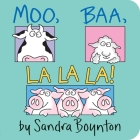
Isabel turns one this coming weekend (I still can't quite believe it -- this year has gone so fast), and I've been putting away books to give her for her birthday.  In addition to the favorites I've mentioned before (Doggies and  Cat top the list), she is currently obsessed with another great Sandra Boynton book:  Moo, Baa, La La La!  She's big on animals and animal noises, and has started referring to most animals, including pigeons, by her dog noise ("Fwoof").

Our pre-bedtime reading ritual has gotten a little more complicated since Isabel started to be just as interested in books as she is in milk.  Eleanor, of course, wants us to read her nice long books.  But as soon as Isabel is done with her bottle, she squirms off my lap, finds one of her board books, picks it up and shoves it at me.  Often, one of us will read Doggies again for the umpteenth time while the other finishes Eleanor's current library book.  On nights when Jeff works late, however, I find myself doing double duty: pausing in the middle of a dramatic scene to direct a "Moo" or a "Woof" at a delighted Isabel.

I remember that your girls had an elaborate routine that involved each having her own book read by a parent, plus having a common book you all read together -- am I getting that right?  I'm starting to wonder how old my girls will have to be before we can all read the same book together and all get real enjoyment out of it.  Not to say that I'm not enjoying this stage, too.  I am.

Two books are hidden on my closet shelf right now.  Dog, of course, is a companion book to Cat.  Pretty sure that will be a hit.  The other is a recommendation from my dear friend Cyd: Maisy's Amazing Big Book of Words.  Cyd's oldest daughter, Rebekah, loved her copy to destruction and they had to get another for Rebekah's sister Ellie.

I'm not the biggest fan of the Maisy books in general.  Maisy herself is a fine character -- she's a mouse, and not too girly, and Lucy Cousins's paintings are bright and appealing.  I like the way she outlines everything in black, making it feel at once childlike and sturdy.  Truth is, though, they're kind of boring.  Maisy does things -- goes to the hospital, bakes gingerbread, makes Valentines, goes to preschool, celebrates pretty much any holiday you can think of -- and nothing very interesting happens, and everyone is fine.  Okay.  Eleanor really likes them, of course, but they are difficult to reread.

Maisy's Amazing Big Book of Words, however, is pretty awesome.  It capitalizes on what Cousins does best, in page after page of bold drawings and words, without being hampered by a plot.  Each 2-page spread has a picture of Maisy doing something on the left (playing the piano, driving a police car, watering plants), often with a lift-the-flap piece, and a series of illustrations of thematically-linked words on the right.  For "Rainy Days," the words are "frog, lightning, ducklings, umbrella, boots, worm, puddle, snail."  There's a page on dress-up, a page on fish in the sea, a page on noisy things, etc.  I'm looking forward to obsessive reading on the part of both girls.  Let's hope I'm right!

Love, Annie

Sunday, September 19, 2010

Reading about the family compound

Dear Annie,

Today I sent off tens of thousands of dollars' worth of orders for kids' books for a new store that we'll be opening in a few weeks in Virginia.  It's so much fun to go through lists of all the books our current stores have sold recently and try to shape a new book section based on books I like.  One of the joys of the job.

Another joy is finding, in the midst of many many sample books, a gem of a new book.  This weekend I discovered Anna Hibiscus, by a Nigerian-born storyteller named Atinuke. (She currently lives in Wales.)  It's an early chapter book with a lovely lilting tone about a girl who lives in an unnamed African city.  Her extended family lives in a compound where the grandparents are revered, where most of the grown-ups have cellphones and commute to their jobs, and where a young child faces universal challenges figuring out what the world is like. 

Anna's father grew up in this family; Anna's mother is from Canada.
    One day, Anna's mother told the family that in Canada she grew up in a house with only her mother and her father.
   "What?" cried Auntie Grace.  "All alone?  Only the three of you?"
   "Yes, and I had a room all of my own," Anna's mother said wistfully.
   Anna's grandmother looked at her.  "Dey make you sleep alone?" she asked.
   "It was not a punishment," Anna's mother said.  "It was a good thing to have my own room."
   Anna Hibiscus and her cousins looked at each other.  Imagine!  Sleeping alone.  Alone in the dark!
   "Nobody likes to sleep alone," said Anna's grandmother.
   Anna Hibiscus laid her warm brown cheek on her mother's white arm.  "Don't worry, Mama," she said.  "You have all of us now.  You will never be alone again."
Anna's mother yearns for a little more solitude, so the nuclear family of Anna's parents, Anna, and her twin baby brothers goes off to the seaside by themselves.  Chaos ensues, and slowly relatives from the city compound arrive to lighten the load and cheer everyone up.

In another chapter, Auntie Comfort is coming to visit from America.  The family worries that she has forgotten the African ways, so with the help of her Uncle Tunde, Anna sneaks off to send some text messages to America.  Comfort arrives satisfyingly African:
Although the question of what is African is debatable:
   "Welcome, Comfort!" Grandfather said.
   "Thank you, Father," Auntie Comfort replied.  "But I am now called Yemisi."
   "Why?" said Grandmother.  "What is wrong with Comfort?"
   "I wanted to have an African name, Mama," said Auntie Comfort.
   The aunties started to laugh.
   "Comfort is an African name," said Grandmother.
   "But it is an English word, Mama," said Auntie Comfort.
   "It is an English word, but an African name," said Grandfather.  "Have you ever heard of any English person being called Comfort?  Come, enough of this.  Let us eat."
The gentle sense of humor reminds me a bit of Alexander McCall Smith's No. 1 Ladies' Detective Agency books, done for the under-eight crowd.  (Smith has a lovely early chapter book series set in a wildlife sanctuary in Africa, but I'll save that one for another day.)  Several of the stories  have Anna wanting to push the boundaries of behavior (I won't fix my hair, I want to sell oranges on the street) and while the parental generation tries to stop her, the grandparents let her go ahead, and take the consequences.  The lesson learned in the orange chapter has to do with understanding that she is a child of a prosperous family and other children must work hard to live.

So far there are two Anna Hibiscus books out in the U.S.  It wouldn't surprise me to see more. 

Love,

Deborah

Friday, September 17, 2010

YA mystery and autism

Dear Aunt Debbie,

So many of my students are obsessed with manga -- I really need to read a few sometime soon.  Perhaps I'll ask them for recommendations.

Your mention of autism brings to mind at once Mark Haddon's YA novel The Curious Incident of the Dog in the Night-Time.  It's a mystery/coming-of-age/parental difficulties story, narrated by an autistic teenager named Christopher.  The narration is compelling, and is, I think, the reason this book got so much good press when it came out a few years ago.  Christopher's voice is extremely rational, and he notices everything about his surroundings without being able to understand the emotional resonances around him.  He's extremely smart, and the book is filled with mathematical digressions and simple diagrams, but he can't tell what other people are feeling, and has difficulty feeling emotion himself.  Even when describing himself at moments when he shuts down, Christopher is rational:

The policeman said, "I am going to ask you once again...."
I rolled back onto the lawn and pressed my forehead to the ground again and made the noise that Father calls groaning.  I make this noise when there is too much information coming into my head from the outside world.  It is like when you are upset and you hold the radio against your ear and you tune it halfway between stations so that all you get is white noise and then you turn the volume right up so that this is all you can hear and then you know you are safe because you cannot hear anything else.

The narration encourages the reader to make connections Christopher does not, which is satisfying, and also feels like a realistic depiction of what it might be like to be autistic.  I didn't feel passionately in love with it when I first read it, but it's certainly an interesting book.

Love, Annie

Wednesday, September 15, 2010

Manga & autism

Dear Annie,

Book Blogger Appreciation Week keeps being interesting.  We received a comment two posts ago from Sam of Sam and Boo Book Reviews, who I suspect found us through BBAW, which she's been participating in.  Sam is the mother of Boo, a book-loving toddler on the autism spectrum.  In addition to the fact that Sam shares our taste in Blogspot templates, she cares very deeply about both parent and child enjoying reading.  At the end of her book reviews, Sam adds a paragraph on how the book can be useful with autistic kids.

I don't have a lot of experience with autistic kids, although I'm constantly impressed with their parents' understanding and resourcefulness.  One book that taught me a lot about raising an autistic child, to get back to one of our threads, is a graphic novel:
With the Light: Raising an Autistic Child
, by Keiko Tobe. It's a serialized story that Tobe started writing in Japan in 2000, and it's still going.  It follows one family from the birth of their first child, Hikaru, through his diagnosis of autism, then through his childhood. In the U.S. Volume 7 has just been published, in which Hikaru is a young teenager.  In the first book, Hikaru's different behavior from other babies creates tensions within his parents' marriage, exacerbated by a mother-in-law who feels the mom is doing something wrong.  When they finally figure out he's autistic, the father can't handle it and leaves, but he later returns and remains an involved parent through Hikaru's childhood.  As the parents learn more about Hikaru, the reader is educated also.  There's the search for a good school and teacher, the heartbreak of the good teacher leaving, the many challenges of everyday life.

It's basically a soap opera with very interesting content.  It's still manga, with those big-eyed women and gender roles which occasionally make me cringe.  The books available in the U.S. are huge -- several inches thick.  They're collections of the small comic books which were published serially in Japan, so one has to adjust to a certain amount of repetition.  And they're manga,  reading from the right side to the left.  This is one of those summarizing pages: start at the upper right corner of the page on the right:


 It's not a kids' book, although I suspect some teenagers would find it interesting.  A former colleague of mine from the store has a son who is on the autism spectrum.  She really liked With the Light because she felt it was a very accessible way to educate her friends and extended family about autism.  And that's often why parents of autistic kids buy it: to give to people they care about.

In the past few years, there have been several quite good novels with autistic characters for middle grade and teenage readers.  Another time, I'll go there.

Love,

Deborah

Monday, September 13, 2010

Graphic novel as first-person historical text

Dear Aunt Debbie,

The Man Who Walked Between the Towers: yet another book I need to check out.  And perhaps a good way to introduce the subject of September 11th to my kids, before they're old enough for me to have the real conversation about it, and eventually explain where their parents were on that day.

Before we leave the subject of the graphic novel, I wanted to mention one more that I adore: Persepolis: The Story of a Childhood, by Marjane Satrapi.  Satrapi was born in Iran, and Persepolis is a memoir: the story of her childhood and early teenage years during the upheaval of the Islamic Revolution.  Iranian history is complex, but Satrapi's child's-eye view of the revolution and the societal repression that followed is crystal clear.  She is an engaging narrator: an irrepressible, funny, angry kid encouraged by her politically active and liberal family to be herself at home, then forced to hide her individuality as much as possible in public.  It opens with an image of Satrapi, age 10, wearing a veil over her hair, followed by an image of a group of schoolgirls during recess, playing with the veils which they have just been forced to wear.  The book is drawn entirely in black and white, a stark, effective way to communicate the story.  As Iranian society becomes more repressive and dangerous, Satrapi's parents decide to send her away to school in Vienna -- this is where book one ends.  The sequel,  Persepolis 2: The Story of a Return, details Satrapi's studies, depression, and romantic relationships, both in Vienna and back in Iran, where she returns as a young woman.  It's a fascinating read.

On a completely different note, I want to mention that it is now Book Blogger Appreciation Week.  Their site lists some fabulous blogs -- I highly recommend checking them out as a resource.  Our readers may remember that we entered ourselves in the awards category for Best Kidlit Blog.  We made it past the first round of voting, but sadly not into the final round.  Still, the competition introduced me to what has become one of my favorite kidlit blogs: Playing by the Book (we've linked to it in our sidebar as well).

It's written by an amazing, creative mom of two young girls who not only reads great books with her kids, but also does intense art projects.  Three of my favorites:

Fishing for Words
Stories in Tune: The Firebird Part I and Part II
Going to the Library

Such inspiration!

Love, Annie