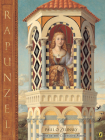
In which Annie (high school teacher, mother of two young girls and a younger boy) and her aunt Deborah (children's bookseller, mother of two young women in their 20s) discuss children's books and come up with annotated lists.

Monday, August 9, 2010

Motherless children

Dear Aunt Debbie,

I agree with you, Bettelheim, and Kathryne that there are good reasons to read fairy tales to kids: they're a way of working through fears safely, they're exciting, and they are referenced throughout our culture.  I think the age at which you read them to a child, and the versions you read, has to be specific to the child -- you learn by reading what's going to scare the pants off your kid, and what she or he will adore.  I agree with Rachel as well that I'm not thrilled with a lot of the motherlessness in these stories, but I think I understand why it's there.

When we started reading fairy tales to Eleanor (and we were certainly spurred to do this earlier than I might have by the ubiquity of Disney princess stuff), she went through a brief period of time when she'd say to me, "I want a stepmother."  She said it thoughtfully, not in anger.  Perhaps, in her mind, having a stepmother was a way into the fairy tale world, since so many princesses (Cinderella, Snow White, Ariel, Belle) begin their stories motherless.  In a way, it reaffirms the power and safety of having a mother: if any of these princesses had mothers around, none of the bad stuff (and none of the adventure) would have happened to them in the first place.  When I explained that telling me she wanted a stepmother hurt my feelings, she began to lean over to me fondly at odd moments and say, "Oh, Mommy, I love you.  And I don't want a stepmother."

Rachel's comment brought to mind two of my favorite chapter books from my elementary school years.  In each, the protagonist(s) are orphaned, thus opening their lives up for adventure that wouldn't be possible if they had a mother and father taking care of them.  I haven't read either book in years, but I'm pretty sure they stand the test of time.
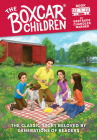
The Boxcar Children, by Gertrude Chandler Warner, focuses on a family of four kids who are orphaned.  They run away from their orphanage and a grandfather they think is cruel (though of course ultimately they're wrong) and live in an abandoned boxcar with their dog, Watch.  I remember scenes of homemaking in the boxcar, and the sense of having to create a whole new life.  In looking it up, I see that it was the first in a giant series, though I don't remember reading any of the others.


A Little Princess
is by Frances Hodgson Burnett, of Secret Garden fame.  Sara Crewe begins motherless, and is orphaned when her father dies in India (the book was first published in 1904, so it's quite Imperial British Empire).  She goes from being one of the richest pupils at a boarding school run by a meanie to being the poorest, and in a Cinderella turn she has to do the school's housework and live in the attic.  Again, one of the things I remember most fondly about the book is Sara making her attic space livable and even homey.  This one has the added benefit of cruel boarding school girls, which resonates with anyone who's ever been a girl around other girls. 

Now that I think about it, in both of these books there isn't much active adventure -- more creating the best and most home-like situation possible in bad circumstances.  I suppose that's true in fairy tales like Cinderella and Rapunzel as well.  Still, there must be something liberating about projecting yourself into the dangerous and adventurous situation, and then comforting about being able to turn again to mom on the couch beside you or in the next room.

Love, Annie

Sunday, August 8, 2010

Fairy Tale Anxieties

Dear Annie,

As you say, fairy tales are elemental and stark.  Primal, one could say.  I think Disney has conditioned us to think of fairy tales as stories for young children, but most of them are adult folktales, or were written for adults originally.  They're also, as Rachel points out in her comment, very woven into our culture, for better or worse.

I tend to subscribe to the general sense of Bruno Bettelheim's analysis of children and fairy tales, summarized well in this article.  The situations and characters in fairy tales, Bettelheim says, reflect thoughts that children have, but don't know how to process. 
Bettelheim argues that what children really gain from these grim and troubling stories of being shoved in a witches oven, having one’s head cut off, or being eaten by a wolf (all not exactly a ball of fun) is the symbolic assurance that all difficulties in life can be mastered with the right attitude and some courage. Folk tale characters experience existential anxieties that are inherent in human nature: the need to be loved, the fear that one is thought worthless (look at poor Jack with his handful of beans!), the value of life and joy, and the ever-present spectre of death.
I've spoken with a number of teachers who read fairy tales to kids in grade school, older than the ages that parents usually turn to these tales.  I often recommend fairy tale collections as gifts for kids who are five, six or seven.  Even though children those ages are able to pay attention to much longer books, the emotional intensity of fairy tales, and the leaps of imagination they entail, appeal to children who are dealing more with how they fit in the world.  They can envision themselves as grappling independently with the world, even if their reality is quite sheltered.

I've never been a fan of the young adult horror genre, but it has a devoted following.  I think the motivations for reading it fit into Bettelheim's analysis: facing one's primal fears, and vicariously vanquishing them.  Again and again.   One gains strength by seeing what it's possible to overcome.

Adam Gopnik wrote an interesting piece on fairy tales in The New Yorker back in 2002 which rambles a bit but discusses both the Bettelheim take on folktales, and a more conservative they-teach-you-good-conservative-values argument. 

Such a rich vein, fairy tales.

Love,

Deborah

Friday, August 6, 2010

The harsh truths told by fairy tales

Dear Aunt Debbie,

Saffy's Angel: clearly another book to put on my library list.  You are turning me into a reader of YA books again.  Just whizzed through Catching Fire, the second book in the Hunger Games trilogy, and am already biting my nails for the third book to be released.  YA fiction can be so intensely gripping.

But YA books aren't the only ones that deal with dark themes.  I mentioned a month ago that we'd been reading Eleanor a gorgeously illustrated version of Rapunzel (retold by Barbara Rogasky, illustrated by Trina Schart Hyman); last week, we bought another Rapunzel, this one retold and illustrated by Paul O. Zelinsky.  Again, it was the illustrations that drew us to the book: Zelinsky's oil paintings have a Renaissance feel, really stunning.  Where Trina Schart Hyman's illustrations are lush and storybook:


Zelinsky's are crisp and dramatic:


Much of the story is the same in both books, including the difficult parts: the parents losing their child to the witch; Rapunzel being locked in the tower, the prince's fall and blinding after the witch catches him.  The main difference between them is the way in which the witch (sorceress, in Zelinsky's version) finds out about the prince.  In Rogasky's telling, Rapunzel is weaving a ladder from pieces of silk the prince brings her, so they can escape together:

     After some time, the ladder was almost finished, and Mother Gothel still knew nothing.  But one day, when Rapunzel had watched the witch make her clumsy climb to the tower room, the girl forgot her secret.
      "Mother Gothel," she said, "how is it that it takes you so long to climb up here when the king's son does it so fast?"
      "Oh, wretched girl!" The witch flew into a rage.  "Wicked, ungrateful child!  I thought I had hidden you from all the world.  I thought I had given you all your heart could desire.  And now you have betrayed me!"

In Zelinsky's retelling, there is no escape plan, and he mentions that Rapunzel and the prince hold a marriage ceremony for themselves on the first night the prince visits.  Time passes, and then: 


     One day when the sorceress entered the tower, Rapunzel said, "If you please, Stepmother, help me with my dress.  It is growing so tight around my waist, it doesn't want to fit me anymore."
       Instantly the sorceress understood what Rapunzel did not.  "Oh, you wicked child!" she shrieked.  "What do I hear you say?  I thought I had kept you safe, away from the whole world, but you have betrayed me!"


 Check out the convex mirror on the table, reinforcing the pregnancy theme.

In the first version, Rapunzel comes off as a little dumb; in the second, she's a sexual innocent, and the revelation of her love is something she couldn't possibly suppress.  Reading this version prompted Eleanor to ask, as she didn't when the Rogasky/Hyman Rapunzel had twin babies in the wilderness, "How did she get pregnant?"

Fairy tales are so elemental, so stark.  Abandonment, death, marriage, childbirth.  I love them, and so does Eleanor, but it's a little bizarre that they are among the first stories we tell our children.  If these themes appeared in contemporary children's books, would anybody read them?  Is it our own familiarity with certain stories that allows us to comfortably introduce them to our children?

Love, Annie

Thursday, August 5, 2010

My First Kiss

Dear Annie,

The other week, as I was walking down the street near the store, a customer greeted me warmly and gave me a kiss.  "Saffy's Angel!" she said. "Thank you for her" -- gesturing to her ten-or-so year-old daughter -- "and thank you for me."

I've been selling kids' books for more than ten years now, but this was the first time I've ever received a kiss for a good recommendation.  And
Saffy's Angel
is a spectacular book, definitely worthy of such high praise.  It's one of those books aimed at "middle grades" -- third or fourth to sixth or seventh grades.  But as the mother in question amply proved, it's a wonderful book at any age.  Written by Hilary McKay in 2001, it won the Whitbread Children's Book Award in England -- their Newbery Medal equivalent.

It's a very moving story, but the thing that makes it so special are the wonderful eccentric characters, each lovingly portrayed.  There's plenty of real emotional turmoil, and there's also a fair amount of hilarity.  Eve and Bill Casson have four children, named Cadmium (Caddy), Saffron, Indigo, and Permanent Rose.  Saffy has always been told their names come from the color chart that hangs on the kitchen wall (both parents are artists).  But when she's eight and finally reads it, she discovers saffron isn't there.  This leads to the long-overdue revelation that she is actually her siblings' cousin, daughter of the mother's twin sister who lived in Italy and was killed in a car accident when Saffy was three.  Saffy trudges on through life feeling slightly detached from her loving family, and with a fairly sizable chip on her shoulder.

The main action of the book takes place about five years later.  Rose is in kindergarten, resenting its structured days, Indigo spends much of his time sitting in his second-floor window, trying to overcome his fear of heights, and Caddy has a crush on Michael, her driving instructor.  Our family first discovered Saffy's Angel on audio.  The CD is out of print now, but I strongly recommend finding it in a library -- it hits all the right notes.  Driving lessons were especially well read.  In this one, Indigo and Rose have come along:

     "Which way  at the rotary?" Caddy asked peacefully.
     "Right.  Sorry, I was forgetting.  You're in the wrong lane!  Signal! Don't barge in front . . . there . . . missed the road . . . take no notice of him honking . . . you can't stop here!  Go round again!"
     Caddy went around again and managed to take the right road the next time, frightening Michael, Indigo, Rose, and a truck driver in the process.
     "I can't believe you just did that," said Michael.
     "That was very, very brave," agreed Rose, unclamping her fingers from the edge of the seat.  "Zipping in front of that enormous truck.  I'm sorry I screamed."
     "Perfectly natural reaction," said Michael.  "Have you seen those cyclists ahead, Cadmium?"
     "No. Oh, yes.  Sorry.  Shut my eyes for a moment."
     "Can you drive with your eyes shut?" inquired Rose, with great interest.
     "No. No, I can't.  Missed.  Good."
     "Missed what?" Michael asked.
     "The cyclists."
     Michael put a hand on the steering wheel and said Caddy should take the next turn on the left and then pull up and park.
     Caddy pulled into a bus stop and thirteen people waved her away.  Rose waved back.

They're all a little daffy, but they all understand the important things in life. Their beloved but addled grandfather dies, and a note on his will leads Saffy on a quest to find a stone angel.  She finds a new friend who ultimately helps with the search.  But the moment of making friends is one Saffy wants to keep to herself:
     She knew quite well what would happen the moment she let Sarah meet her family.  She would lose her.  Sarah was just the sort of person that Caddy and Indigo and Rose would like.  They would make friends immediately.  Then Eve would come out of her shed and be sweet and useless and friendly, and she would like Sarah too.  And sooner or later Bill would reappear from London and be efficient and handsome and make excellent jokes.  Sarah would be swept away on a wave of Casson charm.
     Saffron had lost her grandfather only the week before.  She had lost her family twice -- the first time in Italy, and the second time when she discovered her name was not on the paint chart.  She seemed to have been losing people all her life, and she had no intention of losing the first proper friend she had ever made.

Sarah and Saffy end up going in one direction to solve the mystery of the angel, and Saffy's siblings try something else.  Ultimately the search is what heals her, and pulls her back into the family again.  It's great.

McKay has written four sequels to Saffy.  They're all quite good, and the reader has that wonderful warmth of being back with characters one knows and loves.  But Saffy is without doubt the best.

Love,

Deborah

Monday, August 2, 2010

Performing board books

Dear Aunt Debbie,

We're home again, getting back into the routine, and while we had a wonderful and relaxing vacation, I can't help but be slightly jealous of the hammock, and the hours of uninterrupted reading it implies.  Ah, well.

I realized recently that although we have a photo prominently displaying the board book of Mr. Gumpy's Outing, by John Burningham, neither of us has yet written about it.  What a great little book.  It was a favorite of Eleanor's from early on, and Isabel has already started to get into it (though she's still in the slapping at/eating books phase).

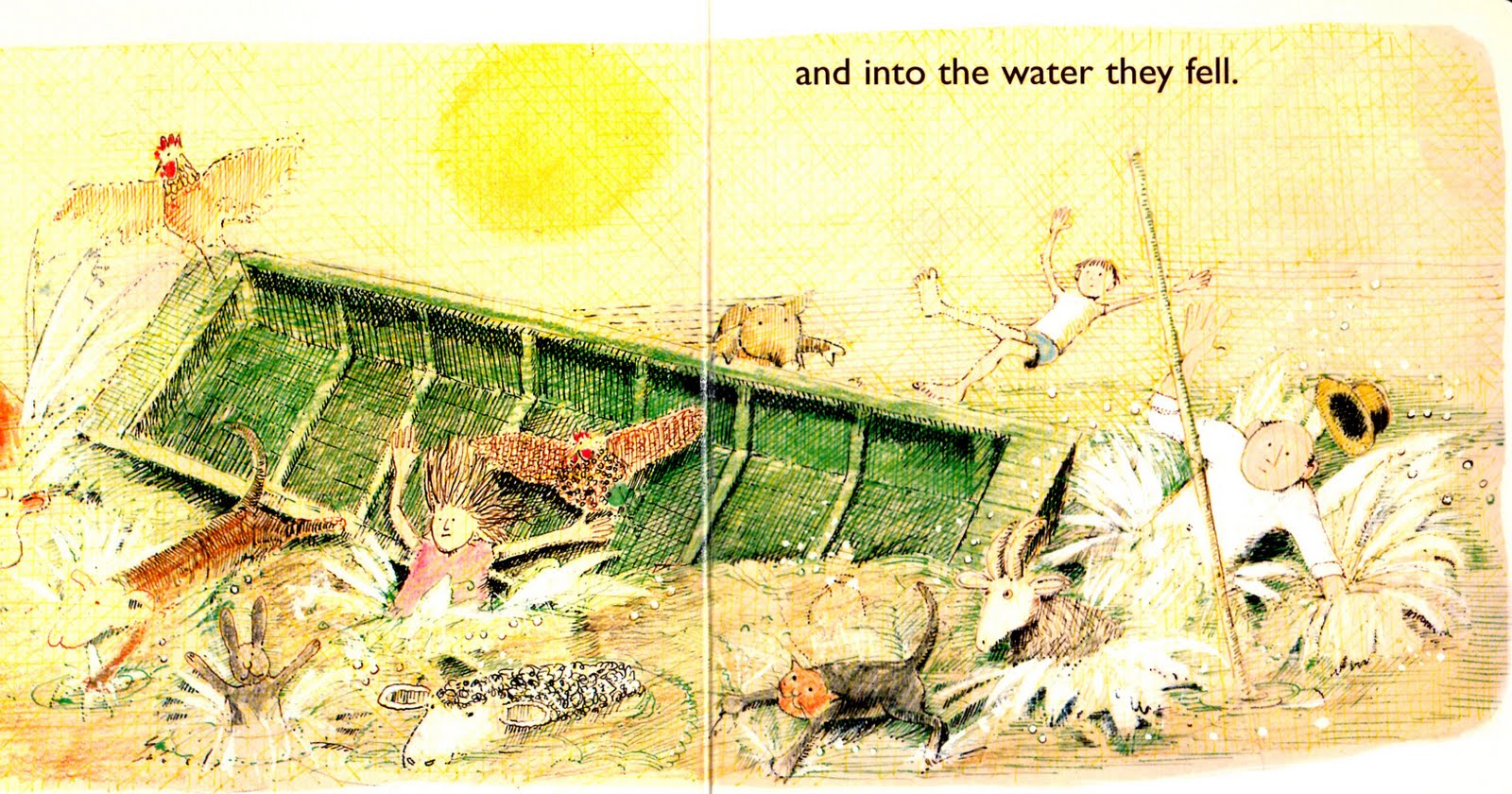
Mr. Gumpy lives by a river, and has a boat, a low raft-like thing.  He goes out in his boat one day, and everyone wants to come with him: the children, the rabbit, the cat, the dog, the cow, the chickens, the goat.  As he says yes to each request, Mr. Gumpy admonishes the newcomer: "'Very well,' said Mr. Gumpy.  But you're not to chase the rabbit.'"  "Yes, but don't keep bleating."  Everything goes along swimmingly until all the animals on the boat begin to do what they aren't supposed to do:

The goat kicked
The calf trampled
The chickens flapped
The sheep bleated
The pig mucked about
The dog teased the cat
The cat chased the rabbit
The rabbit hopped
The children squabbled
The boat tipped...

Eleanor particularly loved this page, coming as it does after the suspense-building setup.  Mr. Gumpy is pleasant about the whole thing, and they all walk home across the fields and have tea together.

Our one elaboration on Burningham's simple text and appealing sketchy drawings is that we've always read the book with different voices for each of the animals, and added in the animal sounds they make: "'Moooo, Can you make room for me?' said the calf." Our kids like it, and it helps differentiate each animal's voice to start with a bleat or an oink or a meow.

It's funny how you start reading books a certain way when you read them aloud over and over again.  You choose inflections and accents and then so often repeat them as reading becomes partly a performance.  When we started reading aloud to Eleanor, Jeff and I were quite rigid about alternating pages, so we'd each read an equal amount of every book, or we'd choose certain characters to read, and we'd fall into patterns with books: I'd know which page I wanted to start on to get some of my favorite pages in the middle.  We're much more lax now, but if we're reading Mr. Gumpy together, one of us will take his voice (slow and soft), and the other will do all the animals.  There's a way our kids now expect certain books to be read, as if they are songs with our own particular music.

Love, Annie

Sunday, August 1, 2010

Bookstore and Berenstains

Dear Annie,

One of the many ways I am fortunate in my work is that I have a lot of control over what books I sell.  I run the book section within a very good independent toy store.   (The website, however, does not yet include our book department -- it's still building.)  The store's book section is as big as a medium-sized children's book store.  We stock thousands of books, so I can't say that I love every one of them.  But I like the vast majority of them, and I can do things like deciding not to carry any of the dreaded Berenstain Bears.  We do carry some books related to television shows -- a few Sesame Street books,  some Dora and Diego, Thomas, and Caillou.  The main place where I concede space to Disney princess junk is in the activity section: we carry $2.99 coloring books, and some sticker books.  Also one or two of the older Barbie sticker books.  C'est tout.  It's too bad that a store that sounds as good as the one you visited feels they have to sell the branded books.  It may be a way to drive more traffic into the store, or it may be that they feel they want to offer as wide a range of books as possible, or maybe they like them.

One of my little rules of thumb about what to carry -- not always followed, I confess -- is to stock books that the writer felt inspired to write.  As opposed to books which marketing departments commission because they believe they'll sell.  When you get into chapter book series that go on forever, that becomes fuzzier territory.  But those books without authors listed on them, and with the little TM on the cover -- they come from market research.

Moving on to the Berenstain Bears.  You called them preachy, which I think is a good word for them.  I think they often choose good topics -- ones which parents want to discuss with their children.  Manners, TV, anger, bad dreams, junk food, etc etc.  Sometimes I think they miss the reason a particular topic has an emotional impact on kids.  But even when they get it right, they're just so clunky.  Often there are better books on many of the Berenstain topics -- they're just not obviously labeled in a series.

Just got to Maine, by the way.  One hammock is already up, and the second will be by tomorrow.  We're all ready to lie around reading in between days canoeing on the river.

Love,

Deborah

Friday, July 30, 2010

The joy -- and danger -- of bookstores

Dear Aunt Debbie,

I'd love to hear you go into detail about the Berenstain Bears sometime.  Not a fan of them myself -- too preachy.

We went to a marvelous bookstore today -- Anderson's Bookshop, in Eleanor and Isabel's grandparents' town.  Fabulous children's section, including a train table, and lots of really well-chosen books.  Eleanor was thrilled to recognize some of her favorites, but then as we got really into looking, she gravitated toward the Disney and Barbie junk: bright-pink books with no plots to speak of and no actual authors listed.  She spent much of the rest of the visit enthralled by them (they were all, of course, on the lower shelves, just at her eye-level).  She asked to buy them, but didn't put up much of an argument when we said no -- we were walking out with several other purchases.  But it made me wonder: when you stock your shelves, how much of the junky bestselling branded stuff do you put out there?  Where do you draw the line?

One of the books we did buy was one I remember from my childhood, but hadn't seen or thought of for years: Tikki Tikki Tembo, a Chinese folktale retold by Arlene Mosel, with utterly appealing woodcut-like drawings by Blair Lent.  It's a simple story about two brothers who, on two separate occasions, fall into a well.  The second brother's name is Chang, so his older brother is able to explain quickly to their mother and then to the Old Man With The Ladder what's happened.  But the elder brother is named "Tikki tikki tembo-no sa rembo-chari bari ruchi pip peri pembo," and that is the joy of this book.  Tikki tikki tembo's full name appears on almost every page, and as Chang tries to tell his mother and the Old Man With The Ladder to come rescue him, he runs out of breath and can barely get the words out.  So much fun to read aloud.  When we got back to the house, it was the first one Eleanor wanted to read, and I think we'll be hearing a lot of it in the days to come.

Love, Annie