In which Annie (high school teacher, mother of two young girls and a younger boy) and her aunt Deborah (children's bookseller, mother of two young women in their 20s) discuss children's books and come up with annotated lists.

Showing posts with label Rowling. Show all posts

Monday, September 5, 2016

Harry Potter and the Girl who Reads Everything

Dear Aunt Debbie,

A couple of nights ago, Eleanor came into my bedroom needing to talk about why she wanted to stop reading a book. On non-school nights, we let the kids stay up with reading lights, and Eleanor is always the last to turn hers off, reading until 10 or sometimes even 11 PM. Then she'll come downstairs to find me and Jeff, or into our room, with a smile on her face, that little smile that says I know I shouldn't be up, but now is my favorite time to talk with you, alone.
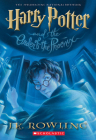
A couple of nights ago, she wasn't smiling. Earlier this week, she had begun to read Harry Potter and the Order of the Phoenix, the fifth Harry Potter book. I wrote this summer about Eleanor starting the series; how much I love what she is getting from the books, but how I have also been trying to slow her down, out of fear that the emotional content will take her too deeply over her head too young. I said I was fine with books 1-3, but discouraged book 4, in which Harry experiences the first death of a character we have grown to like, a fellow student murdered by Voldemort during the Tri-Wizard Tournament. My caution was rebuffed; she read on. After book 4, she reassured me the content was fine. She paused again, but late in the summer she began pushing to read book 5. She borrowed it from my parents last week.

Which brings us to Eleanor walking into my bedroom with The Order of the Phoenix under her arm, upset. A little more than 500 pages in, she had just read a scene set in a wizarding hospital, in which Harry, Ron, Hermione, and Ginny run into their friend Neville and his grandmother. Neville and Mrs. Longbottom are there to visit Neville's parents, who were tortured into insanity by one of Voldemort's followers.

It's not a dramatic or violent scene:

Neville's mother had come edging down the ward in her nightdress. She no longer had the plump, happy-looking face Harry had seen in Moody's old photograph of the original Order of the Phoenix. Her face was thin and worn now, her eyes seemed overlarge, and her hair, which had turned white, was wispy and dead-looking. She did not seem to want to speak, or perhaps she was not able to, but she made timid motions toward Neville, holding something in her outstretched had.

"Again?" said Mrs. Longbottom, sounding slightly weary. "Very well, Alice dear, very well -- Neville, take it, whatever it is...."

But Neville had already stretched out his hand, into which his mother dropped an empty Droobles Blowing Gum wrapper. 

"Very nice, dear," said Neville's grandmother in a falsely cheery voice, patting his mother on the shoulder. But Neville said quietly, "Thanks Mum."

His mother tottered away, back up the ward, humming to herself. Neville looked around at the others, his expression defiant, as though daring them to laugh, but Harry did not think he'd ever found anything less funny in his life.

In telling me what had upset her, Eleanor was close to tears: the image of parents unable to communicate with their child, unable to do more than hand him a useless gum wrapper, was deeply troubling. This, even more than the images of death threaded through the books, was what made her want to stop reading. It was empathy; the book striking too close to a horror she could imagine.

But she didn't feel she could stop reading. Why not?

"I'm supposed to be the girl who reads everything," she said, hugging me. Oh dear.

"No," I said carefully, "you're the girl who loves to read. And you're someone who reads deeply, and who gets emotionally involved in the books you read. This is a good thing. But sometimes that might mean that something your friends have read is going to feel different to you than it did to them when they read it." We talked about how people read in different ways, and how something that feels scary to one reader might not to another. I mentioned that J.K. Rowling wrote the Harry Potter books to be read by kids who were Harry's age in each book -- by that rule, she's a 9 year old reading something written for 15 year olds. There's nothing to be ashamed of if it doesn't feel like the right thing to be reading at the moment.

She decided she wanted to stop reading the book, and I said I thought that was a good decision. The wonderful thing about books is that they will be there for you when you're ready for them. Until then, you can reread the first four books, and pick up the next one sometime in the future, when it feels like the right time. We practiced what she might say to her friends who have read the whole series, if they ask why she hasn't finished. She said, "I'll say it makes me feel too much emotional pressure to read it right now." Then she asked if we could give the book back to my parents for now, "so I won't feel possessed by the urge to pick it up again."

Two things struck me deeply about this conversation. First, Eleanor's determination about what feels "real" and what doesn't. She compared Harry Potter to the Percy Jackson series, saying that Percy Jackson felt less scary because "it couldn't really happen." Of course, both series are fantasy, filled with magic and impossible occurrences, but I understood what she meant: the situations in Rick Riordan's books feel more episodic; even when terrifying things happen, you're not really worried that the main characters will be hurt. There are so many moments in J.K. Rowling's books like the one between Neville and his mother: moments that feel emotionally real; not plot points, but character moments. (I googled the gum wrappers while writing this post, and found both that a lot of fans had wondered whether Neville's mother was slipping him secret messages, and that J.K. Rowling had said in an interview that that wasn't happening at all. She based the scene on the experience of a friend visiting his mother, who had Alzheimer's.) As she reads, Eleanor feels the difference.

The second thing that struck me was how much this book choice mattered to Eleanor in terms of her self-perception. I read somewhere recently that kids start to consciously carve out aspects of their identity around this age, 8 or 9; they start to see themselves as a certain type of person, and to act accordingly. This wasn't just about the question of stopping a particular book; because Harry Potter is so big, and because several of her friends have read the whole series, Eleanor saw it as something she should be doing as well as something she wanted to be doing. Because she's the girl who reads everything.

And that's where we try to step in as parents, right? To say yes, I see who you are becoming, and I love who you are becoming, and take my hand and step just a little over this way, see it just a little bit differently. See? It's still you, this slightly changed image. It's maybe even a slightly truer you.

I think often of something my Grandpa Frank, your father, used to say about kids: "You raise what you get." Here they are, these amazing young people growing into themselves; all we can do is try to know them and raise them the best that we can. Thank goodness we have books to help us along.

Love, Annie


Saturday, March 21, 2015

After Harry Potter: good (and different) books

Dear Annie,

Funny you should be writing about the BabyLit books now.  Just last week a customer came in saying her 6 year-old insisted on being Anna Karenina for Book Character Day because she loved reading Will's favorite BabyLit book to her baby sister.  Go figure.

Hi, I'm back from a hiatus of sorts.  The always-interesting Cyd has sent us a question I couldn't resist.  Rebekah -- 7 years old?  almost 8? -- plowed through all of Harry Potter recently.  So Cyd wants to know:
...what to read next?  What can I give her that won't feel like a huge let-down after those enormous HP volumes, that fully realized world? It doesn't need to be fantasy - in fact, she's not particularly into fantasy - but I want something just as rich. I think of some of the things I loved at her age - Edward Eager, E. Nesbit, - but they feel so much less compared to HP. I think she's a little young for Cynthia Voigt; I have read her all of Frances Hodgson Burnett; I have read her all (yes, ALL) of Louisa May Alcott; I am reading her much of L.M. Montgomery. She really likes historical fiction and for Hanukkah I bought her a 30-volume set of My Story books, which is the British version of the My America books (which she had already ripped her way through), and they are decent books but they're not Harry.
When one's child is doing amazing things -- in reading or any other endeavor -- she doesn't have to have a steady diet of the same kind of amazing.  Just as adults vary what they read, kids like to do that too.  As you know, we read the unabridged Les Miserables to Lizzie (at her insistence) when she was in second grade.  The following year she fell in love with the Animorphs series and charged through about 12 of them before abruptly dropping them and moving on to other things that I'm sure her parents liked better.  Variety is a great thing in all our lives.

So Cyd, I'm interpreting your query as looking for good stuff Rebekah can immerse herself in next.  So here are a bunch of authors worth sampling.

These four, like J.K. Rowling, wrote series in which one returns to beloved characters in successive books, seeing how they're growing up and their worlds are changing.

Hilary McKay wrote Saffy's Angel and its sequels.  Plots and themes abound in these books, but what makes them special is the four children of the eccentric Casson family.  One goes on to book after book to find out how these friends are doing.

When it came out, I wasn't immediately taken with Jeanne Birdsall's
The Penderwicks
.  It felt like it was trying a little to hard to have an old-fashioned feel: a family of four girls (oh. you probably already know this one, Cyd) having wholesome adventures on summer vacation while still missing their dead mother.  But talking with kids over the years, and seeing how many come back for the sequels -- #4 is due out on Tuesday -- has changed my mind.  I gave an advance copy of the book to a wonderful family one of whose children dressed at The Penderwicks: the book for Halloween.  They talked with me about the excitement of opening the book and catching up with the characters, who are now old friends.  It sounded so much like our family's experience with the Harry Potter books -- it was really moving.

Madeleine L'Engle's Wrinkle in Time and sequels has more of what Cyd calls the "fully realized world."  You did a lovely blog on them here.

Arthur Ransome's Swallows and Amazons books feature children from three different families who have summertime adventures in England and Scotland in the 1930s.  They have everything to do with kids and boats and elaborate games of imagination.

I would encourage Cyd and Rebekah to pick up E. Nesbit and Edward Eager again.  They're both delightful, and they spend a lot of time -- with a heavy dose of humor -- on siblings in large families.  Eleanor loved the Half Magic series almost four years ago, but if she were to revisit those books now, she'd get lots more out of them.  Just as Rebekah may end up with the thrill of discovery all over again if she picks up Harry Potter when she's 12.  E. Nesbit is viewed as a seminal writer of 20th century children's literature because she wrote about realistic relationships among family members.  My favorite of her magical books is Five Children and It, in which everything that can go wrong with a wish does.  But the one our entire family loved best was
The Railway Children
, the story of city children who move with their mother to the countryside after their father is falsely accused of spying.

The Prydain Chronicles -- starting with The Book of Three -- by Lloyd Alexander could be a lot of fun for  Rebekah.  They're loosely based on Welsh mythology.  Harry Potter incorporates elements of lots of mythology of the British Isles -- she might find some familiar stories.  The current Book of Three paperback has a scary image that I've found turns some kids off.  The book isn't as creepy as the picture.

And while we're adventuring, don't forget Robert Louis Stevenson.  Treasure Island is still a great read.

Moving closer to the twenty-first century, I suspect Rebekah would connect with Sharon Creech's books.  Walk Two Moons is her best-known, and spectacular -- it has a lot to do with characters telling each other stories.  Mona and Lizzie's favorite was Bloomability, about a lower-middle class girl who ends up in a Swiss boarding school for a year, completely out of her element, and figures out what's important in people and in life.

 And last, there's some contemporary historical fiction.  Has Rebekah tried any books by Karen Cushman yet?  Here's a complete list: most of them are set in medieval or Elizabethan times.  She's probably best known for The Midwife's Apprentice, which won a Newbery medal.  Most of her main  characters are children who have been rejected by the people who should be caring for them.  They learn to make their own way in the world, often with the help/supervision of unlikely adults.

I hope there are some surprises in this list.  Enjoy!

Love,

Deborah


Friday, September 23, 2011

The pleasures of a complete universe

Dear Aunt Debbie,

I'm afraid we've reached the limit of my recent YA series knowledge, but I have been thinking about what these series we're calling keepers have in common: Harry Potter, The Golden Compass, the Chronicles of Narnia, The Lord of the Rings.

Part of it, I think, is the pleasure of getting to know a complete universe.  Each of these series allows you to become familiar with a world over a period of time.  They are rich worlds, filled with detail, like our world in some ways but totally unlike it in others. 

And they are worlds we want to inhabit.  There is some kind of magic in each of them that is deeply attractive.  In Narnia, there is the portal to another world, the prospect of going through the back of your closet and into a forest populated with talking animals and other fantastic creatures.  In The Golden Compass, there are the daemons: each person in this alternate world has one, an animal of the opposite gender who is part of that person and travels with them throughout life, able to change shape until the person hits puberty, then choosing its permanent animal form.  How can you read Philip Pullman and not wonder who your own daemon would be, what form he would take?  And then of course there's Hogwarts.  Even without Harry, Hermione, and Ron there, who wouldn't want to get the letter from that first owl, proving that the strange sense of not-belonging you've been experiencing was an indication that you are secretly a wizard?  Though all these worlds are mired in war, there's a sense of what they would be like in peace as well.  There is an invitation to join them.

I loved reading Chaos Walking and The Hunger Games, but the worlds they describe are not places I would ever want to be.  Their dystopian strength seems to me to be about showing me dark things about the world I live in already, rather than opening an aspirational escape.  I wonder whether this makes them more of our moment, and whether they will last.

Love, Annie

Wednesday, September 21, 2011

Keepers?

Dear Annie,

Ah, spoilers as occupational hazards.  Before Harry Potter and the Goblet of Fire came out in 2000, there was buzz that one of the characters was going to die.  Quickie reviews carefully kept the secret.  I read it fast, but not as quickly as one of my customers.  A ten year old boy dropped by the store to tell me that he'd finished the book -- probably within the first 48 hours of publication.  "And I just knew ______ was going to be the one to die!" he crowed.  I was about two-thirds through the book at  that point, but such is life.

You ask what series will last.  Hmm.  I think Harry Potter will for lots of reasons: good writing (most of the time), humor, evolving characters and evolving complexity of successive books.  And it draws so heavily from the British mythic tradition: those themes are keepers.

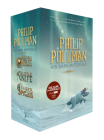
The only other series I can feel confident saying that it'll be around in 50 years is Philip Pullman's
His Dark Materials Trilogy
-- usually referred to as the Golden Compass books.  The first one came out in 1995.  It's so ambitious, creating a wonderfully believable parallel world and weaving together varied characters and great action.  And it grapples with much bigger issues, many of them having to do with religion and organized religion.  It's wonderful.

Game of Thrones is one of my boss Steven's favorite books.  I think I need a long summer after I retire to attack that series, but it sounds riveting. 

A lot of the other series we've been talking about are good entertainment, and some of them can really resonate with their readers.  Does that mean they'll still have the emotional pull exerted by some of the literary first loves we talked about last spring?  I guess part of what I'd hope for in a book or a series that's going to last is that it affects a reader.  Not just entertains or engages, but really makes someone think, or see the world differently.  The transformative power of literature.  It's hard to know which ones those are until someone has lived with them for a while.

Any more nominees out there?

Love,

Deborah

Sunday, September 18, 2011

YA Hit Parade, take two

Dear Annie,

It's an interesting list your students have created.  I've read at least pieces of each of those series and understand the attraction of them all.  But very little of this list are titles that I would guess will stay with the readers throughout life.

The one most likely to, IMHO, is Harry Potter.  My experience of it, and that of my children and customers, was that the year or more between each book was crucial to one's appreciation of the series.  A new book would come out, it would be inhaled by all within a week of publication, then it could be savored.  There were re-readings, and intense speculation about what would happen next.  The characters soaked into kids' consciousness, so that when the next book arrived, one would be reacquainting oneself with old friends.  Rowling's little asides and character tics were appreciated all the more for the familiarity.  I often wonder how the easy availability of all seven books affects readers' experiences now.  I suspect your current freshmen had most of them available when they started the series.

The Percy Jackson series by Rick Riordan (first syllable pronounced like "fire") has been phenomenally popular.  The basic concept of the books, starting with The Lightning Thief, is that there's a group of kids in contemporary society who are the half-mortal children of Greek gods and goddesses.  Riordan, who used to be a middle school teacher, says he invented the stories to interest his own children in Greek mythology.  The popularity of the books has created a wave of interest in anything related to mythology -- it's been fascinating.  Two years ago, Riordan spoke at the Washington DC Book Festival on the National Mall.  The tent where he spoke was overflowing with kids clutching their books.  When he arrived on stage, it felt like a major rock star was there: the crowd cheered, screamed, waved, jumped up and down.  Riordan has started two other series: one on Egyptian mythology (biracial brother and sister, separated by divorce, who are direct descendants of Egyptian gods), and a follow-up to Percy Jackson, introducing Roman mythology.

I will confess to you something I don't often say aloud.  When I first read The Lightning Thief before it came out, I stopped after two chapters.  I think the deciding moment was the scene where a teacher on a field trip turns into some sort of monster with knives shooting out of her fingers.  It's a very action-action series, with teenagers constantly deciding the future through individual combat.  Parts have more depth to them too, but I wonder about the series' staying power.  What do your students talk about liking about Percy Jackson?

I think of the Sisters Grimm as being a bit younger than the others on your list.  Also very popular, in part I think because it maintains good mysteries through the books.  The sisters have inherited the responsibility to keep fairy tale characters confined to a small town in upstate New York and not let them escape and wreak havoc on modern society.  The characters, with well-known names from fairy tales, all have personalities fairly far off from how they are in the original tales (Grimm and others).

I'm surprised and pleased that The Agency, by Y.S. Lee made it onto the lists. It feels a step up in both sophistication and language.  You've already linked to an enthusiastic review.  The fact that the heroine is Anglo-Asian, and that the author has a PhD in Victorian literature and culture, give the books a deeper, engaging edge.  The heroine is fallible in sympathetic but sometimes excruciating ways.  Your parallel to the Sally Lockhart stories is a good one.

I'm curious to know more about why your students love the books they do.  Anybody out there who wants to talk about your favorites?

Or maybe I'll just hear more from you...

Love,

Deborah