Dear Annie,
This past Monday was your grandma's 90th birthday, and although she's no longer with us, I've been thinking about her and how much she read to us. My memories of my father reading out loud have to do with bedtime, but with Mom, the reading was all in the kitchen.
Our father commuted to The City (in those days I believed there was only one), and always came home on a train that arrived at 7:12 pm -- a time considered too late for our dinner. So the three of us ate earlier, and Mom, sitting on the other side of the kitchen counter, read to us. Your mother (my sister) remembers being told that reading was a way to keep us from fighting. I just thought of it as What Happened at Kids' Dinner.

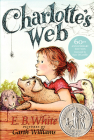
My most vivid single image from all those years was of Grandma taking off her glasses and wiping away her tears over the death of
Charlotte. That may have been the first time I saw my mother cry. She read us
Stuart Little, too.
She had to find books that would appeal to children across a range of six years. I was eleven when your mom went off to college, so we're talking about keeping the interest of kids ranging from maybe six to twelve on up to eleven to seventeen.
There was a lot of
Thurber.
Ogden Nash: I don't know if it was specifically child-oriented poetry, or just a collection of all his poems.
One of the striking things about the list that Judy, Al and I have put together over the past few days is the large percentage of books written for adults, many of them written from the 1920s to 1940s, often by people affiliated with the New Yorker or the New York literary establishment.

After fifty years, one of the first titles both my siblings remembered was
The Education of H*Y*M*A*N K*A*P*L*A*N by Leo Rosten (under the pseudonym Leonard Q. Ross). Hyman Kaplan is an eastern European immigrant in what we would now call an ESL class who mangles English syntax and meaning constantly while maintaining his lovely and frustrating personality. While trying to define vast, used to describe America's deserts, Kaplan says, "Ven I'm buyink a suit clothes, I'm gattink de cawt, de pents, an' de vast!" "Mom read his accent perfectly," says your mother.
There was a Fireside Collection of American Humor, which gave us Twain's
The Celebrated Jumping Frog of Calaveras County. Link is to full text, as is this one to one of our other favorite short stories,
The Diamond as Big as the Ritz, by F. Scott Fitzgerald. The latter is not in the humor category, but a wonderful story of the world's richest family, which lives on top of a mountain-sized diamond in Montana. I remember loving
The Dog Who Wouldn't Be by Farley Mowat: a memoir of his Canadian childhood with a dog of pronounced personality.

archy and mehitabel, which you introduced to my Lizzie, was a favorite in our kitchen. It started as a newspaper column by Don Marquis, who said he found the writing of a cockroach with a human soul in his typewriter every morning. Archy jumped on each typewriter key and couldn't manage the shift for capitals, so it was all lower case. Mehitabel the alley cat was a friend of archy's; she claimed to have been Cleopatra in an earlier life.
This site is a great introduction to archy and mehitabel. Here is part of her Song of Mehitabel: imagine Grandma reading it:
i once was an innocent kit
wotthehell wotthehell
with a ribbon my neck to fit
and bells tied onto it
o wotthehell wotthehell
but a maltese cat came by
with a come hither look in his eye
and a song that soared to the sky
and wotthehell wotthehell
and i followed adown the street
the pad of his rhythmical feet
o permit me again to repeat
wotthehell wotthehell
my youth i shall never forget
but there s nothing i really regret
wotthehell wotthehell
there s a dance in the old dame yet
toujours gai toujours gai
So much of what she read us had real style, good writing, and a certain
esprit. My ten year-old self enjoyed archy and mehitabel without understanding a lot of it, but it was a wonderful thing to be immersed in. There's family lore about Grandma's father (your great-grandfather) holding your infant mother on his lap, reading her the phone book in warm and loving tones. He undoubtedly read many things beyond phone books (did they exist in the '20s?) with his own daughter when she was little too. Generations of our family have instilled the love of reading from a very early age.
We're all grateful to all of them.
Happy Birthday, Mom.
Love,
Deborah