In which Annie (high school teacher, mother of two young girls and a younger boy) and her aunt Deborah (children's bookseller, mother of two young women in their 20s) discuss children's books and come up with annotated lists.

Showing posts with label Dr. Seuss. Show all posts

Wednesday, February 25, 2015

Breakthroughs!

Dear Aunt Debbie,

Suddenly, Isabel can read.

Of course, it isn't sudden at all: we've been reading together for more than five years, pretty much since the day she was born. She's been "reading" on her own for quite some time as well, poring over picture books and graphic novels, staying up on weekend nights with her own reading light and our copy of Smile or one of the Olympians books while Eleanor whizzes through another chapter book in the bunk above and Will sings to his stuffed animals.

But, like Eleanor when she was first learning to read, Isabel has been resistant to reading out loud at home. Her fabulous kindergarten teacher sends her home every night with a book baggie containing a small pile of early readers. As part of her homework, she's supposed to read these books aloud to an adult, and practice the sight words taped to the baggie.

Cue the misery: resistance to reading aloud, complete resistance to trying to sound out any word she didn't know (or hadn't memorized). Book baggie evenings often culminated in hysterical wild guesses and dissolving onto the living room floor in boneless refusal. Needless to say, we weren't doing this every night. The level of the readers Isabel was bringing home (first A and B, then C and D) was rising based on what her teacher saw at school, but we weren't seeing any difference in her reading at home.

A few weeks ago, I went in to meet with Isabel's teacher to talk about her reading. Ms. Mazor took me through Isabel's school work, showing me how Isabel has been telling stories: first in pictures, then through accompanying words, and in her latest story, writing the words first so that she could get them down, leaving space for the pictures to come later. The writing she showed me was dramatic and vivid, and her message was clear: silly mama, you have nothing to worry about here.

Here is Isabel's story of her own birth:


For Isabel, clearly, writing and reading are happening hand in hand. The comprehension is there, and the mechanics are catching up.


The week after this meeting, Isabel picked up a note I was sending in to her teacher and read it aloud. Then it was a couple of pages of P.D. Eastman's Go, Dog. Go! Then every other page of The Cat in the Hat.

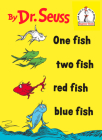
On Sunday, we sat down with The Cat in the Hat and One Fish, Two Fish, Red Fish, Blue Fish, and Isabel read 100 pages of Dr. Seuss in one sitting. (As our guest blogger/kindergarten teacher Clara noted when Eleanor was learning to read, some of those early readers are weirdly long.)

Her mom and her dad and her sister are so delighted.

Love, Annie


Friday, June 22, 2012

Oh, the graduations you'll attend!

Dear Aunt Debbie,

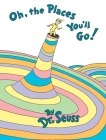
The school year is winding to its slow, hot end here in New York.  I turned my grades in today, and graduation is on Monday.  This afternoon, the girls and I went to get summer haircuts at our lovely local hair salon.  While waiting for our turn, Isabel picked a book out of the basket of kids' books the owner keeps waiting on the floor: the perennial graduation-gift favorite, Dr. Seuss's Oh, the Places You'll Go!

About which I feel -- eh.  There's a lot of Dr. Seuss I love: Green Eggs and Ham, The Cat in the Hat, Hop on Pop, The Lorax, to name a few we've touched on.  But I have to admit, aside from the pleasurably wacky Seussian drawings, Oh the Places You'll Go! is a pretty boring book.

Which is funny, because even when Dr. Seuss is plotless and random, as in Hop on Pop or One Fish Two Fish Red Fish Blue Fish, he's always quirky and specific as well.

Probably my favorite page in One Fish Two Fish is a brief stand-alone scenario, accompanied by this illustration:

Look what we found
in the park
in the dark.

We will take him home.
We will call him Clark.
He will live at our house.
He will grow and grow.
Will our mother like this?
We don't know.


 Compare that to the banality of Oh, The Places You'll Go!:

Out there things can happen
and frequently do
to people as brainy
and footsy as you.

And when things start to happen,
don't worry.  Don't stew.
Just go right along.
You'll  start happening too.
 
I talk to my creative writing students a lot about avoiding general statements, understanding that often, it's the most specific details that pull a reader in and lead to an emotional response.  Too many generalizations, and your book starts to read like a long-form greeting card.  And, apparently, to sell like hotcakes.

So, any other suggestions for graduation-appropriate kids' books?

Love, Annie

Friday, March 30, 2012

Guest blogger: teaching kids to read in kindergarten

Dear Aunt Debbie,

I have some thoughts on books about edgy issues, and will post about them soon.  Right now, I have one more addition to our discussion of teaching kids to read.  Our guest blogger tonight is Clara, mom of Isabel's good friend Vera, and a kindergarten teacher here in New York.  I asked her a few weeks ago to weigh in on the subject, and here she is:

Dear Annie,

I'm glad you asked for me to guest blog about learning to read. As a teacher of kindergarten and first grade for six years, I work every day to teach all kinds of readers how to read, love books and feel confident in their reading abilities. Very close to my heart is also helping parents feel confident in their role as their child's first and most important teacher.

I'm so excited for you and Eleanor that she is learning to read! Obviously both of your girls have a big love of books, which is no surprise. That Eleanor can read at her age is special and should definitely be encouraged. I'm also relieved to hear of your awareness that too much pressure could be bad for her, and even poor book choices could dampen her interest.

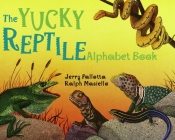
When parents ask me advice for encouraging and teaching their children to read at home, I give different advice depending on the age and type of child they have. For a child who shows no interest in learning how to read, I suggest immersing them in highly engaging books based on their interest (chosen for content rather than reading level, for parents to read with the child) to nurture a love of books. This will soon enough turn into a motivation to read independently. Books like The Yucky Reptile Alphabet Book, by Jerry Pallotta, will have a young naturalist's rapt attention, and happen to sneakily also teach letter recognition and phonemic awareness! For a child who desperately wants to read but is anxious and possibly behind his or her peers (or siblings), books should be made by the parents and children or selected very carefully from a book store. These books should include just a few words that the child can figure out from the pictures so that the child feels success right away and doesn't get discouraged by any struggle yet. A book like this may be homemade with family photos, with text like "Mommy loves me," "Grandpa loves me," and so on. After the child "reads" that book from memory, the parent can ask the child to point under each word next time he or she reads, so the child starts to get the idea that one word on the page matches to one spoken word, and begins to naturally pick up on cues like looking at the first letter. 

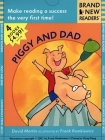
And finally, for eager young readers who are naturally beginning to crack the code like your Eleanor, I suggest getting started with short and repetitive books with a high level of picture support. All of the books in the Brand New Readers series, which can be found online and in bookstores, fit that bill. In school, we use books that are even more reliant on a pattern. For example, a book called "Who Lives in a Tree?" may have only 8 pages following the pattern of "A squirrel lives in a tree. A bird lives in a tree. A raccoon lives in a tree," and so on. These books are great for school, but are nearly impossible for parents to find outside of a specialized catalogue. Also, they are incredibly short and boring to read more than once or twice. My five year old students who are reading books at that level read 8 to 10 of those books every week in their personal "book baggie," and exchange the books for new ones once a week. Books like the Brand New Readers have a story, and recurring characters. I use them less at school because they often appear to be very easy, but break the pattern that a child has predicted so that the child needs adult support which they can't have 100% of the time at school. Perfect for reading at home! Rereading books at this stage is so crucial for memorizing high frequency words, so the more fun the stories are, the more likely your child will want to read them over and over.


For home reading and teaching of reading, I would move from books like that to books that are often called "level 1" in book stores. I think your Aunt Debbie has pointed out that all publishers use different criteria for their so-called levels, which drives parents mad. What I suggest looking for is again high interest books, but also books that are SHORT. The classic early reader Danny and the Dinosaur, by Sid Hoff, for example, is 64 pages long. Not short! Others, like this Scholastic Level 1 reader, have half the pages, and more importantly only a sentence on each page. 


Books like Dr. Seuss' Hop on Pop are in fact exhaustingly long. While it does a good job of teaching short vowel spelling patterns, no child aged 4 to 6 has the stamina to read it! Early chapter books can be challenging at first, so I recommend books that children think have chapters, but really have separate stories, like the Poppleton series by Cynthia Rylant. As a gauge, in New York City Poppleton is the level we want first graders to be reading between spring and June of first grade. 

This was a very long letter to a mom who sounds like she knows what she's doing already. But it's so important to check ourselves as parents, especially when we realize we have been presented with a child who is either ahead of or behind the curve for their age group. I am far too wordy in my letter writing today, but if you had insisted I write a one sentence piece of advice to parents on teaching their children to read, it would be this: "Read together, every day." For a child who associates reading with love will not find it difficult to love to read.

Best wishes on your reading adventures!

Thanks, Clara!


Love, Annie

Sunday, March 11, 2012

Learning to read 4

Dear Annie,

I love the Flip-a-Word books!  Their publisher is phasing them out this year, which makes me quite unhappy.  A week or two ago, I bought up every copy of Snake Cake that I could find from suppliers, but they're going fast.  Harriet Ziefert, who wrote the books,  is a prolific and wonderful writer on many levels -- we've written about her non-early-reader books here and here.

The classic of this form of early reader has to be Dr. Seuss's 
Hop on Pop
.  It's funny, it's frenetic, and it gets the job done phonetically:

ALL TALL
We are all tall.
[pictures of long skinny beings]

ALL SMALL
We are all small.
[pictures of little skinny beings]

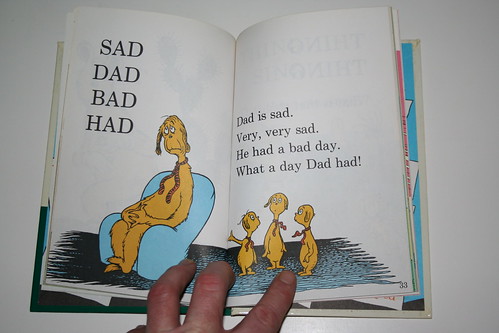
Then there's one of the show-stoppers.  Excuse the imperfect illustration: my scanner's still on the fritz and this was the best I could find online:
SAD 
DAD
BAD
HAD

Dad is sad.
Very, very sad.
He had a bad day.
What a bad day Dad had!

Lots of rhyming, lots of changing only the first consonant of words.  And -- very important in the learning-to-read trajectory -- lots of HUMOR!  (note who's wearing a tie.)

We've received a number of comments on the
Bob Books
, which are the 800-pound gorilla of the learning-to-read world.  They come in sets: a box with 8 to 12 booklets inside, depending on the reading level.  They're very methodical.  The first set sticks mostly with three-letter words, all capable of being sounded out.  The inside of the cover tells the adult what sounds the book will be presenting.

So for Book 1 of Box 1, the sounds are:
M m - moon
A a - apple
T t - table
S s - sun
And the text goes like this:
Page 1:
   Mat.
Page 2:
   Mat sat.
Page 3:
   Sam.
Page 4:
   Sam sat.
Page 5:
   Mat sat.  Sam sat.
Page 6:
   Mat sat on Sam.
Some kids will pick up booklet #1 and get it immediately and then just keep charging through the clear presentation of different sounds -- and before they know it they're readers.  In my experience, though, this isn't at all universal.  Equally as possible is a Deep Boredom reaction.   A child will get as far as the second "Sam sat" and walk away from the book.  Some of the stories are nothing but non sequiturs, and the sense of humor is thin. For some kids, box #1 is a jumpstart, and they're flying on to anything else they can get their hands on.  For others, they'll go through all five boxes before they're ready to explore more random reading choices.  As with everything else, you just have to see what your child reacts to.

I've always had this suspicion that my sister (your mother) is the person who really invented the Bob Books, and that someone more commercially-oriented created the ones that ended up with a copyright and publisher.  You mentioned that Eleanor has been practicing reading with some of the books Judy wrote as a reading teacher.  They're short, phonetically-oriented booklets, but full of a great sense of humor.  My memory of them is that in the days before the internet, she would xerox them and give them out to other teachers who wanted to use them (Judy -- ??).  Judy has both a great sense of humor and a lovely, funny artistic talent.  I can't reproduce the pictures here, but I will give the full text of The Cat and the Cab, by Judy Thoms.  Each line is a new page:

The cat has a cab. [picture: cat driving a cab, complete with little tree-shaped deodorizer]
The cab gets gas.
A man has a bag.
Cab! Cab! [man is flagging cab driven by cat]
The cab gets the man.
The cat gets the bag. [cat putting suitcase in trunk of cab]
Good-bye, cat.  Good-bye, man.  Good-bye, bag.  Good-bye, cab!

Good-bye readers, one and all.

Love,

Deborah

Monday, November 28, 2011

Book lists and rhyme, all the time

Dear Aunt Debbie,

I really want to see Hugo.  Going to need babysitting for that one.  We took the girls to their first movie-theater movie this weekend: the new Muppet movie.  It was a total hit, both girls mesmerized by the big screen.  Isabel didn't say a word, and practically didn't move, for more than two hours.  Eleanor had much more active reactions, laughing, squealing, even crying towards the end when it looked like the bad guy was going to win.  She knows a lot of stories, but doesn't yet fully understand that comedy means the good guys are going to come out on top at the end.

While movies are clearly a different medium from books, and what they require from an audience is different as well, I can't help feeling that the sustained attention span Eleanor and Isabel have built up in all our reading time has something to do with their ability to follow the narrative of a full-length movie.  It certainly informs the way they tell stories.  A couple of nights ago, they were in the bath together, each girl playing her own separate narrative game.  Eleanor had a Barbie in the tub with her, who she had cast as Cinderella, and there was a complex dialogue going on, Eleanor voicing Cinderella and herself and a small cast of other characters.  Right next to her, Isabel swam a rubber crocodile through the water, saying, "And the crocodile swam toward the child, and the child kissed the crocodile" (she picked it up and kissed it) "and took the crocodile home to its mother."  I'm a sucker for kids narrating stories about themselves in third-person.

But back to books.  Earlier tonight, Nick left a comment asking about more recommendations for rhyming books for 3-year-olds.  I'll answer that partially by encouraging readers to check out our Book List pages.  Under Picture Books, I have two lists that might be helpful: "Books it's fun to read aloud because of rhythm and rhyme" and "Rhyming books."  I've just added a few titles to each from the archives.

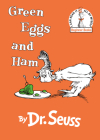
Lately, Dr. Seuss has been circulating heavily in our rotation.  In an earlier discussion of poetry, you mentioned Green Eggs and Ham, one of Isabel's current favorites.  Talk about rhythm and rhyme -- this book has an engine thrumming beneath every page:

I do not like them in a box.
I do not like them with a fox.
I do not like them in a house.
I do not like them with a mouse.
I do not like them here or there.
I do not like them anywhere.
I do not like green eggs and ham.
I do not like them, Sam-I-am.

I didn't realize until I had kids that, of course, this is a book about picky eaters.  How many times has every parent played out this same scenario? "You do not like them.  So you say.  Try them!  Try them! And you may."

Dr. Seuss has so much going for him: the strange, effective creatures, the loopy twisting roads and railroad tracks, the rhyme, the repetition.  It's funny -- I don't feel the same affection for his books that I do for, say, anything by Margaret Wise Brown, but he is classic, worth rereading often, and a natural place to go to when you want some serious rhymes.

Love, Annie

Wednesday, June 29, 2011

Unrestrained id: so attractive!

Dear Annie,

I think kids can distinguish fairly early between outrageous unlikely-to-happen or flat-out impossible stuff in books, and more realistic fiction.  And some of the outrageous stuff -- like the scary stuff we've written about -- is a direct line to the subconscious.  I suspect Eleanor knows that it's highly unlikely that a ten year-old girl can live alone and carry a horse around with one hand.  But it's cool.  Pippi, like another classic character, the Cat in the Hat, is both funny and attractive because she's so unrestrained, so beyond the rules.  And Tommy and Annika, like Sally and her unnamed narrator/brother ("I"), have to process the craziness and still live by their own rules of behavior (e.g., going home to bed every night), even as the crazy one enables them to push the envelope a bit.  Tommy and Annika have the internalized parents to help restrain them; Sally and I have a Very Serious goldfish invoking the name of Mother:
But our fish said, "No! No!"
Make that cat go away!
Tell that Cat in the Hat
You do NOT want to play.
He should not be here.
He should not be about.
He should not be here
When you mother is out!"

 So there you have it: id and superego, with ego (split into siblings) getting to process it all.  And when you're in the thick of the Processing It years of childhood, it's wildly entertaining to watch behavior you're learning not to do.

Not to say that all writing about beyond-the-rules behavior is a good thing.  You've got to have good writing and some engaging characters too -- which both Astrid Lindgren and Dr. Seuss provide quite nicely.  One of the more love-her-or-hate-her characters in kids' literature these days is
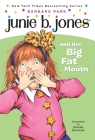
Junie B. Jones
, by Barbara Park. She's rude, she has terrible grammar, she rarely learns from her mistakes, and she's in 27 books, which follow her through kindergarten and first grade.  I'm in the hate-her camp on this one.  But the people who love her, and whose children love her, do so for that titillation of bad behavior.  Look, she's more clueless than I am! 

And on another Pippi-inspired note, I'd like to point out an excellent post after your previous entry from our own guest blogger Rachel of Even in Australia.   Here's the central question, and it's wonderful food for thought and discussion on another day:
So, here's the question - which books do we read to our kids and which do we let them read and discover on their own?
I encourage our readers to read the entire comment.

Love,

Deborah

Monday, February 28, 2011

Competing messages

Dear Aunt Debbie,

Of course you're right -- parental involvement in reading is natural and vitally important in terms of the message a kid takes away from a book.  There are still books I don't want in the house, but when we bring home or are gifted with less than great books, there is opportunity for discussion about them.  And then sometimes I secretly throw them away.

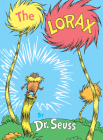
But it's not always the parents', or the author's, intent that comes through.  Thinking about this subject, I was reminded of Eleanor's reaction to The Lorax, Dr. Seuss's classic of environmental awareness.  We read the book multiple times in a period of a couple of weeks: the Once-ler sent down his grovulous glove and told in low tones the story of how he deforested the land of Truffula trees to make and sell Thneeds, depriving all the local animals (Bar-ba-loots!  Swomee Swans!) of their natural habitats, and leaving the land miserable and polluted, despite the Lorax's warnings.  The story ends with the Once-ler tossing down the last Truffula seed for "you" (the boy standing in for the reader) to take care of, and a moment of hope that the trees can be brought back if you care and work hard enough.

What did Eleanor learn from all this?  For months afterwards, she would chant the Once-ler's words at every opportunity: "Business is business, and business must grow!"

There's a takeaway for you.

Love, Annie