In which Annie (high school teacher, mother of two young girls and a younger boy) and her aunt Deborah (children's bookseller, mother of two young women in their 20s) discuss children's books and come up with annotated lists.

Showing posts with label Teague. Show all posts

Saturday, September 28, 2013

Surviving, and loving books

Dear Annie,

Like you, I revisited My Side of the Mountain a few years ago.  It's assigned a lot in fifth grades in our area.  What struck me was how out of date it seemed.  It's the story of a young man who goes off to live by himself in nature, but the first thing he does is hollow out a centuries-old tree with fire.  His attitude toward his surroundings was one of using it for his needs: burning the tree, stealing a falcon from its nest.
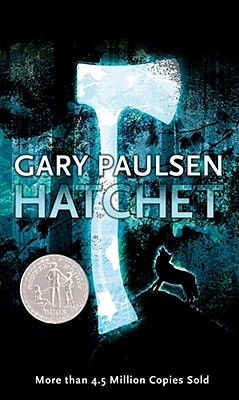
That book leads one to think of the uber-survival novel: Hatchet, by Gary Paulsen.  A light plane goes down in the wilderness of northern Canada, with the sole survivor a teenage boy whose only possession is a small hatchet.  Unlike My Side of the Mountain, Hatchet is filled with self-doubt, and the trials of a young man who starts out completely clueless about how to survive.  It's an older read: the first chapter includes a graphic description of the pilot dying of a heart attack.  But it's riveting.

If you're revisiting survival novels of your youth, why not take a look at  Island of the Blue Dolphins by Scott O'Dell?   I don't know how it would play for Eleanor.  An Indian girl living alone on an island off the coast of California.  Lots of figuring out how to fend for oneself, and defending against predators. 

Last weekend was the National Book Festival here in D.C.  I missed one day of it because I was hosting several authors -- including Mark Teague and Tamora Pierce! -- who came by the store to sign copies of their books.  It was a pleasure to meet them -- they were in town for the festival.  On Sunday I managed to get to the mall and hear a number of kids' authors.  What struck me most this year, though, had to do with the people in the audience.

During Grace Lin's presentation, I sat next to a middle-aged woman from Pennsylvania who was getting her PhD in children's literature.  Her dissertation is on kids' books about racially mixed families.  When Susan Cooper spoke, I wasn't very aware of the woman sitting on my right until, when the audience started moving out, a young woman appeared on my left, leaning over me, and breathlessly asked my seating companion if she had spoken on a panel the day before.  Yes, she had.  "Oh, you're,  you're -- "  "Megan Whalen Turner," the woman replied, smiling, "Yes I am."  They walked off together.  She's the author of a much-loved fantasy series set in Attolia (see Tui's comment here).

Wow -- I've just mentioned three major fantasy writers (Cooper, Pierce, Turner) who I saw last weekend, none of whom we've blogged about at any length.  So much still to do!

But back to book-lovers.  Mark Teague, illustrator of the Poppleton books and the cloying but well illustrated How Do Dinosaurs... books attracted a crowd whose average height must have been about four feet tall.  Dozens of kids lined up to ask him star-struck questions about his work.  It was pretty much the same four questions over and over, all of which he answered with warmth and humor.  The whole festival made me feel great about the future of reading.

So I leave you with the first eight panels of Lynda Barry's "20 Stages of Reading," a work commissioned by the Washington Post to publicize this year's Book Festival:


... continued here.

Love,

Deborah


Friday, September 30, 2011

An old story in a new form

Dear Aunt Debbie,

I can't wait to check out some of those animal books with Isabel!  She's still very much an animal (mostly dog) girl.

We went to the library yesterday, and reading some of our loot this morning, I had a book epiphany -- a moment when I realized that the story I was reading was a new version of a story I knew quite well, but hadn't thought of in years, so dressed up that I never would have known from the cover that there was a connection.

The book we were reading was Anne Isaacs's Pancakes for Supper!, illustrated by Mark Teague.  (I'm surprised to find it's out of print, as it's relatively recent; the link is to Alibris.)  Isaacs is the author of Swamp Angel, which you wrote about a while back, and its sequel Dust Devil; she has a great knack for tall tales and feisty heroines.  Teague is the illustrator of the How Do Dinosaurs series and the marvelous Poppleton books; his paintings are large, bright, and expressive.

Pancakes for Supper! tells the story of Toby, a girl riding on the back of her parents' wagon through snowy woods somewhere in the Northeast.  She's making up a song as she goes, about all of the special clothes she's wearing:


I've got a sky-blue coat with purple lining, 
A sun-yellow sweater with green leaves twining,
Thick orange mittens with a matching cap,
Buck hide boots to keep out the damp,
Fuzzy red long johns and a dress of brown:
Brand-new clothes for Winter Creek town!

The wagon hits a bump, Toby goes flying way into the sky, and when she comes down, she's far from the wagon and right next to a hungry wolf.  After some rhyming dialogue, Toby convinces the wolf that she can make him into "the grandest animal in the forest" by giving him her beautiful blue coat.  He takes it and struts off.

After the wolf come a cougar, a skunk, a porcupine, and a bear, each of whom gets another piece of fine clothing, until Toby is left shivering in her red long johns.  She rounds a corner, looking for her parents, and finds all the animals fighting over who looks the best.

At this point, I'm starting to think, This seems familiar....  And then I turn the page and see the animals chasing each other in a circle around a big tree:

All their fine clothes fell off as they ran.  They caught hold of each other's tails and raced around the trunk of the huge maple tree.  Soon they were spinning so fast that Toby couldn't tell which animal was which.  Round and round the animals whirled, faster and faster, until at last they melted into a great golden puddle at the base of the trunk.

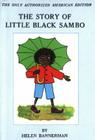
Because of course, Pancakes for Supper! is a retelling of Little Black Sambo.  

Grandma and Grandpa (your parents) had a copy of Little Black Sambo on the kids' shelf in their apartment when I was growing up.  I remember having intensely mixed reactions to it: both loving the story and realizing at the time (probably due to my parents' intervention) that there was something uncomfortable and racist about the illustrations.  Jeff has a similar memory of the book: he remembers reading it, but knowing at the same time that it was in some way bad to like.

Helen Bannerman wrote the original story in 1899, when she was living in India with her husband, an officer in the medical service there.  Sambo is apparently supposed to be a caricature of a Tamil child, but in a number of later pirated versions of the book, he was depicted as African, or African-American, in illustrations which helped cement the image of the happy, none-too-smart pickaninny child.  Wikipedia has a good rundown of the controversy.  The original is very much in print, and online reviews seem to be split among grandparents who are thrilled to find it for their grandchildren and people who are appalled that its racist drawings are still available.

The story is pretty much the same one Isaacs uses: Little Black Sambo has fine new clothes, which he gives up to four tigers who want to eat him.  The tigers get jealous of each other and whirl themselves around a tree, eventually becoming a puddle of butter.  Sambo's mother makes the butter into pancakes, and Sambo eats 169 of them. (In Isaacs's version, the animals become maple syrup, which gets soaked up into the tree.  Toby taps it, her mom makes pancakes, and she also eats 169 of them.)

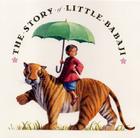
There's at least one other contemporary version out there: Fred Marcellino (of Pelican Chorus fame) changed the names of the characters from "Little Black Sambo, Mumbo, and Jumbo," to "Little Babaji, Mamaji, and Papaji," and kept the rest of the text the same in his book, The Story of Little Babaji.  I haven't seen it, but apparently it takes care of the racism question quite nicely.

I wish now I had the version I grew up reading and could assess it as an adult.  In the meantime, Anne Isaacs's book gives Isabel the animals she loves to look at, gives Eleanor a spunky heroine, and makes everybody white.  Progress?

Love, Annie

Wednesday, August 18, 2010

Dinosaur picture books

Dear Annie,

Dinosaurs, dinosaurs -- so many different things to different people. 

Dinosaur books tend to come in two categories: one where dinosaurs are
the stand-ins for people and things and tend to get very rollicking.  The other tries to
convey some facts about the big old guys.

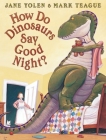
Dinosaurs as stand-ins for kids are what the Yolen/Teague How Do Dinosaurs... series is all about.  How Do Dinosaurs Say I Love You? is one of the more recent ones, and it sounds like it's lacking in the strong behavioral message that comes with most of them.  The first,
How Do Dinosaurs Say Good Night?
has dinosaurs acting out bad going-to-bed behavior in a way that many kids find hilarious:
Does a dinosaur slam his tail and pout?
Does he throw his teddy bear all about?
Does a dinosaur stomp his feet on the floor and shout: 'I want to hear one book more!'?
DOES A DINOSAUR ROAR?
After detailing many wrong ways to go to bed, the book goes on to the right ways to say good night -- whisper, hug, kisses, etc.  It's a widely-loved book, by both parents and kids.  I feel a little grinch-like saying it's not one of my favorites.  A little too far into the preachy end of things.  I'd be curious what Eleanor thinks of it.  And, as you pointed out, all the books in this series have accurate dinosaur names.

Another book which includes scientific names, but has a great story-book plot is
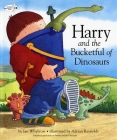
Harry and the Bucketful of Dinosaurs
by Ian Whybrow. Harry finds a stash of plastic dinosaurs at his grandma's house, washes them off and identifies them all -- identifying dinosaurs is an important element of many kids' dinosaur fascinations. They go everywhere with him, in a bucket, until the day he loses them.  Getting them back involves Harry reciting their names -- it's a lovely ending.


Advances in paleontology have made a few old dinosaur classics out of date, but some new ones are filling the demand for dinosaur science.   
Oh, Say Can You Say Di-no-saur?
is part of a new series of science books for pre-schoolers, all written in Dr. Seuss meter.
Dinosaurs lived
on the earth long ago,
before you and me.
So how do we know?
From fossils!
Dinosaur teeth, eggs, and bone
got stuck in the muck.
Then that muck turned to stone.
I realize the rhymes can become mind-numbing, but the series -- called The Cat in the Hat's Learning Library -- conveys a lot of information well.

And I'll end with my current favorite dinosaur book:
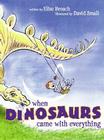
When Dinosaurs Came with Everything
by Elise Broach.  A boy and his mother are doing errands, and  every business they visit (bakery, doctor, dentist, etc) is offering a free dinosaur with purchase.  So he ends up accumulating several full-size
live dinosaurs, which he takes home with him.  Much chaos results.  Great illustrations by David Small, and the story is a lot of fun.

Lots lots more, but there's a start.

Love,

Deborah

Monday, August 16, 2010

How do dinosaurs compare to princesses?

Dear Aunt Debbie,

It's heartening to know that there's more complexity to princess books than Disney fare; I'm looking forward to checking out your latest recommendations.  (Particularly the King Arthur stuff; we play the music from Camelot a lot in our house.  As with so many other musicals, this leads to interesting conversations about Major Life Issues, such as adultery.)

In our growing conversation about princess books, however, I'm afraid we're leaving out the other major toddler and little kid subjects which seem to engulf boys in the same way Princess engulfs girls: dinosaurs and trains.  Before starting this blog, you and I corresponded at length about both of these subjects, and I'd love to bring that conversation here.

Your mention of good parenting made me think about my decidedly mixed feelings for the best-selling How Do Dinosaurs series, by Jane Yolen and Mark Teague.  The one we own is How Do Dinosaurs Say I Love You?, but there are endless variations: How Do Dinosaurs Say Goodnight?  How Do Dinosaurs Eat Their Food?  How Do Dinosaurs Get Well Soon?  How Do Dinosaurs Love Their Dogs?  (I worry a bit about that last one.)  The conceit of the books is that children are like dinosaurs, galumphing around and misbehaving, but parents love them anyway.  The children are depicted as full-sized dinosaurs, and the parents as normal-sized, racially diverse humans trying to wrangle creatures ten times their size.

It's the illustrations that make the books.  I knew I liked Mark Teague's work from the Poppleton books, but he outdoes himself here with double-page spreads of parents and dinosaurs in bright acrylic paints.  He paints a wide variety of dinosaurs, so much so that I looked some of the names up tonight to see if they were real: Tapejara, Nothosaurus, Kentrosaurus, Neovenator.  They all were.

It's the text that bothers me.  Jane Yolen writes the books in perfectly decent rhyming couplets, and stresses that bad behavior doesn't stop a parent from loving a child, which is a moral I agree with.  But in these books (or at least the one I'm looking at right now), there are no consequences for bad behavior at all:

Out in the sandbox
you threw lots of sand.

You ran from the slide,
after slapping
my hand.


But you suddenly turned
with a smile I adore.
Oh, I'll always 
love you, 
my dinosaur.

Well, yes and no.  You do those things, my little dinosaur, and that smile needs an apology to go with it.  The illustrations are so full of humor and love, and of course the sentiment makes sense when you're dealing with toddlers, but I wish the text didn't seem to encourage bad behavior.

What are some of the other good options out there?

Love, Annie

Tuesday, July 6, 2010

Pippi and Poppleton

Dear Aunt Debbie,

Your thought about the age at which books become funny to a child makes me think immediately of two we've picked up recently.

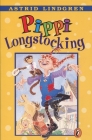
The first is an example of the Stuart Little problem: remembering my own love of the book, but forgetting at what age I enjoyed it, I bought Eleanor a copy of
Pippi Longstocking
, by Astrid Lindgren.  Turns out that Pippi's kookiness doesn't fully translate until you've had some experience with school.  Sure, it's kind of odd that she lives with a horse and a monkey, but without the context of rules and expectations that Eleanor will understand later in childhood, the book takes too much explaining, and just isn't funny yet.  We're putting it away to try again in a few years.

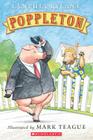
The second is a series that hits the funny bone of child and adults in this house at once: Cynthia Rylant's Poppleton. Rylant is also the author of the High Rise Private Eyes series I've written about before; her sense of humor is quirky and odd and totally pleasing, and happily, she's prolific, so there are always more books to check out.  We've read three of the Poppleton books so far; there are eight.

Poppleton is a pig who moves from the city to a small town peopled by a variety of animals: Cherry Sue, the llama next door; Fillmore, the hypochondriac goat; Hudson, a mouse who likes to go to the shore.  The stories are highly random: in our favorite in the first book, Fillmore is sick but refuses to take his pill unless Poppleton hides it in his food:

"I'll put it in the soup," said Poppleton.
"No, it has to be in something sweet," said Fillmore.
"Sweet?" asked Poppleton.
"Sweet and soft," said Fillmore.
"Sweet and soft?" asked Poppleton.
"Sweet and soft with raspberry filling," said Fillmore.
"Sweet and soft with raspberry filling?" asked Poppleton.
"And chocolate on top," said Fillmore.
"Chocolate on...Fillmore, are you talking about Cherry Sue's Heavenly Cake?" asked Poppleton.
Fillmore smiled.


This passage reduces Eleanor to giggles every time.  

Our favorite in Poppleton and Friends is titled "Dry Skin," and is entirely about Poppleton believing he has dry skin, and trying to fix it by covering himself with oil (which makes him want french fries) and honey (which makes him want biscuits).  Each book contains three stories, with brightly colored and personality-filled illustrations by Mark Teague on every page.  We are clearly going to have to read them all.

Love, Annie