
In which Annie (high school teacher, mother of two young girls and a younger boy) and her aunt Deborah (children's bookseller, mother of two young women in their 20s) discuss children's books and come up with annotated lists.

Showing posts with label Jean Craighead George. Show all posts

Saturday, September 28, 2013

Surviving, and loving books

Dear Annie,

Like you, I revisited My Side of the Mountain a few years ago.  It's assigned a lot in fifth grades in our area.  What struck me was how out of date it seemed.  It's the story of a young man who goes off to live by himself in nature, but the first thing he does is hollow out a centuries-old tree with fire.  His attitude toward his surroundings was one of using it for his needs: burning the tree, stealing a falcon from its nest.
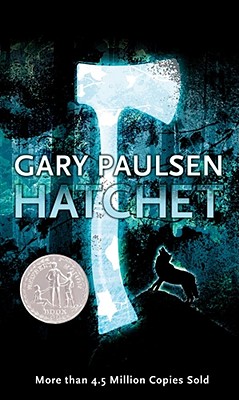
That book leads one to think of the uber-survival novel: Hatchet, by Gary Paulsen.  A light plane goes down in the wilderness of northern Canada, with the sole survivor a teenage boy whose only possession is a small hatchet.  Unlike My Side of the Mountain, Hatchet is filled with self-doubt, and the trials of a young man who starts out completely clueless about how to survive.  It's an older read: the first chapter includes a graphic description of the pilot dying of a heart attack.  But it's riveting.

If you're revisiting survival novels of your youth, why not take a look at  Island of the Blue Dolphins by Scott O'Dell?   I don't know how it would play for Eleanor.  An Indian girl living alone on an island off the coast of California.  Lots of figuring out how to fend for oneself, and defending against predators. 

Last weekend was the National Book Festival here in D.C.  I missed one day of it because I was hosting several authors -- including Mark Teague and Tamora Pierce! -- who came by the store to sign copies of their books.  It was a pleasure to meet them -- they were in town for the festival.  On Sunday I managed to get to the mall and hear a number of kids' authors.  What struck me most this year, though, had to do with the people in the audience.

During Grace Lin's presentation, I sat next to a middle-aged woman from Pennsylvania who was getting her PhD in children's literature.  Her dissertation is on kids' books about racially mixed families.  When Susan Cooper spoke, I wasn't very aware of the woman sitting on my right until, when the audience started moving out, a young woman appeared on my left, leaning over me, and breathlessly asked my seating companion if she had spoken on a panel the day before.  Yes, she had.  "Oh, you're,  you're -- "  "Megan Whalen Turner," the woman replied, smiling, "Yes I am."  They walked off together.  She's the author of a much-loved fantasy series set in Attolia (see Tui's comment here).

Wow -- I've just mentioned three major fantasy writers (Cooper, Pierce, Turner) who I saw last weekend, none of whom we've blogged about at any length.  So much still to do!

But back to book-lovers.  Mark Teague, illustrator of the Poppleton books and the cloying but well illustrated How Do Dinosaurs... books attracted a crowd whose average height must have been about four feet tall.  Dozens of kids lined up to ask him star-struck questions about his work.  It was pretty much the same four questions over and over, all of which he answered with warmth and humor.  The whole festival made me feel great about the future of reading.

So I leave you with the first eight panels of Lynda Barry's "20 Stages of Reading," a work commissioned by the Washington Post to publicize this year's Book Festival:


... continued here.

Love,

Deborah


Monday, September 23, 2013

Independent living

Dear Aunt Debbie,

Your mention of Julie of the Wolves reminded me of another One Young Person Surviving the Wilderness story which I read in elementary school: My Side of the Mountain.  I'd forgotten, if I ever knew, that both books were written by the same author, Jean Craighead George.  My memories of the book were fairly dim -- a snowstorm, a hollow tree, a bird -- and I don't think it's a book I ever reread, which says something about how much I liked it, as I was an inveterate rereader.  I thought of how much Eleanor loved the Little House books, with their highly specific details about how to make and do the things necessary for life in the Big Woods and on the prairie, and of how much she loved the running away and planning in From the Mixed-Up Files of Mrs. Basil E. Frankweiler, and wondered if My Side of the Mountain  would be a good book to go to next.  Happily, it's one of those classics that is easily found on the shelves of my local library, without having to request it from another branch.  I took it out and reread it today.  And remembered why I do not love this book.

On one level, it's a really interesting story: 12-year-old Sam Gribley decides he's fed up with life in a New York apartment with his eight brothers and sisters, and runs away to live alone on land owned by his family in the Catskill Mountains.  He is amazingly successful at feeding, clothing, and housing himself, and George provides copious details about how to hollow out a tree to live in, and which plants are edible.  Sam steals a baby falcon from her nest and trains her up to hunt for him; for much of the book, the falcon Frightful is his only companion.  Sam enjoys the solitude at first, but then begins to look for human companionship, and has a few interactions with people who come across him on the mountain: a lost college professor, a boy his age who wants to be a newspaper reporter.  Though he's tried to escape into the wilderness, he ultimately creates civilization around himself.

I think what keeps me from entering into the story more is Sam's total competence.  Nowhere in the book does he explain how he knows so much about every aspect of living in the woods.  At the beginning, he refers to not knowing at first how to start a fire with a flint, and later he describes having to try building a chimney for his treehouse a few times before getting it right, but his narration is largely straightforward: then I skinned the deer and tanned its hide and made a perfect pair of pants.  Really?  On your first try?  After coming from an apartment in New York City?  I buy that a city boy would want to run away to the wilderness, and that he might know something about how to survive.  (My own brother, Michael, chafed at growing up in New York and once in high school went so far as to plan to run away to the Grand Canyon; later in life, he learned to farm, to butcher cows, and to camp pretty much anywhere.)  In a preface to the edition I read, Jean Craighead George writes that in her own childhood, her father took her camping and taught her about wilderness survival, and her brothers trained falcons.  Giving that kind of background to Sam would make his abilities more believable, but in the narrative there's almost no reference to his family or life before running away.  His voice reads largely like a summary of his experience, a kind of animated How To Survive in the Woods.  His character is stoic, and I find it hard to imagine a truly stoic 12-year-old.

So this won't be the next book I pick up with Eleanor.  Perhaps she'll like it herself, in a few years time.

Love, Annie

Wednesday, September 18, 2013

Name that book

Dear Annie,

Ah, the power of great folk tales.  Especially when women are leading the charge.

I had a very satisfying Book Lady Moment yesterday.  A customer had been asked by a friend to pick up a book about which she knew only:
  • It was by a Newbery or Caldecott winning author.
  • It had a monster or a wolf and the ocean in it.
  • The author was female.
My first thought was Julie of the Wolves, by Jean Craighead George.  The story of an Inuit girl who lives with a wolf pack, it won the 1973 Newbery Medal.

No, said the customer, that's not it.  Then she added that the friend had heard the author on the radio recently.  George died last year, so that was definitely out.

But radio attention was the key that solved the riddle.

This week, the National Book Award, in an effort to get more publicity for good books, decided to release a "Longlist" of contestants for the 2013 Award.  The Young People's Literature list includes ten nominees.  It's a good list this year, ranging from edgy YA books to some very sweet and engaging books aimed much younger kids.

One of the nominated authors is Kathi Appelt, who won both a Newbery Honor and a National Book Award Finalist spot for her 2010 book The Underneath.  Not a big fave of mine: a little dark and too fond of the nobility of suffering.  Her current release, though, is delightful: The True Blue Scouts of Sugar Man Swamp.  There are no wolves in the book, although there are two very likable raccoon siblings.  The bad guys are the evil real estate developers, but there is a monster of sorts: the Sugar Man, a tropical yeti-like figure.  It all takes place in a swampy bayou in Texas -- I guess it sort of qualifies as ocean.

No wolves or open ocean, but it was the answer.  Once she heard the title, the customer knew that was it.  It's fun, this guessing game I play often with my customers.  And when the answer is a thoroughly enjoyable book, it feels all the better.

Love,

Deborah