In which Annie (high school teacher, mother of two young girls and a younger boy) and her aunt Deborah (children's bookseller, mother of two young women in their 20s) discuss children's books and come up with annotated lists.

Showing posts with label Mary Pope Osborne. Show all posts

Monday, January 5, 2015

Early chapter books, step by step

Dear Annie,

Happy New Year!

We're starting 2015 with an Emerging Reader, as we say in the biz.  Your pal (and guest blogger) Cyd's daughter Ellie is working her way into independent reading step by step:

We went from Learn to Read type books (Henry and Mudge, Pinkalicious, Fancy Nancy) to Mercy Watson and then to Stephanie Greene's Princess Posey series (perfect next step: chapter books but with large print, short chapters, and easy vocabulary, but high-interest level for a first grader, as they are about a first-grader) and now we've just started Julie Sternberg's
Like Pickle Juice on a Cookie
, which is also perfect: very short chapters, slightly harder vocabulary (but only slightly), written almost like verse so not much text on a page.... I need something at either the same level or just above.  She gets overwhelmed by too many words on a page and too much vocabulary she doesn't know and then gives up, so taking it up notch by notch is very important.

I've grabbed a handful of books -- all from different series -- which I would talk with Cyd and Ellie about if they came to the store.  I'm not sure where Ellie's interests lie, but here's an assortment to consider, more or less in order of difficulty.

-- The Cam Jansen series by David Adler, now up to #33.  Cam is a fifth grader with a photographic memory.  She needs only to say "click," and she memorizes a perfect image of what she's looking at.  Very useful in solving a string of mysteries with her friend Eric.  The mysteries maintain interest, and  action.  Pictures on almost every page, with occasional lapses.  Here's a two-page spread from the first book:

 
-- I know I rail against Magic Tree House books, but this is the situation they were invented for.  They're great for kids who are getting their confidence reading on their own.  Think of these books, with repetitive plots and structure, as aerobics for the reading muscles.  The reader doesn't need to figure out who the characters are every time she opens a book, she knows more or less what to expect, yet has some variety from story to story.  She can keep exercising those muscles until they're strong enough to realize they're a bit bored, and ready for something more challenging.

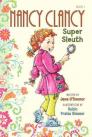
-- Cyd mentions that Ellie's progressed beyond the Fancy Nancy readers.  Jane O'Connor has also put her character into a chapter book mystery series: the first is
Nancy Clancy Super Sleuth
.  The mysteries are tame, the emoting is high.  As with all Fancy Nancy books, these come with a Lesson to be Learned.  In this book, it has to do with her parents trying to convince her that everything isn't a huge deal to worry about.
-- Sometimes I feel the entire publishing industry is pushing Books About Girls, and Books About Boys, with not a lot in between. But hey, you may find the perfect book if you cross the line. 
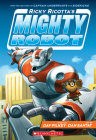
Ricky Ricotta's Mighty Robot
, by Captain Underpants author Dav Pilkey, combines slick illustrations, a little bit of graphic novel, simple text and a sense of humor.  Ricky is a mouse who befriends a giant robot.  They have adventures that involve some cartoon physical combat and villains from many planets.  They're an easier read than Captain Underpants.

-- Moving to slightly harder, the Geronimo Stilton series is wildly popular.  It's translated from the Italian, about a newspaper editor mouse who has many many adventures.  The series has spawned several spinoff series as well.  Part of the attraction of the books is the playful use of typeface:

-- The same author has started a lovely mystery series called Agatha, Girl of Mystery, under another pseudonym, Sir Steve Stevenson.  It's a little harder read.  Agatha goes to a different country in each book (eight so far), and the mystery usually involves a missing object.

-- Has Ellie read Flat Stanley by Jeff Brown yet?  A classic: Stanley wakes up one morning and he's flat.  Flat enough to be a kite, to be mailed to California, and to solve a museum theft by hanging on a wall.

Three which you've probably hit as read-alouds are worth considering for reading alone:

-- The wonderful Anna Hibiscus.  Good stories, lots of pictures, just good.

-- The Ramona books.  Ellie's probably not quite there yet, but her familiarity with them might make them feel a bit less intimidating.

-- Lulu and the Brontosaurus comes in a nice oblong shape with illustrations on every two-page spread.  And it has that excellent repeating chant:  "I'm gonna, I'm gonna, I'm gonna, gonna get/A bronto-bronto-bronto Brontosaurus for a pet."
I've saved one of my favorites for last.  In the great sea of early chapter books, many of which are just great for this stage of getting used to reading, lovely writing is not always there.  Enter
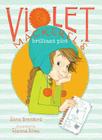
Violet Mackerel
by Anna Branford, a relatively recent arrival from Australia. It has large type, fewer words per page, but a more sophisticated vocabulary than others with this typeface. Violet lives with her single mom (romance shows up as the series progresses) and has real-life feelings and mild adventures.  I love to sell this book: I just open it up and show the customer the first page:
Chapter One: The Red Button
Violet Mackerel is quite a small girl, but she has a theory.
  Her theory is that when you are having a very important and brilliant idea, what generally happens is that you find something small and special on the ground.  So whenever you spy a sequin, or a stray bead, or a bit of ribbon, or a button, you should always pick it up and try very hard to remember what you were thinking about at the precise moment when you spied it, and then think about that thing a lot more.  That is Violet's theory, which she calls the Theory of Finding Small Things.

Here's hoping Ellie will find many more books -- small and large -- to keep her happily reading.

Love,

Deborah


Wednesday, January 22, 2014

Independent reading

Dear Aunt Debbie,

What a prodigious feat of linking!  I love Bob's poem, and loved perusing your 1994 reading history, recognizing so many of the names listed and discovering a few I didn't know.

I wrote last week about the ways in which our family reading has come together in our love affair with the Bone graphic novels. On the flip side, my three children are each individually highly engaged with books of their own choosing.

At 11 months, Will understands that books are important. He has gotten terribly good at pulling books off the coffee table onto the floor, where he can sit and get them open. He takes dust jackets off hardcovers and mauls paperbacks, yelling when we take them away. We keep our board books on the lowest shelves in the living room, and about two weeks ago, Will started pulling out bunches of them and then bringing them to us to read to him. He can crawl with a board book in one hand, sit up, and proffer it with a raised arm and a hopeful glance. His most-requested list at the moment: I Love Colors,  My Face Book, Doggies, and Global Babies. Sometimes, he bats them open himself and pats at them on the floor -- this total independence is especially true with the Matthew Van Fleet books Cat and Dog. Pictures of babies still bring the biggest smiles and most vocalization.


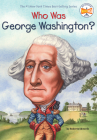
Between her classroom library, your gifts, and our local library, Eleanor is speeding through a variety of series. She loves the Who Was... books, and tonight in the bath entertained us with facts about George Washington (he had a harsh, cold mother), Harry Houdini (he was the first man to fly an airplane in Australia), and Sally Ride (she had to strap herself in with Velcro in order to go to the bathroom in space).

Eleanor is also picking up historical facts from the Magic Tree House series, by Mary Pope Osborne. I'm so glad I followed your advice on not introducing these books until she was reading independently -- there are five million of them, all versions of the same plot and all written in the same flat language. The plus side is that Osborne does her research. Eleanor now knows about groundlings in Shakespeare's Globe Theater, and has learned how gorillas frighten away predators, among other things. After reading 10 or so of the series, Eleanor is becoming dissatisfied with it, however. Her complaint? The close third-person narration always focuses on Jack rather than his sister Annie -- you don't get as much of a sense of what she's thinking or feeling. (That's literary criticism I can get behind.)

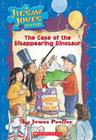
The Jigsaw Jones mysteries, by James Preller, are another recent favorite. Jigsaw (his real name is Theodore, but he solves puzzles, so...) is a second-grader, who works to solve not-too-scary mysteries with his partner, Mila. There are more than 30 books in the series, and I think Eleanor is close to having brought all of them home. Apparently the gender balance in these doesn't bother her as much, though it's another boy-with-girl-sidekick situation.

And Isabel? Yesterday she spent close to an hour sitting on the couch with three Bone books and two Zita books, totally focused in her reading. We just took Bone #8 (of 9!) out of the library today. The series is getting darker and more complicated, and Isabel prefers her own reading of the later books to my offer to read the words. I have a feeling these will be some of the first longer books she learns to read on her own, in a couple of years.

Love, Annie

Monday, June 3, 2013

Reading humility

Dear Annie,

It was so delightful to see you and all of yours this weekend!  I read two books to Isabel; Eleanor read two books to me.  And it was a pleasure to meet the newest relative: young Will was wonderful.

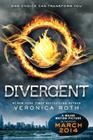
As you know, I was in New York for Book Expo America, the annual booksellers' conference.  It always provides a few unexpected moments that make me glad I was there; this time the surprise came from a wildly successful 24 year-old writer of YA dystopian fiction.  Veronica Roth has sold 3 million copies of
Divergent
and its sequel,
Insurgent
.  Divergent has a YA-familiar story line: in a future controlled society, teenagers get sorted into different groups which narrowly define them for life.  The government is repressive and more corrupt than originally believed by our teenage protagonist.  There's friendship, betrayal, and a fair amount of hand-to-hand combat.  The book ends leaving fans impatient for the sequel.

BEA's Children's Author Breakfast is often inspirational for the hundreds of booksellers gathered at the Javits Center.  (See Lowry, Selznick, and others.)  In theory, this year Roth had tough acts to follow: she spoke after Mary Pope Osborne (Magic Tree House: 110 million books in print) and Rick Riordan (Lightning Thief and many mythology-based sequels: 33 million books in print).  Osborne's speech had been okay; Riordan's felt like he'd said the same words at every book event he'd ever been to.  Then Roth got up, and with an occasional quaver in her voice, spoke from the heart.

She had, she said, been an obsessive child reader until high school.  She had a boyfriend who felt he was too cool for Harry Potter, ridiculing the excitement around the release of the last book.  She ended up reading it in secret weeks after it came out, not telling anyone that she had.  "After that I became ashamed of a lot of the books I liked and tried to push myself to read the books I felt you weren't supposed to be ashamed of."  This eventually led to her stopping reading for pleasure. "I lost my love of reading at the same moment I started to say, 'I already know' instead of 'I'm here to learn.'  In other words, at the moment that I lost my reading humility."

She said her fans got her back into the love of reading because of their unapologetic enthusiasm for many different kinds of literature.
When I talk about reading humility, I'm not talking about turning off your critical brain. I'm talking about the way you read. Reading like someone who is there to learn means assuming at the outset that a book is valuable and searching it for that value. If, at the end of that search, you don't come up with anything, it's important to be able to figure out why. But it's that starting place, that willingness to love things, that I most admire about young readers.

Roth went on to talk about bringing the "I'm here to learn" attitude to her writing -- both in the editing process, and in dealing with reader reaction.


A few months after my first book came out, several book bloggers in the Young Adult blog-o-sphere made me aware of something. There's a trend in Young Adult books in which a sexual assault is used as a plot device, either to illustrate just how bad an antagonist is or to heighten the suspense, which is harmful for many reasons. Chiefly, that it doesn't engage with the issue of sexual assault with care and respect. The aforementioned bloggers indicated to me that a scene in 'Divergent' participated in this trend.


She went through months of feeling defensive before she acknowledged that she used the assault to advance the plot without incorporating its emotional effect on her character.
 
I couldn't change what I had written, but I could change the way I reacted to it. So, I talked about it on my blog, and it was humbling. That act of humility, painful and uninviting though it was, it was a gift. I realized that if I wanted to write a character whose experience was different than mine, humility could drive me to diligent research, careful depiction, thoughtful revision and openness to critique. It could make me free to say, 'I'm here to learn' instead of 'I already know.' And if and when I failed I could be free to say, 'Maybe you have a point, and I can do better next time' instead of 'your critiques are not valid.'

I think what I like about Roth is the sense of her as a work in progress: someone who's still thinking and working things out even though she's become a star in the YA world.  It made me think I should pick up Insurgent sometime soon and check out the author's evolution.

Love,

Deborah

Here's the whole speech.

Wednesday, September 19, 2012

Wisdom and an owl

Dear Annie,

Athena -- a far cry from princess-in-pink.

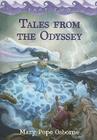
You and Eleanor might like to check out Mary Pope Osborne's
Tales from the Odyssey
. It was originally written as six little books (one of them called The Gray-Eyed Goddess), but the publisher has sensibly pulled them into two volumes -- still pretty short.  Yes, she's the author of the Magic Tree House books, which are not my favorites, but this is better.  I confess I've only browsed through these tales, but they consistently get surprised and pleased reviews from customers.  I'm curious what you'd think of them.

One of the joys of domestic life in our household is the high quality literary references.  Bob and I were discussing your latest post at dinner, and he reached a book off the shelf and read me a few pages.  It was The Sword in the Stone by T. H. White, and the scene is one in which the young Arthur -- known as the Wart -- first meets Merlyn, and his owl Archimedes.  At first the owl tries hard to ignore him, then perches skeptically on his shoulder as the humans converse.
   . . . he felt a curious sensation at his ear.  "Don't jump," said Merlyn, just as he was going to do so, and the Wart sat still.  Archimedes, who had been standing forgotten on his shoulder all this time, was gently touching himself against him.  His beak was right against the lobe of the ear, which its bristles made to tickle, and suddenly a soft hoarse little voice whispered, "How d'you do," so that it sounded right inside his head.
   "Oh, owl!" cried the Wart, forgetting about Merlyn's troubles instantly.  "Look, he has decided to talk to me!"
   The Wart gently leaned his head against the soft feathers, and the brown owl, taking the rim of his ear in its beak, quickly nibbled right round it with the smallest nibbles.
   "I shall call him Archie!" exclaimed the Wart.
   "I trust you will do nothing of the sort," cried Merlyn instantly, in a stern and angry voice, and the owl withdrew to the farthest corner of his shoulder.
   "Is it wrong?"
   "You might as  well call me Wol, or Olly," said the owl sourly, "and have done with it."
   "Or Bubbles," added the owl in a bitter voice.
   Merlyn took the Wart's hand and said kindly, "You are only young, and do not understand these things.  But you will learn that owls are the politest and most courteous, single-hearted and faithful creatures living.  You must never be familiar, rude or vulgar with them, or make them to look ridiculous.  There mother is Athene, the goddess of wisdom, and though they are often ready to play the buffoon for your amusement, such conduct is the prerogative of the truly wise.  No owl can possibly be called Archie."
   "I am sorry, owl," said the Wart.
   "And I am sorry, boy," said the owl.  "I can see that you spoke in ignorance, and I bitterly regret that I should have been so petty as to take offense where none was intended."
I hope Eleanor's Athena is both truly wise and equipped with an exceptional owl.

Love,

Deborah