In which Annie (high school teacher, mother of two young girls and a younger boy) and her aunt Deborah (children's bookseller, mother of two young women in their 20s) discuss children's books and come up with annotated lists.

Showing posts with label Cleary. Show all posts

Monday, January 5, 2015

Early chapter books, step by step

Dear Annie,

Happy New Year!

We're starting 2015 with an Emerging Reader, as we say in the biz.  Your pal (and guest blogger) Cyd's daughter Ellie is working her way into independent reading step by step:

We went from Learn to Read type books (Henry and Mudge, Pinkalicious, Fancy Nancy) to Mercy Watson and then to Stephanie Greene's Princess Posey series (perfect next step: chapter books but with large print, short chapters, and easy vocabulary, but high-interest level for a first grader, as they are about a first-grader) and now we've just started Julie Sternberg's
Like Pickle Juice on a Cookie
, which is also perfect: very short chapters, slightly harder vocabulary (but only slightly), written almost like verse so not much text on a page.... I need something at either the same level or just above.  She gets overwhelmed by too many words on a page and too much vocabulary she doesn't know and then gives up, so taking it up notch by notch is very important.

I've grabbed a handful of books -- all from different series -- which I would talk with Cyd and Ellie about if they came to the store.  I'm not sure where Ellie's interests lie, but here's an assortment to consider, more or less in order of difficulty.

-- The Cam Jansen series by David Adler, now up to #33.  Cam is a fifth grader with a photographic memory.  She needs only to say "click," and she memorizes a perfect image of what she's looking at.  Very useful in solving a string of mysteries with her friend Eric.  The mysteries maintain interest, and  action.  Pictures on almost every page, with occasional lapses.  Here's a two-page spread from the first book:

 
-- I know I rail against Magic Tree House books, but this is the situation they were invented for.  They're great for kids who are getting their confidence reading on their own.  Think of these books, with repetitive plots and structure, as aerobics for the reading muscles.  The reader doesn't need to figure out who the characters are every time she opens a book, she knows more or less what to expect, yet has some variety from story to story.  She can keep exercising those muscles until they're strong enough to realize they're a bit bored, and ready for something more challenging.

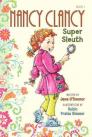
-- Cyd mentions that Ellie's progressed beyond the Fancy Nancy readers.  Jane O'Connor has also put her character into a chapter book mystery series: the first is
Nancy Clancy Super Sleuth
.  The mysteries are tame, the emoting is high.  As with all Fancy Nancy books, these come with a Lesson to be Learned.  In this book, it has to do with her parents trying to convince her that everything isn't a huge deal to worry about.
-- Sometimes I feel the entire publishing industry is pushing Books About Girls, and Books About Boys, with not a lot in between. But hey, you may find the perfect book if you cross the line. 
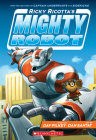
Ricky Ricotta's Mighty Robot
, by Captain Underpants author Dav Pilkey, combines slick illustrations, a little bit of graphic novel, simple text and a sense of humor.  Ricky is a mouse who befriends a giant robot.  They have adventures that involve some cartoon physical combat and villains from many planets.  They're an easier read than Captain Underpants.

-- Moving to slightly harder, the Geronimo Stilton series is wildly popular.  It's translated from the Italian, about a newspaper editor mouse who has many many adventures.  The series has spawned several spinoff series as well.  Part of the attraction of the books is the playful use of typeface:

-- The same author has started a lovely mystery series called Agatha, Girl of Mystery, under another pseudonym, Sir Steve Stevenson.  It's a little harder read.  Agatha goes to a different country in each book (eight so far), and the mystery usually involves a missing object.

-- Has Ellie read Flat Stanley by Jeff Brown yet?  A classic: Stanley wakes up one morning and he's flat.  Flat enough to be a kite, to be mailed to California, and to solve a museum theft by hanging on a wall.

Three which you've probably hit as read-alouds are worth considering for reading alone:

-- The wonderful Anna Hibiscus.  Good stories, lots of pictures, just good.

-- The Ramona books.  Ellie's probably not quite there yet, but her familiarity with them might make them feel a bit less intimidating.

-- Lulu and the Brontosaurus comes in a nice oblong shape with illustrations on every two-page spread.  And it has that excellent repeating chant:  "I'm gonna, I'm gonna, I'm gonna, gonna get/A bronto-bronto-bronto Brontosaurus for a pet."
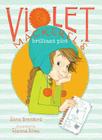
I've saved one of my favorites for last.  In the great sea of early chapter books, many of which are just great for this stage of getting used to reading, lovely writing is not always there.  Enter
Violet Mackerel
by Anna Branford, a relatively recent arrival from Australia. It has large type, fewer words per page, but a more sophisticated vocabulary than others with this typeface. Violet lives with her single mom (romance shows up as the series progresses) and has real-life feelings and mild adventures.  I love to sell this book: I just open it up and show the customer the first page:
Chapter One: The Red Button
Violet Mackerel is quite a small girl, but she has a theory.
  Her theory is that when you are having a very important and brilliant idea, what generally happens is that you find something small and special on the ground.  So whenever you spy a sequin, or a stray bead, or a bit of ribbon, or a button, you should always pick it up and try very hard to remember what you were thinking about at the precise moment when you spied it, and then think about that thing a lot more.  That is Violet's theory, which she calls the Theory of Finding Small Things.

Here's hoping Ellie will find many more books -- small and large -- to keep her happily reading.

Love,

Deborah


Saturday, September 27, 2014

Audio on the road

Dear Annie,

I hope you all are feeling more settled in your house, into the routines of school, and well-partied from Isabel's fifth birthday.  What a lot has been happening!

You sent me a lovely query from your friends Eunice and Ryan about audio books on a car trip, a topic near and dear to my personal and professional hearts.

Ryan is taking two boys, in first and third grade, "on an epic southwest road trip (Yosemite, Mammoth, Death Valley, Grand Canyon, Bryce, Zion, Yellowstone, Tahoe). "  Says Eunice:
There's a lot of car time coming up for Ryan and the boys. I tried convincing him that an audio download of Harry Potter would be the perfect fit, but Ryan is dead set on sticking with only "western" themed children's books.
As a family, we spent large amounts of time listening to audio books, both on long road trips, and going from place to place in town.  They're a fantastic way to enjoy a trip while still being able to look out the windows.

With audio books, even more than when a parent reads, delivery trumps content.  A good or average book read by an average (or bad) reader won't hold anyone's attention.  As we used to counsel our children in college: pick the elective course by the professor, someone who can excite you about a topic you didn't know you wanted to know about.  Going for the topic alone -- with professors or audio books -- can condemn you to boredom.  I think that's Eunice's motivation with the Harry Potter suggestion.  They're fantastic audio, but I'd suggest waiting a couple of years for the kids to get more out of them, and to avoid the really scary bits.

So I've come up with a list which includes some western themes, some vaguely western themes (does Portland, Oregon count?), books about trips and quests, and just good books.

I'll start with Jim Weiss, who's a storyteller.  His recordings sound like someone who's telling a story -- a little chattier -- not like someone who's reading you a book.  Lizzie was hooked on his King Arthur recording for years.  He's got a few western themes:
American Tall Tales: Paul Bunyan, Pecos Bill, "Fastest Draw in the West."
His Gone West includes Lewis and Clark, the Oregon Trail, and Indian wars.
A CD called Tales from Cultures Far and Near has what's described as a funny Lakota Sioux legend, then other stories from around the world.

Robin Williams' Pecos Bill
The best storytelling audios ever, in my opinion, are the Rabbit Ears recordings.  They paired famous actors and actresses reading with background by major musical talent.  So you've got:
Robin Williams reading Pecos Bill with music by Ry Cooder,
Keith Carradine telling the story of Annie Oakley with music by Los Lobos,
Jonathan Winters doing Paul Bunyan with Leo Kottke.
There are lots more: check out the Rabbit Ears site.

All of these storytelling recordings, although entertaining, are not as long as book audios.  Most of them are 30 to 60 minutes.  Most books will run you much longer.

On themes of the west and wildlife and a great story, you can't go wrong with
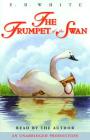
The Trumpet of the Swan
, written and read by E.B. White. He has a wonderful old Mainer voice.  The story of Louis, the mute trumpeter swan, starts in western Canada, spends a good deal of time in Montana, and eventually makes it cross country to the Boston Public Garden.  It's full of nature and boy/swan friendship, and just great storytelling.

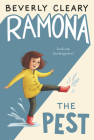
On to Portland, Oregon and two wildly different genres.  Beverly Cleary, as you know, is one of my favorite authors.  Stockard Channing did an excellent job of recording the Ramona books: they follow a younger sister from her pre-school days through fourth grade.  I don't know how these guys feel about books whose central characters are female (sigh), but I'd recommend two different Ramona books with boys as major secondary characters.  Cleary writes very empathetically about the experience of whatever age she's describing.  Ramona the Pest, about her kindergarten year, includes a rivalry with Howie, the boy next door.  And in Ramona Quimby, Age 8 she has a constant teasing friendship with the boy she refers to as "Yard Ape."  That book also features Ramona throwing up in school, and breaking a raw egg on her head.

Cleary also did a series about a boy named Henry Huggins.  Those books feel a little more dated than the Ramonas, but they're still entertaining.  The reader isn't up to Channing's high quality.  The first book, Henry Huggins, includes the story of Henry finding Ribsy, a stray dog, and coming very close to losing him again.  Great for dog loving kids.

And one other Portland book:
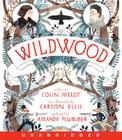
Wildwood
, by Colin Meloy (lead singer of the Decembrists), read by Amanda Plummer.  I'm surprised I haven't blogged about this book.  It's a Narnia-like fantasy: two kids enter a magical forest in Portland, trying to find a baby who's been stolen by crows.  They enter into a world of talking animals, bandits, and shifting alliances.  It's an intricate and well-written tale which will last for many hours.  I haven't heard the audio, but we get good reviews of it from customers.

I'll end with two great completely different books about travel/quests.  We know how much we all like Where the Mountain Meets the MoonThe recording, I'm told, is also excellent.  It's about running away from home and going on a quest to find the Man in the Moon.  Will entertain in a car for quite a while.

I've saved the weirdest for last:  Jim Copp's and Ed Brown's  children's stories, recorded mostly in the 1960s.  We came upon them by chance, following up on a brief mention of them in The Atlantic, of all places.  Lunatic, hilarious, wacky and weird are words which come up in descriptions of them.  The recording we loved -- and the whole family can still quote from -- is A Journey to San Francisco with the Glups.  Think of it as The Stupids Go on a Road Trip.  The Glups are a completely clueless family, traveling with their cow Bossy from Maine to San Francisco to claim an inheritance.  There are songs and great sound effects and many different accents -- and of course some mooing. 

So there's an array of audio.  I envy those three guys the trip.   How about a guest blog when they get back about what they listened to?

Love,

Deborah


Wednesday, February 13, 2013

Will!

Dear Annie,

The entire extended family is dancing with joy, waiting for this little guy to wake up, grow a bit, and dance with us:

Will!
Will arrived early this morning, missing his uncle's birthday by a few hours.  You're now a five-person nuclear family.  I suspect Will's big sisters (how does that title feel to Isabel?) will start reading to him soon.  The new baby books, of course, and the three-child-family ones, and many many more.

We can't wait to meet him.  In the meantime, we will send him books and ooh and aah over his pictures, and cheer on his amazing sisters.

I offer you two quotes from children's literature, to celebrate the boy.

I've cited Ramona's wonder at having a baby sister in the three-child-family post, but here's a snippet again:
"Look at her tiny fingernails," Ramona marveled as she looked at the sleeping Roberta, "and her little eyebrows.  She is already a whole person, only little."
And from William Steig's Sylvester and the Magic Pebble, a different context -- the missing Sylvester has been restored to his parents --but applicable to the birth of a baby as well:
When they had eventually calmed down a bit, and had gotten home, Mr. Duncan put the magic pebble in an iron safe. Some day they might want to use it, but really, for now, what more could they wish for? They all had all that they wanted.
I suspect you have all you want right now (except maybe more sleep...).   Enjoy tomorrow's homecoming, and all that follows.  We have guest bloggers waiting in the wings, and will be very happy to hear all about your five-person family whenever you come up for air.

With much love for all,

Deborah

Tuesday, October 16, 2012

Families of five

Dear Annie,

I'm not so good on the Noisy Nora girl-girl-boy family structure, but here are a few classic three-child families (with thanks to the brainstorming abilities of my co-workers):
  Wendy came first, then John, then Michael. 
  Peter Pan!  (Full text here.)  Mrs Darling remembers the children's last evening at home:
She had found her two older children playing at being herself and father on the occasion of Wendy's birth, and John was saying:
  "I am happy to inform you, Mrs. Darling, that you are now a mother," in just such a tone as Mr. Darling himself may have used on the real occasion.
  Wendy had danced with joy, just as the real Mrs. Darling must have done.
  Then John was born, with the extra pomp that he conceived due to the birth of a male, and Michael came from his bath to ask to be born also, but John said brutally that they did not want any more.
  Michael had nearly cried. "Nobody wants me," he said, and of course the lady in the evening-dress could not stand that.
  "I do," she said, "I so want a third child."
  "Boy or girl?" asked Michael, not too hopefully.
  "Boy." 
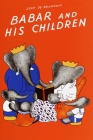
 Staying with the classics,  Babar and Celeste have an instant three-child family when their first-born turns out to be triplets in
Babar and His Children
. The girl is named Flora; the boys are Pom and Alexander.

Another Alexander, this one of the Terrible, Horrible, No Good, Very Bad Day, is afflicted with two big brothers.
At breakfast Anthony found a Corvette sting Ray car kit in his breakfast cereal box and Nick found a Junior Undercover Agent code ring in his breakfast cereal box but in my breakfast cereal box all I found was breakfast cereal.

Three boys there, and on the other side of the country, three girls at the Quimbys'.  The summer after Ramona's third grade year, the ultimate little sister becomes a big sister. 

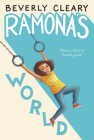
Ramona's World
starts:
Ramona Quimby was nine years old.  She had brown hair, brown eyes, and no cavities.  She had a mother, a father, a big sister named Beatrice who was called Beezus by the family, and -- this was the exciting part -- a baby sister named Roberta after her father, Robert Quimby.
     "Look at her tiny fingernails," Ramona marveled as she looked at the sleeping Roberta, "and her little eyebrows.  She is already a whole person, only little."
Of course the baby becomes a bit more problematic as she grows, learns to spit mashed peas, screams a fair amount, and sucks up adult attention.

And another big favorite: Dogger, with a wonderful girl-boy-boy family.  It's a story of siblings caring about each other.  So I'll leave you with this lovely illustration, and I'll think of your future in Brooklyn whenever I look at it:
Love,

Deborah


Tuesday, July 17, 2012

Rule-breakers and their siblings

Dear Aunt Debbie,

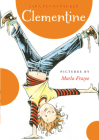
While I understand the desire to write about a book in a way that doesn't give away major plot elements, that is one very strange review.  We read the first Clementine book several months ago, and enjoyed it -- shades of Ramona or Junie B. Jones, with uncontrollable but generally well-meaning acting out, and a quirky heroine with a pleasant, also quirky family.  Knowing that this is the series Pennypacker is most famous for, I'd think a reviewer would want to drop a hint about unexpected darker content. 

Eleanor and I just finished Ramona the PestAs you've written before, Beverly Cleary does a terrific job of communicating kid-logic.  Ramona's thought processes and obsessions feel age-appropriate, though there's also a clear adult sensibility in the narration, providing details which allow you to see what's going on beyond Ramona's understanding.  Ramona is exactly Eleanor's age in the book -- five years old, and starting kindergarten.  So there's some room for identification with a character there, but at the same time, Eleanor is not anywhere near the kind of rule-breaker Ramona is.  As we read about Ramona's inability to keep herself from pulling her classmate Susan's curls, even when she wants to please her teacher, Miss Binney, Eleanor seemed a little confused: why can't Ramona control herself better?

As foil to Ramona, there is of course her older sister Beezus, who follows rules, is concerned about reputation, and finds Ramona's uncontrollable behavior incredibly hard to deal with.  There's something to identify with there, too, in the older sister.  But of course Beezus isn't as interesting a character as Ramona.  We get one book from her perspective (Beezus and Ramona), as opposed to Ramona's seven.

Clementine's
foil isn't a sibling (she has a younger brother, who she refers to with a changing variety of vegetable names: "Spinach," "Lima Bean"; at least in the first book, he's not much of a character), but her friend Margaret, who is neat, clean, organized, and rule-following. And, you know, less interesting than Clementine.

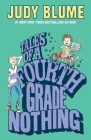
One of the few series I can think of in which the perspective stays with the better-behaved sibling is Judy Blume's Tales of a Fourth Grade Nothing.  Peter Hatcher narrates this and the following three books, recounting his tribulations as older brother to the rambunctious, rule-breaking Fudge.  Of course, the series is referred to as the Fudge Books.  I've always liked Peter as a narrator -- exasperated, but ultimately fond, taking responsibility for his little brother even as he feels like he's being driven crazy.  He's a nice guy, and the books are very funny.  And perhaps my own older-sibling status as I was growing up made me gravitate toward him, rather than Ramona.

On a final note, sad news: I read last night that this week we lost both Donald J. Sobel, author of the Encyclopedia Brown mysteries, and Else Holmelund Minarik, author of the Little Bear books, which are some of our most beloved here.  Both had long lives, but it's a loss just the same.

Love, Annie

Wednesday, February 1, 2012

Tummy misery

Dear Annie,

I'd never thought of The Very Hungry Caterpillar as a cautionary tale on overeating -- interesting interpretation!  But the overeating leads ultimately to beauty and flight...

The other illness from overeating I can think of is
The Lady with the Alligator Purse
, which is about a baby drinking the bathwater, eating the soap, and being misdiagnosed. Lovely video of three sisters reading it here.

I'm taking you up on the Throw-Up Challenge.  (The Upchuck Event?)  I still can't think of any in the picture book category. 

I return to the Ramona books by Beverly Cleary, exquisitely empathetic portrayals of life from pre-school to fourth grade.  I've just re-read Chapter 6 of
Ramona Quimby, Age 8
: "Supernuisance."  Ramona is in third grade and her loving but overloaded parents are struggling with financial problems.  She has overheard her teacher describe her as "a nuisance," which has deflated her enthusiasm for anything in school.  So one morning when her parents' car breaks down, she arrives in her classroom with its wall of science experiments (fruit flies growing in colored oatmeal), feeling increasingly bad:
She sat motionless, hoping the terrible feeling would go away.  She knew she should tell her teacher, but by now Ramona was too miserable even to raise her hand.  If she did not move, not even her little finger or an eyelash, she might feel better
   Go away, blue oatmeal, thought Ramona, and then she knew that the most terrible, horrible, dreadful, awful thing that could happen was going to happen.  Please, God, don't let me. . . . Ramona prayed too late.
   The terrible, horrible, dreadful, awful thing happened.  Ramona threw up.  She threw up right there on the floor in front of everyone.  One second her breakfast was where it belonged.  Then everything in her middle seemed to go into reverse, and there was her breakfast on the floor.
Ramona is miserable and humiliated.  The teacher sends a student to take Ramona to the office, and she gives the rest of the class permission to "hold your noses and file into the hall until Mr. Watts comes and cleans up."

The school secretary is the mensch of the story, cleaning Ramona up, settling her on a cot, and calling her mother.  Mrs. Quimby is at work, leading Ramona to worry that her illness will cause her mother to lose her job.  When Ramona throws up again, the secretary gets her to the toilet in time, gives her a cup of water and cheerfully says, "You must feel as if you've just thrown up your toenails."

Cleary charts Ramona's misery -- from willing herself not to throw up in the taxi her mother has brought to take her home, through the days of fever and slow recovery.  First she can think only of the secure feel of the clean sheets on her bed.  Family members look in on her from the doorway.  Then she's aware they're having dinner without her.  Next her world expands enough to understand that they're being especially quiet just for her.  There's ginger ale, and later dry toast.  And when she asks sadly for  butter on the toast, we know she's on the way up, at least physically.
Remembering what had happened at school, she began to cry.
   "Dear heart," said her mother. "Don't cry.  You just have a touch of stomach flu.  You'll feel better in a day or so."
   Ramona's voice was muffled.  "No, I won't."
   "Yes, you will."  Mrs. Quimby patted Ramona through the bedclothes.  
   Ramona turned enough to look at her mother with one teary eye.  "You don't know what happened," she said.
   Mrs. Quimby looked concerned.  "What happened?"
   "I threw up on the floor in front of the whole class," sobbed Ramona.
She works her way out of misery during her convalescence in the next chapter, and by the time she gets back on the school bus, throwing up is in the distant past. 

I trust your misery is also a dim memory at this point.  And that it hasn't visited itself on others near and dear to you.

Love,

Deborah

Sunday, July 3, 2011

Family listening

Dear Annie,

Ah, so well said.  And so full of cross-generational memories!  It's wonderful to know that my father read you all the R.L. Stevenson adventures that he read with such relish to me.  No wonder we all love reading with kids so much.  Our imaginations were formed by the voracious reading habits of a quiet Ohio boy of the 1920s whose parents didn't read to him.

There's one reading experience that I discovered with my kids that wasn't a part of my childhood: audio books.  We got into them as a form of entertainment on long trips, then the girls and I would listen in the car when we were running around town, and ultimately the girls would listen to much-loved books over and over again in their rooms.  For reasons I don't quite understand, the audio book experience is different from a parent reading a book.  Sure, there's the obvious difference of having a skilled professional performing the book.  But it also puts parents and kids together on the same side of the experience: we all listen together. 

I never read the Ramona books by Beverly Cleary as a child, and was thrilled to read them to the girls, but the best discovery of all was the
Stockard Channing recordings
.  Cleary is so empathetic to Ramona, whatever age she is.  And Channing captures that real understanding of what it's like to be in kindergarten and angry at the injustice of school rules, or in third grade and throwing up in public, or participating in a wedding with too-tight shoes.  Channing adds dimension to the books, without distorting them.

The summer Mona turned 10 and Lizzie was 11 we drove across the country, listening to books on tape all the way.  There was something very odd about listening to P.G. Wodehouse, a wildly witty British author (and inventor of Jeeves the butler) while driving across Wyoming, but it worked!


And of course the ultimate voice/book combination, embedding itself in the brains of an entire generation since 1999, is
Jim Dale reading Harry Potter
.  He did all seven books, creating voices for hundreds of characters.  I've already written about his "Sorr-eee, Harr-eee,"
an inflection that's positively contagious.

We wondered at times if the girls' love of some audio books was keeping them from reading on their own.  They always read to themselves, but sometimes audio books trumped reading.  During those in-between years of knowing how to read, but not being able to read everything one wanted to fluently, I think the audios sometimes snuck in as a welcome escape.  And the well-loved ones were welcome background noise: it used to drive me crazy that Lizzie would do math homework while listening to a book.  The homework got done, though, and she's been a committed read-to-herself reader for a long time.  But it was a stage in the process of becoming fluent. 

Love,

Deborah

Sunday, June 20, 2010

Books and Movies: which comes first?

The Helen Oxenbury Nursery Collection is so great -- I'm mystified why Candlewick Books decided to put it out of print.  One of our readers has asked about how we know about out-of-print books.  There are lots of sources.  Libraries are probably the best.  They have many books which are great and may have gone out of print recently.  Then there are the books you remember from your own childhood -- alas, many of those may be no longer in print.  If you have only a vague memory of the plot, I recommend www.whatsthatbook.com -- it's lovely.  And once you know what you want, if a library loan isn't permanent enough, check out www.alibris.com.  It's a consortium of used book stores from all over the country. Prices are usually fairly reasonable, and their assessment of condition is pretty close to accurate.

Moving on..  I wanted to talk a little about movies made from books. The Ramona books, by Beverly Cleary, are going to be put into movie form this summer by Disney.  Having looked at the trailer, this depresses me a lot.  Ramona seems to be well cast, but big sister Beezus is a kind of sexy Selena Gomez -- aack!   And scenes from books spanning Ramona's life from pre-school through fourth grade have all been mushed together.  Cleary has written eight Ramona books, which take her from pre-school to fourth grade.  I'll write more about them in another post, but they're wonderfully written, full of funny moments and wry wit, very empathetic with whatever age Ramona is in the book, and understandingly realistic about the little tensions that exist within families.  Although they've been written in order, one can read any one without having read what came before.  For an excerpt from one of them, see my May 2 post.

 I want to bring up parental policy about movies made from books.  There are, of course, many of them , aimed at many different ages.  I've been impressed over the years how many parents I've talked to in the store who say they insist on reading a book before seeing the movie -- no matter how different the two are.  I know you did this, Annie, with Wizard of Oz.  It gives a child the real story before seeing how Hollywood re-works it.  And it offers lots of teachable moments for discussion  of how elements were changed.

So if there are folks out there with children between say, 5 or 6 and 10, why not do a festival of reading Ramona books before Disney undercuts them?  It would be a lovely way to spend the summer. 

Love,

Deborah

Sunday, May 30, 2010

Mirrors & windows 2

Dear Annie,

I think I may have oversimplified Mitali Perkins’ mirror/window analysis in my last post. You talked about a book being able to be both: a reflection of the reader with which s/he can identify, and a way to see new places and have new experiences. Which of course Perkins was intending with the concept too. I really want to read her Bamboo People. Here’s her May 27 post on that BEA breakfast. I love her description of how Cory Doctorow entertained himself while others were speaking.

I’m so glad Eleanor took to Babies Can't Eat Kimchee. It acknowledges the ways in which a newborn can be disappointing (can’t play yet, cries inexplicably, etc) while still celebrating the relationship between siblings – and reminding the older one of her many accomplishments. The window element of the book -- introducing three year-old Eleanor to little bits of Korean culture – is such a great thing to be able to do within the context of everyday reading.

You ask about Lizzie and Mona and the window/mirror stuff. At some point in their chapter book lives, they each gravitated to different kinds of books. Their reading wasn’t exclusively one kind. But Lizzie definitely got very involved in adventure and fantasy books. Treasure Island, The True Confessions of Charlotte Doyle, and The Hobbit were books that she revisited frequently. I think she loved worlds which were very different, yet at the same time she could imagine herself an adventurer in those worlds. Window?

Mona, a year and a half younger, grounded herself in what we referred to as “domestic fiction,” Beverly Cleary’s Ramona books being the best example. Real life for kids. As you know, they’re among my favorites for taking the trials and tribulations of growing up so seriously, while presenting them with such a gentle sense of humor. Mona has always been interested in the interpersonal dynamics around her, and many of the books she chose gave her more reflections of her world. It’s funny, the last books we read aloud with Mona, when she was a high school freshman, were The No. 1 Ladies' Detective Agency series. She was already a strong feminist, and I think the biggest attraction of those books was Mma Ramotswe’s perception of human relations, and Mma's own strong sense of self. So does that make it a mirror? Am I pushing this concept too far?
Love,

Deborah