In which Annie (high school teacher, mother of two young girls and a younger boy) and her aunt Deborah (children's bookseller, mother of two young women in their 20s) discuss children's books and come up with annotated lists.

Showing posts with label mystery. Show all posts

Wednesday, January 22, 2014

Independent reading

Dear Aunt Debbie,

What a prodigious feat of linking!  I love Bob's poem, and loved perusing your 1994 reading history, recognizing so many of the names listed and discovering a few I didn't know.

I wrote last week about the ways in which our family reading has come together in our love affair with the Bone graphic novels. On the flip side, my three children are each individually highly engaged with books of their own choosing.

At 11 months, Will understands that books are important. He has gotten terribly good at pulling books off the coffee table onto the floor, where he can sit and get them open. He takes dust jackets off hardcovers and mauls paperbacks, yelling when we take them away. We keep our board books on the lowest shelves in the living room, and about two weeks ago, Will started pulling out bunches of them and then bringing them to us to read to him. He can crawl with a board book in one hand, sit up, and proffer it with a raised arm and a hopeful glance. His most-requested list at the moment: I Love Colors,  My Face Book, Doggies, and Global Babies. Sometimes, he bats them open himself and pats at them on the floor -- this total independence is especially true with the Matthew Van Fleet books Cat and Dog. Pictures of babies still bring the biggest smiles and most vocalization.


Between her classroom library, your gifts, and our local library, Eleanor is speeding through a variety of series. She loves the Who Was... books, and tonight in the bath entertained us with facts about George Washington (he had a harsh, cold mother), Harry Houdini (he was the first man to fly an airplane in Australia), and Sally Ride (she had to strap herself in with Velcro in order to go to the bathroom in space).

Eleanor is also picking up historical facts from the Magic Tree House series, by Mary Pope Osborne. I'm so glad I followed your advice on not introducing these books until she was reading independently -- there are five million of them, all versions of the same plot and all written in the same flat language. The plus side is that Osborne does her research. Eleanor now knows about groundlings in Shakespeare's Globe Theater, and has learned how gorillas frighten away predators, among other things. After reading 10 or so of the series, Eleanor is becoming dissatisfied with it, however. Her complaint? The close third-person narration always focuses on Jack rather than his sister Annie -- you don't get as much of a sense of what she's thinking or feeling. (That's literary criticism I can get behind.)
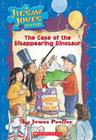
The Jigsaw Jones mysteries, by James Preller, are another recent favorite. Jigsaw (his real name is Theodore, but he solves puzzles, so...) is a second-grader, who works to solve not-too-scary mysteries with his partner, Mila. There are more than 30 books in the series, and I think Eleanor is close to having brought all of them home. Apparently the gender balance in these doesn't bother her as much, though it's another boy-with-girl-sidekick situation.

And Isabel? Yesterday she spent close to an hour sitting on the couch with three Bone books and two Zita books, totally focused in her reading. We just took Bone #8 (of 9!) out of the library today. The series is getting darker and more complicated, and Isabel prefers her own reading of the later books to my offer to read the words. I have a feeling these will be some of the first longer books she learns to read on her own, in a couple of years.

Love, Annie

Thursday, October 25, 2012

Starry River

Dear Aunt Debbie,

Last month, you sent us Grace Lin's Starry River of the Sky, and ended your post wanting to know what we'd think of it.  The verdict is in: Eleanor LOVED it, perhaps more than any other chapter book we've read in a few months.  We read it very quickly, sneaking in a chapter as part of our morning reading along with a picture book for Isabel, and another chapter or two at night.  (There were enough references to animals, and drawings by Lin at the beginnings of chapters, to keep Isabel somewhat engaged.)

What worked so well about this book?  Part of it is the structure Lin uses in Where the Mountain Meets the Moon as well: stories within stories.  The stories in Starry River offered Eleanor multiple opportunities to piece together elements of plot by herself in ways she clearly found satisfying.

At the beginning of the book, the protagonist, Rendi, is presented as a mystery.  We know he's on the run, but don't know where he's going or what he's running from.  He's hostile and uncommunicative, but appealing -- it's clear he's upset by something real.  The mysterious guest at the inn, Madame Chang, tells stories based on Chinese mythology, including the story of WangYi and his wife, who becomes the Moon Lady.  She gets Rendi to agree to tell stories in return, and when he does, it becomes immediately clear that he's telling the true story of his own father.

Or I should say: it becomes immediately clear to an adult reader.  To a five-year-old, it becomes interesting, then exciting, then thrilling to spot the connections and figure out the truth.  The stories invite a gentle spirit of detective work, and wind together in a satisfying puzzle-like way.  When we finished, Eleanor asked immediately if we could read it again soon.  Thank you!

Love, Annie


Saturday, July 14, 2012

Reflections on Nancy Drew

Dear Aunt Debbie,

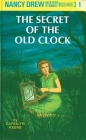
We're back home from a lovely lakeside vacation, during which we finished reading The Secret of the Old Clock.  Eleanor's excitement and complete inability to sit still as we read to her continued through the last chapter of the book, which I found to be an interesting mix of empowering, old-school, and just a little odd.

You mentioned logical reasoning and working things through as one of Nancy's best attributes.  I was struck perhaps even more by her cool competence in a variety of difficult situations.  When she sees a girl fall from a bridge into shallow water, she runs to the rescue and carries her home.  She drives a car (her own) extremely well, including driving her father around to a few appointments.  She knows how to drive a boat, and when the motor stalls (through no fault of her own), she works on it for more than an hour before giving up.  When help doesn't arrive after a few hours of waiting, she tries again:

To occupy her mind, Nancy concentrated once more on the motor.  Determinedly she bent over the engine.  It was not until the sun sank low in the sky that she sat up and drew a long breath.

"There!" she declared.  "I've done everything.  If it doesn't start now, it never will."

To her relief and astonishment, it responded with a steady roar as if nothing had ever gone wrong!

When confronted with rude girls of her own age or with possibly violent thieves, Nancy is internally morally outraged, but keeps her cool.  When locked in a closet, she tries to pick the lock from inside with a bobby pin, then tears down a wooden rod and uses it as a lever to break open the door at the hinges, citing Archimedes as she does so.  She knows how to bandage an elderly woman's leg properly, cook her a nourishing lunch, and move straight on to following thieves at close range and breaking into their truck.  When describing all of these episodes later, she's humble and undramatic.  Some nice role modeling here.

There are of course the requisite descriptions of every outfit she puts on throughout the book (lots of "smart little suits"), which made me think each time of the initial descriptions of the twins at the beginning of each Sweet Valley High book.  And Nancy is quite purely good in so many ways that one wishes at moments for a little more shading of character.  Still, there's a toughness to appreciate.  Eleanor has already asked me to find her book two.

Love, Annie

Monday, July 9, 2012

Mellow mysteries

Dear Aunt Debbie,

I love your suggestions, and will be sure to check them out.  Our nightly vacation reading of Nancy Drew is getting Eleanor so excited that she literally cannot sit still -- she's up and down, sitting on the floor and on the arm of the chair, moving closer to and farther away from the book with the intensity of the suspense.  I look forward to more mysteries with her.

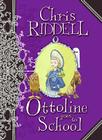
I'm realizing, thinking back on it, that a few of our favorites have also been mysteries of a comic sort, so disguised that I don't think of them as mysteries first.  I wrote a while back about the fabulous Ottoline and the Yellow Cat, by Chris Riddell; in the year and a half since we first read it, we have acquired the other two Ottoline books: Ottoline Goes to School, and Ottoline at Sea (sadly out of print).  All three books are graphic novels, extremely quirky, mysteries of a sort but mostly just tremendously, enjoyably odd.  In Ottoline Goes to School, Ottoline and her friend/caretaker/tiny hairy Norwegian bog-person, Mr. Munroe, enroll along with Ottoline's new friend Cecily in the Alice B. Smith School for the Differently Gifted.  There are very few pupils, each astoundingly rich and odd, and each with a unique pet (the son of the Invisible Man, for example, has an Invisible Dog).  Ottoline tries to determine what her Different Gift is; meanwhile, the school appears to be haunted by the ghost of the Horse of the Hammersteins, who Cecily has a lot of stories about.  While that ghost is revealed by the end not to be real, there are some friendly true ghosts who wander through the pages, and can be great fun to pick out as you go along.  The story is about neediness and friendship -- Ottoline has to navigate her new exciting friendship with Cecily, who tries to pull her away from Mr. Munroe; ultimately, Cecily's loneliness for her parents turns out to be a major cause of her unhappiness.  (A funny moral, given that Ottoline never seems to see her parents, the Roving Collectors, but oh well.)  Ottoline at Sea contains a trip to Norway, a bog monster, and a pair of "bog-goggles" you can use to see hidden pictures in the book.  Eleanor will pore over these books for long periods of time.


For the early reader set, there's the Cynthia Rylant series The High-Rise Private Eyes, more humor than mystery, as I've written about before, but pretty great.


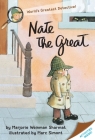
And speaking of great, let's not leave out Nate the Great, those odd little meandering books by Marjorie Weinman Sharmat.  Nate's mysteries always involve him eating a lot of pancakes, and at least in the several we've read, usually also involve slightly odd female friends and a number of cats.  The stakes are low -- a drawing disappears, and Nate figures out that his friend's little brother drew over it -- and the tone is thoughtful.

None of these make Eleanor squirm in her seat, but they do keep her interested.

Love, Annie

Friday, July 6, 2012

Young sleuths

Dear Aunt Debbie,

We just read the dramatic department store scene tonight!  I'm interested to see where it goes, and will report back when we finish our first full Nancy Drew mystery.  So far, Eleanor is totally engaged, but there's a lot to explain, starting with what it means to make a will.

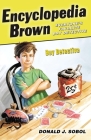
I've been thinking about your point about Nancy Drew (and the Hardy Boys, who I've never read -- in my experience, people read one series or the other, but not both) being models of clear deductive reasoning.  I've written before about my love of mysteries, and have pinpointed Nancy Drew as the beginning of that love, or close to it.  But around the same time, perhaps slightly later, I also read a lot of Donald J. Sobel's Encyclopedia Brown.  


The Encyclopedia Brown stories had a very different feel than Nancy Drew.  From what I remember, the stakes were always much lower, and most of the mysteries focused on kids and their interactions with each other.  The stories were short -- ten to a book -- and offered the same kind of teasing, almost-solvable pleasure that Christie's Poirot mysteries played with later.  You could almost figure these things out, and sometimes maybe you could, but most often you'd just get enough so that when Encyclopedia announced the answer you'd feel a little bit smarter.  The feeling wasn't so much following a train of thought as experiencing or observing a moment of insight.


I still remember a number of random facts gathered from the solutions to these mysteries: a hard-boiled egg spins better than a raw one; the word "bookkeeper" has three consecutive sets of repeated letters; you can use peanut butter to remove chewing gum from hair; tears fall from the inner corner of your eyes, not the outer one, because that's where your tear ducts are.  The first three of these solutions had to do with contests: an egg-spinning contest, a contest at a library, a bubble-blowing contest.  Lots of contests in Idaville, apparently.  The fourth had to do with a girl pretending to cry and using eye drops to fake it, but I forget over what.


I don't feel the same visceral love of Encyclopedia Brown as I do of Nancy Drew, but he was a lot of fun to read, and gave me a taste for puzzling that has served me well.


Love, Annie

Monday, July 2, 2012

Following the clues to the Nancy Drews

Dear Aunt Debbie,

It's interesting to hear what's stuck with you from the Gregor books, and to think about them as homage to Alice in Wonderland as well as A Wrinkle in Time -- of course, the fall down the laundry room grate is like that old rabbit hole.  But no, Gregor and Boots remain their same human size, and it is the animals who are truly enormous -- six-foot tall cockroaches, giant vicious rats.  At the beginning of the second book, Gregor takes Boots to go sledding in Central Park, and she's kidnapped by giant cockroaches there (one of the other entryways to Underland is under a large stone slab in the park).  Gregor figures out what's happened when he sees a dog going crazy barking at what looks like a stick, but turns out to be an enormous articulated cockroach leg that snapped off during the kidnapping.  (To clarify: the roaches kidnap Boots for her own safety, so the rats won't get her first.  They're still good guys.)  Oh yes, I'll be reading all five of these.

We're gearing up for our own vacation, and I've been stockpiling books to read with Eleanor during the week we'll be away with my in-laws in a cabin by a lake in Wisconsin.  The second Borrowers book is waiting for us, and we're already halfway through Ramona the Pest.  The book Eleanor was most excited to pick up from the library, however, was The Secret of the Old Clock, a.k.a. the first volume of the Nancy Drew mysteries, by Carolyn Keene.

Eleanor's interest in Nancy Drew was sparked by our recent reading of The Worry Week, which was a total joy.  Jeff began it with Eleanor, but it was her first week of vacation, so my mom and I were commuting with her around the city, and we all took a turn reading.  What a good book!  I knew I'd read it, but didn't realize until we started again just how many times I must have reread -- so many places throughout the book where I knew lines by heart, after more than 20 years....

It's a book full of references.  Alice, the oldest sister, quotes Romeo and Juliet throughout, so I had to explain the plot of that story.  Allegra, the narrator and middle sister, refers several times to her "pile of Nancy Drews," and Alice at one point twists her ankle and stays in the bath and on the couch reading "all the Nancy Drews."  Eleanor picked up on it: "What's a Nancy Drews?" and I dredged up what I could remember of the many, many Nancy Drew books I sped through in 2nd grade.  I have an image of the shelf they all sat on in my elementary school library: a bottom shelf, filled gloriously from one side to the other with the worn permabound covers, their yellow spines fraying a little at top and bottom, each front cover bearing an image of Nancy finding something amazing or sinister, usually surrounded by darkness.  I remember Nancy was motherless, and lived with her wealthy father and a motherly housekeeper.  She drove a blue roadster, dated the totally forgettable Ned Nickerson, and was best friends with plump, girly Bess and short-haired, tomboyish (ahem, butch) George.  I don't remember a single complete plot.  Elements, yes: a broken locket, lots of running to gazebos at night, close calls.  I have no idea what to expect when Eleanor and I crack this one open.

But apparently I'm in good company in having been a huge fan.  Three years ago, when Sonia Sotomayor was being confirmed as a justice of the Supreme Court, someone dug up the fact that all three (at that point, pre-Kagan) female Supreme Court justices cited Nancy Drew as a major influence.  The New York Times published two articles digging into Nancy Drew's appeal: one focused on the justices, and one expanding the pool of fans to include all kinds of high-powered women.  She's been a lot of things to a lot of girls and women over the years.  I'll report back on her impact in this house.

Love, Annie