In which Annie (high school teacher, mother of two young girls and a younger boy) and her aunt Deborah (children's bookseller, mother of two young women in their 20s) discuss children's books and come up with annotated lists.

Thursday, October 4, 2012

Tickle break

Dear Annie,

That's so lovely that you know the author of Gotta Go! Gotta Go! in a completely different (and excellent) context.  Tell him he has fans down here in Washington DC.

It's been a busy week in the toy store.  At one point I was straightening the board book section in the the aftermath of some particularly fast-fingered toddlers when I had to stop and read the book I'd just picked up. 

Tickle Time
came out earlier this year, leading me to believe that Sandra Boynton was back to her old excellent form.  You and I are both quite fond of her, as illustrated here, here, here and here.   I've commented before that her period of greatest creativity didn't seem to extend far into the 21st century, but here's a great new one.

Actually, no.  It's just new to board book format.  Tickle Time's original copyright is 1996, when it appeared as one of the songs in
Rhinoceros Tap
, one of Boynton's CD-and-lyrics books.  One could find the tune of Tickle Time in that CD, but it's pure delight on its own, with a beat to match Barnyard Dance.
If you're feeling blue
and you don't know what to do,
there is nothing like a 
TICKLE TIME
to make you feel like new.
The accompanying animal (cat?) appears doubtful, but the crowd gets going:
We can tickle LEFT.
We can tickle RIGHT.
We can tickle all the day
until the tickle night.

 There's a rest break in the middle of all that gitchy-gitchy goo-ing, then on to tickling a million friends.

Books like this can change a mood in a moment.  One of the perks of my job: I have access to Sandra Boynton whenever I need her.

Love,

Deborah 


Monday, October 1, 2012

More migration

Dear Aunt Debbie,

We opened Isabel's birthday box on Thursday night, as you'd surmised, and have been happily reading and re-reading the new books since then.  One in particular was a happy surprise to me, due both to its subject matter and its authorship.

Gotta Go! Gotta Go! is not at all a bathroom-related book, but the story of a "creepy-crawly bug" who hatches from her egg with an immediate purpose:

The creepy-crawly bug held up her head, looked out at the beautiful meadow, and said, "I don't know much, but I know what I know.  I gotta go!  I gotta go!  I gotta go to Mexico!"

She eats and crawls her way across the meadow of her birth, encountering other small creatures who are curious about her destination:

"Mexico?" said the grasshopper.  "What on earth is Mexico?"
"I have no idea," said the creepy-crawly bug.  "But if Mexico is where I'm going, and it is, then Mexico will be wherever I get."
And she creepy-crawled away just as fast as she could go.

You have to admire this bug's self-assurance.

After some time, a shedding of skin, and a very long nap, she emerges again as "a creepy-crawly bug with wings," a.k.a. a monarch butterfly, as is clear from Sue Riddle's illustrations.  The journey toward Mexico continues, now slightly less improbable, though still insanely long.  There is resting and dancing with other butterflies, and then the journey back, and a lovely ending which mirrors the first page of the book, implying a repeating cycle.

Because, of course, this is the story of the migration of the monarch butterfly (the second monarch migration story we've received, and loved, for Isabel's birthday).  While Bird, Butterfly, Eel tells it at a more poetic remove, Gotta Go! Gotta Go!, like its title, moves forward at a pleasing pace.  It's fun to read, and inspires chanting.  Of course, we may need to visit Mexico sometime soon because of it.

The author is Sam Swope, who I know personally through two great organizations.  I met Sam through the New York City Public Library's Cullman Center, which runs a series of workshops for teachers which are among the best professional development I've ever taken part in.

Sam's new brainchild is a terrific organization called the Academy for Teachers, which aims to bring together great teachers from New York City public schools (and someday, schools around the country) in seminars with great public figures (Gloria Steinem is holding one in February) at cultural institutions throughout the city.  I've known for years that Sam was a tremendous organizer and intellectual, as well as a tremendously charming man; I didn't realize that he was a terrific children's book author as well.  This may be one I'll need to get autographed someday soon.

Love, Annie

Thursday, September 27, 2012

Opening boxes

Dear Annie,

Children's birthdays tend to spread across many days, so a birthday like Isabel's can be celebrated with a party last weekend, then I suspect there was some merriment on the day itself (yesterday), and with luck (and a reliable postal system), my box of books should have gotten there today.

One of the books in that box just arrived at the store this week.  Early fall is a fun time in the book biz, because publishers are sending out lots of good offerings for holiday shopping.  So almost every day I get boxes with new books that cheer me up. 

Starry River of the Sky
, by Grace Lin, appeared a week early, in time to catch the mail train to your family in Brooklyn.  It's a companion book to the wonderful Where the Mountain Meets the Moon, which we've both written about.   That one's the story of a girl who has run away from home and is on a quest to ask the Old Man of the Moon to change her beloved parents' fate.  The new book is about Rendi, a boy who has run away from home in anger.  He ends up stuck in one place: the Village of Clear Sky, a barren flat spot where a mountain once stood.  Both the mountain and the moon are missing at the start of the tale.  Once again, Lin weaves together the main plot and stories told by the characters -- in this case, people who live, work, and dine at the village inn.  A mysterious woman appears and starts telling stories, then others chime in.  Mysteries of the moon's disappearance and of Rendi's origin are ultimately solved.  Themes and characters from the first book are here, but anger and forgiveness are central to this one.  It's lovely, and has its odd enchanting moments too.  A toad who appears from a well becomes the pet of the elderly Mr. Shan, who dangles bright objects in front of it as though it were a cat.  Whether the animal is really a toad, or maybe a rabbit, is a question the reader gets to contemplate.

It's been a while since I read Where the Mountain Meets the Moon, but the new book feels a little heavier-handed.  The author underlines the steps in Rendi's emotional growth more than is necessary.  But it's still a beautiful book, full of good story-telling and moral depth.  I can't wait to hear what you guys think of it.

Love,

Deborah

Monday, September 24, 2012

Three migrating animals

Dear Aunt Debbie,

While you were hanging out at the National Book Festival listening to excellent YA authors, we were having Isabel's third birthday party, a few days before her actual birthday.  Less of a crowd for our event, but I'm guessing better cake.

One of the presents Isabel received from friends is a gorgeous picture book by James Prosek: Bird, Butterfly, Eel.  I hadn't heard of Prosek before, but he's an interesting guy, as his website attests: just about my age, an accomplished painter, author, naturalist, and activist.  Most of his books are for adults, and starting with Trout: An Illustrated History, most have something to do with fish, and are sumptuously illustrated with his paintings.

Bird, Butterfly, Eel begins by depicting these three animals on a Connecticut farm.  The text is spare and calm:

It's summer on the farm, and bird, butterfly, and eel are at home.

Butterfly is a monarch.
She lives in the meadow behind the pond.

Eel lives in the dark, cool waters of the pond, below the lilies.

Bird lives in the barn at the end of the meadow, in nests she made of mud and straw.
She loves being safe, high up in the rafters, away from the barn cats.

Each double-page spread opens one of these habitats in luscious detail:


When fall comes, each animal begins her migration journey.  There's a map, and an astounding page of facts -- who knew that barn swallows flew eight thousand miles to Argentina, or monarch butterflies three thousand to Mexico?  Before their return, there's a lovely page depicting the loneliness of winter, with the details of Prosek's artistic craft left lying on the table:


We sat down to read this book for the first time last night, and it felt like the perfect respite after a party-filled day.  A book about observation, beauty, and facts of the natural world.  Both girls seemed calmer as we finished, and I've found myself returning to the images all day today.

Love, Annie

Sunday, September 23, 2012

Three book guys

Dear Annie,

This weekend was the National Book Festival on the National Mall here in D.C.  I went down for a few hours to hang out in the Teens & Children tent.  The audiences really make the event: it's always fascinating to see who attends, and how they react.

The day started with John Green, about whom we've written here, here and here.  And he definitely attracted a crowd: I couldn't even make it into the tent:
there he is in front of that green screen in the middle
The crowd was mostly female, mostly between the ages of 14 and 30, with more probably at the upper end, and wildly enthusiastic.  Green spoke mostly about The Fault in Our Stars, calling it "in some ways...my first novel -- the one I always wanted to write."  He spoke about wanting to "make it okay to look at death.  You have to be brought to a place that it's okay and not scary to look at it: a place of love and respect."  "I wanted to argue that a short life can be a good life, a rich life."

Green says he writes a book every three or four years -- Fault went through some massive revisions.  He so clearly cares about every aspect of his writing.  And as you've pointed out so well, imbues it with many layers of meaning.

Lupica - a little closer
Next up was Mike Lupica, sports writer and author of a slew of middle grade novels about sports -- most of them centered on boys.  There's a whole sub-group of parents who believe that their child (usually a son) won't read anything other than books about sports.*  So an accessible, action-packed series of sports books comes in handy.  He says he writes two books a year -- and they have that feel.

But Lupica, too, is a man who cares about what he writes.  "My books are about friendship, teamwork and loyalty."  His first kids' book was based on his own family's experience when his seventh grade son was cut from his basketball team because he was too short.  He pulled a group of rejected kids together into an independent team which went on to prove the redemptive power of trying hard and not giving up.  "I'm gonna have characters who get knocked down.  How they get back up is what my stories are about." His fans weren't the packed-together screaming crowd that Green attracted.  But the lines at the microphones for questions were heavily populated with boys grasping their copies of his books and asking about different characters in the stories.

Walter Dean Myers
Walter Dean Myers, who is currently national ambassador for young people’s literature, spoke of the transformative power of reading.  One felt all three of these guys hadn't prepared a speech for the event: they were giving their well-used stump speeches -- but they were still interesting.  Myers told the story of his life, which includes warm memories of sitting on his foster mother's lap as she read true romance magazines out loud, following the words with her finger.  He eventually learned to read and would read them out loud to her as she did housework. 

Myers is 75, and had a tough childhood, but spoke fondly of a number of teachers who steered him to classic books, and later to writing.  "I loved the Little House books  -- I loved them for taking me out of Harlem (which I loved) and putting me in the big woods."  One of Myers' predecessors as national children's lit ambassador was Jon Scieszka, a very funny and entertaining writer whose big focus is to get more boys involved in reading.    Part of Scieszka's schtick is that adults give boys too many old-fashioned "girl books" that they can't engage with.  The Little House books are the ones he tends to cite as not-for-boys.  It was a lovely contrast to hear Myers, whose books often focus on the difficult experiences of young men, appreciating how imagination can be fed.

Love,

Deborah


*I think they just haven't found the right books yet -- but that's a discussion for another day.

Friday, September 21, 2012

Owl as villain

Dear Aunt Debbie,

From Athena's owl to the Mother Owl and her babies, we are generally big owl fans in this house.  Isabel even has a hooded towel shaped like an owl, with head and claws, so after baths she often pretends to be an owl.  Sometimes, like the baby owl in The Mother Owl, she is threatened by a dangerous raccoon, and needs us to come swoop in as her parent owls and save her.  I'm sure that, when the time comes, she'll love Archimedes.

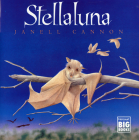
But in tonight's requested book, the owl is the bad guy, and it's bats who take center stage.  I'm writing, of course, about Stellaluna, Janell Cannon's lovely and scientifically accurate account of a baby fruit bat who is separated from her mother and goes to live for some time with a family of birds.  It's an owl who causes the separation:

One night, as Mother Bat followed the heavy scent of ripe fruit, an owl spied her.  On silent wings the powerful bird swooped down upon the bats.

Dodging and shrieking, Mother Bat tried to escape, but the owl struck again and again, knocking Stellaluna into the air.  Her baby wings were as limp and useless as wet paper.

Down, down she went, faster and faster, into the forest below.

Stellaluna came to us as a gift from cousins Ona and Jessie when Eleanor was not quite two years old, and it took a little while for her to warm to the book.  It's a fairly long picture book (48 pages), and is a little scary at the start.  Isabel was interested earlier than Eleanor, partly I think because of the gorgeous illustrations of the bats and Stellaluna's foster bird family.  Many of the pages are taken up largely with a saturated blue sky as backdrop to the pale beige of the bats, birds, and trees.  Each feather and bat wing is lovingly articulated -- looking at the pictures, you really get a sense of how a bat might move, hang, or fly.

The story moves quickly past the traumatizing beginning: Stellaluna lands in a birds' nest, and becomes a foster sister to Pip, Flitter, and Flap.  In return for feeding and housing Stellaluna, Mama Bird insists that she behave like a bird rather than a bat: she eats insects, flies during the day rather than at night, and by no means is allowed to hang upside down from the nest -- her foster siblings try it too, and almost fall.  Late in the book, Stellaluna strays away from the others and is caught away from the nest at night.  Happily, she's discovered by a group of bats, and even more happily, one of the bats is her mother, long feared to be owl prey.  There's a reunion ending, cross-species friendship, and two detailed pages of "Bat Notes," explaining in more detail to kids Eleanor's age or above interesting facts about bats ("The scientific name for bats is Chiroptera, 'hand-wing,' because the skeleton that supports the wing is composed of the animal's elongated finger bones.")

So far, Isabel has shown no disconnect between the image of owl life here and in her rich fictional world.  When you come down to it, the girl really just loves animals, in all their combinations.

Love, Annie

Wednesday, September 19, 2012

Wisdom and an owl

Dear Annie,

Athena -- a far cry from princess-in-pink.

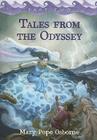
You and Eleanor might like to check out Mary Pope Osborne's
Tales from the Odyssey
. It was originally written as six little books (one of them called The Gray-Eyed Goddess), but the publisher has sensibly pulled them into two volumes -- still pretty short.  Yes, she's the author of the Magic Tree House books, which are not my favorites, but this is better.  I confess I've only browsed through these tales, but they consistently get surprised and pleased reviews from customers.  I'm curious what you'd think of them.

One of the joys of domestic life in our household is the high quality literary references.  Bob and I were discussing your latest post at dinner, and he reached a book off the shelf and read me a few pages.  It was The Sword in the Stone by T. H. White, and the scene is one in which the young Arthur -- known as the Wart -- first meets Merlyn, and his owl Archimedes.  At first the owl tries hard to ignore him, then perches skeptically on his shoulder as the humans converse.
   . . . he felt a curious sensation at his ear.  "Don't jump," said Merlyn, just as he was going to do so, and the Wart sat still.  Archimedes, who had been standing forgotten on his shoulder all this time, was gently touching himself against him.  His beak was right against the lobe of the ear, which its bristles made to tickle, and suddenly a soft hoarse little voice whispered, "How d'you do," so that it sounded right inside his head.
   "Oh, owl!" cried the Wart, forgetting about Merlyn's troubles instantly.  "Look, he has decided to talk to me!"
   The Wart gently leaned his head against the soft feathers, and the brown owl, taking the rim of his ear in its beak, quickly nibbled right round it with the smallest nibbles.
   "I shall call him Archie!" exclaimed the Wart.
   "I trust you will do nothing of the sort," cried Merlyn instantly, in a stern and angry voice, and the owl withdrew to the farthest corner of his shoulder.
   "Is it wrong?"
   "You might as  well call me Wol, or Olly," said the owl sourly, "and have done with it."
   "Or Bubbles," added the owl in a bitter voice.
   Merlyn took the Wart's hand and said kindly, "You are only young, and do not understand these things.  But you will learn that owls are the politest and most courteous, single-hearted and faithful creatures living.  You must never be familiar, rude or vulgar with them, or make them to look ridiculous.  There mother is Athene, the goddess of wisdom, and though they are often ready to play the buffoon for your amusement, such conduct is the prerogative of the truly wise.  No owl can possibly be called Archie."
   "I am sorry, owl," said the Wart.
   "And I am sorry, boy," said the owl.  "I can see that you spoke in ignorance, and I bitterly regret that I should have been so petty as to take offense where none was intended."
I hope Eleanor's Athena is both truly wise and equipped with an exceptional owl.

Love,

Deborah