In which Annie (high school teacher, mother of two young girls and a younger boy) and her aunt Deborah (children's bookseller, mother of two young women in their 20s) discuss children's books and come up with annotated lists.

Showing posts with label art. Show all posts

Tuesday, August 13, 2013

Night at the museum, in miniature

Dear Aunt Debbie,

After our recent visit with you in Washington D.C., you sent us home with a bag full of books and other goodies, which we're still working our way through.  One chapter book in the bunch was clearly something we had to pick up immediately, as it was place-specific, and we were about to travel to exactly the right place.  It turned out to be both a good read and an excellent jumping-off point for a museum visit.

The book is The Sixty-Eight Rooms, by Marianne Malone.  The rooms in question are the Thorne Rooms in the Art Institute of Chicago, 68 historically accurate miniature rooms created in the 1930s by craftsmen under the direction of Mrs. James Ward Thorne.  There are two sets of rooms: the European rooms depict interiors from the late 13th century to the 1930s; the American rooms from the 17th century to the 1930s.  The rooms were built on a scale of one inch to one foot, and the detail in them is astounding, as you can see in this slightly interactive Art Institute "Game of Thornes."

The premise of the book is a good one: best friends Ruthie and Jack, both sixth-graders, discover an ornate key in an access hall to the back of the Thorne Rooms.  When Ruthie picks up the key while standing near the rooms, she feels a magical wind and shrinks down to fit the scale of the rooms, becoming five inches high. With Jack's help, Ruthie gets up into the rooms and begins to explore.  The friends sneak back to the museum for an overnight visit, and discover that if Jack holds Ruthie's hand while she shrinks, he'll shrink too.  Further exploration reveals that there's more magic inside the rooms: a book which speaks to Ruthie, and the discovery that the rooms can serve as portals to the past.  Little people, time travel, sneaking around inside a museum -- there's a lot to keep a reader interested.

Eleanor loved the book, and we ripped through it in just a few days.  The combination of magic and the working through of practical details kept her riveted (how will Jack and Ruthie get up from the floor to the rooms when they're both five inches tall?  Build a staircase of catalogs while normal-sized, and then scale them as little people!).  I found Malone's writing a little flat: lots of dialogue tags like "Jack responded" and explanations of what Ruthie is thinking and feeling, rather than details which might communicate states of mind more organically to a reader.  For this reason, it wasn't the most satisfying read-aloud, though Eleanor's experience of it was quite positive.

We read The Sixty-Eight Rooms while visiting my in-laws in Illinois, and used one of our vacation days to drive in to Chicago and visit the Art Institute to see the Thorne Rooms in person.  Hands down, this was the best thing about reading the book.  Eleanor made a list of the rooms which figured most prominently in the story, and ran from one to the next discovering details that Malone had written about.  She was incredibly excited.  My mother-in-law bought her Miniature Rooms, a catalog/coffee table book of color photos of the rooms, and Eleanor pored over it for days, holding it open on her lap as we finished the book together and imagining other stories for herself. (Clearly, Malone has done this too: there are already two sequels.)

Looks like it's time to break out From the Mixed Up Files of Mrs. Basil E. Frankweiler, and take a trip to the Metropolitan Museum next.

Love, Annie

Monday, January 21, 2013

Guest blogger: Making Mistakes


Dear Aunt Debbie,

I hope you're right this year!  I've certainly agreed with your votes before, over the official committees'.

I'm still knee-deep in portfolios, so I've asked another family member to be our next guest blogger: my cousin, and your niece, Ona, who teaches kindergarten in Seattle.  Here she is, in the first of what I hope will be many guest blogger appearances:

Making Mistakes

Much of my year as a kindergarten teacher is spent on life lessons. My hope is to impart these lessons in a fun way-- and at times these ideas outweigh the academic material.  One such lesson is that the brain needs to explore, try new things and make mistakes. Every day I point out to my students mistakes that I have made, as well as complimenting them on catching them, "Wow, you have sharp eyes that you caught my mistake." (Adults: check out the awesome book Brain Rules, by John Medina-- highly recommended for teachers and parents alike!) 

Making mistakes is a fresh topic in my mind this year as I have a perfectionist in my class. I will call her "Sally." I can relate to Sally as I have similar traits so I have even more of a vested interest while working with her. Sally becomes so frustrated if her work is not "perfect" that she will cry or just give up. I found out at our recent parent teacher conferences that Sally's mother regularly scans and photoshops her "mistakes" and prints off a new page so her daughter can have it "just the way she wanted." After her mom told me this, she asked me, "Is that too much?"

I offered the following books:

Your Fantastic, Elastic Brain: Stretch It, Shape It by JoAnn Deak Ph.D. and illustrated by Sarah Ackerley is a kid-friendly version of Brain Rules [Annie's note: it seems to be out of print, and the Alibris link above links only to pricey versions.  Try the library?]. With cartoon-like images, it alternates from simple ideas and language, to a specific explanation of how the brain and its various parts function. The most important take away is that it is crucial for your brain to make mistakes so it can learn. Deak provides an example of jumping into a swimming pool. If this is the first jump, the signals from your brain might make you feel nervous or scared. Once you jump, the brain can remember the sensations it felt and the experience becomes less daunting the second time around. During ages 0-10 the brain grows and learns the most.  The more things you try and the more mistakes you make, the better! Cool lesson for kids, right?


Another fantastic exploration into making mistakes is the artistic book, The Dot, by Peter H. Reynolds. A little girl, Vashti, is asked to draw and is so worried about how to draw that she is frozen, as Reynolds says "glued to her seat." "I just CAN'T draw!" is a frequent line in the beginning of the book, a line I hear in my classroom too. Vashti's teacher says, "Just make your mark and see where it takes you." What a beautiful message-- this encourages Vashti to try by drawing a simple dot, and the more she does the more confident she becomes. At the end of the story Vashti teaches another student to “make your mark.”


Another way of helping kids become unglued from their seats is to provide a structure as a starting-off point.
I Can Draw People
 and I Can Draw Animals,
 by Ray Gibson, are from a series that I often use in my classroom. The books offer a step-by-step take on drawing and each page has numbered directions: Step 1, Step 2 and Step 3. Children follow the shapes that are drawn in each step, thereby adding another detail to their picture. This is a beauty of this series as reading is not necessary, just copying the steps. The scaffolding that this provides helps those kids who say, "I can't draw" start with the most basic shapes and at the end discover they have drawn an angel or a giant or a lion!

Sally is becoming like Vashti. Last week she came up to me during art class and was beaming. She proudly told me that she had made a mistake and figured out how to fix it-- all by herself! I asked Sally if she cried or got upset and quit, and with a big smile she said, "Nope!" What a teachable moment this was-- Sally  felt the joy of overcoming a difficulty and she made her mark. I hope that these selections help you and yours do the same.

Love, Ona

And love from me, 

Annie

Monday, January 9, 2012

Guest blogger: Art Immersion -- Books as Museums

Dear Aunt Debbie,
It's portfolio time again!  This morning, I collected two class sets of writing portfolios from my juniors and seniors, and will be putting my nose to the grindstone in grading and commenting on them for the next couple of weeks.  Which means, of course, that it's time for some excellent guest bloggers.

First up is our regular guest Denise, who has written here before about picture books that raise social awareness and picture books that capture the essence of summer.  Here she is:
One of the first museums my husband and I took our daughter Jacinta to was the Museu Picasso in Barcelona. It was on a narrow, cobbled, pedestrian street in a Gothic-style brick building with a courtyard; we were fortunate to have come on the one free day of the week, and the line was nowhere as long as the line to Target-free Fridays at the MOMA in Manhattan.


Jacinta was a little over two, so she wasn’t as excited as we were to enter this sacred place. She did look intently and excitedly at a few paintings in the first parlor and made her parents proud by answering questions like, what colors do you see? And what shape is this? After looking at a wall of work, she wiggled out of her dad’s arms and started roaming around, pushing through people’s knees and bumping into their bags. At this point, Sean and I took turns watching her and looking at the decades of work on display.


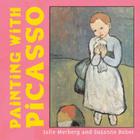
This was her first immersion in art history, and to remember it, we bought a souvenir: a board book called Painting with Picasso by Julie Merberg and Suzanne Bober. In this book, lyrical, rhyming lines on one side complement a painting on the other side. On the first page: “An artist paints people / in all different places, / and captures the feelings / that show in their faces.” The painting beside this is “Interior with a Girl Drawing." Most of the other nine paintings include young children; each page is saturated with vibrant colors. It is so much easier to appreciate each individual painting when it sits between your hands. And there is an entire series of books like this one that showcase other artists such as Van Gogh and Matisse; the series is called Mini Masters and is published by Chronicle.

It’s been over two years since our trip to Barcelona, and now that we have a two-year old boy, Emerson, visiting a museum has become much more challenging and arduous. We have been to the Cloisters in Manhattan and the Brooklyn Museum, but during these visits, we didn’t really engage with the art work; we did family activities and briefly glanced at some works that caught our eyes. But I’ve realized that we don’t need to visit museums to appreciate art; we can adopt our own artists and fills our shelves and walls with art. And that was my mission this Christmas, to have a renaissance of art appreciation at home.

The Metropolitan Museum of Art publishes some of the most amazing books that expose children to centuries of art. The books I (aka Santa) bought are:


My First ABC, a board book with vibrant paintings spanning continents and centuries; each page zooms in on an object beginning with a particular letter. One of my favorites is: H h Hair; the subsequent painting focuses on the profiles of an Egyptian man and woman in a painting from Tomb of Ipuy, ca. 1279-1213 BC.


Museum Shapes: each section begins, What shape is… and is followed by a painting that focuses on that particular shape; on the next page, the shape, the word, and other excerpts from visual art. What’s unique about this book is that it includes architecture and textiles in addition to paintings.

Can You Find It? is a search and discover book that includes nineteen paintings and a list of details to find in each. The art work is stunningly detailed and finding the individual items is difficult; Jacinta is much better and finding things than I am – I really have to strain my eyes. One we looked at together is a painting of The Feast of Sada from Shahnama by Firdausi. The text beside it states: “In this painting of an outdoor feast, can you find: 1 box, 4 birds, 1 bear throwing a rock… 4 bottles, and 6 beards.” I love how poetic the list is. I also love how there is something in each work of art for both my daughter and son to recognize and appreciate.

The final book is not published by the Met. It is an instructional book:
I Love to Draw!
by Jennifer Lipsey. It breaks down how to draw trees and dogs and cars in such a simple way that even I can draw these things.       

As the winter ensues and encourages us to stay in our living room, we will have many works of art to enjoy at our own leisure, without having to abide by museum rules. The kids can touch the pages, but not bend them, then march around and sing and scat while still being immersed in art.

Inspiring ideas!
Love, Annie