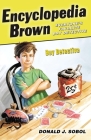
My girls were briefly into Encyclopedia Brown, but some stories were satisfying and others frustrating, requiring arcane knowledge to solve the mystery. I gave up after reading "The Case of the Hidden Will," in which Encyclopedia Brown exposes the culprit because he knows that only one king in a deck of cards is without a mustache. (See a funny critique here.) I prefer the old-fashioned logic-it-out mysteries.
 |
| Meg Mackintosh |
In
Meg Mackintosh and the Mystery on Main Street, Meg helps her brother Peter find an old family diamond ring that he lost while running errands. He had put it in his mitten for safekeeping. During the day, he took some pictures in a toy store (and developed them in a home darkroom -- explainable moment!). Peter shows the photos to Meg (we see illustration).
She goes on to find a clue or two in the pictures. The questions at the bottom of the page offer the chance to figure out the answer oneself, or just to get on with the story. The plots all have a few red herrings to throw the unvigilant off the trail. Meg carries a notebook with her and keeps careful notes throughout the stories."Hmm, every picture tells a story," said Meg. "I'm not sure how the story turns out. I do know that you took your mittens off."Do you see anything unusual in Peter's photos?Why would Peter have taken the mitten off?[turn page]"Peter, if you took pictures in the toy store, you probably took your mittens off so you could press the buttons easier," said Meg, as she examined the photos.
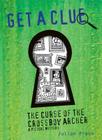 The "Get a Clue" series by Julian Press (originally published in Germany) are the same idea, but rely more heavily on illustration. Every page has a picture -- usually it's full of detail -- and there's a question at the end of each page. In "A Four-Legged Mystery," one of three stories in
The Curse of the Crossbow Archer, three children go into a hair salon in their search for a missing dog. There's a full-page illustration of the salon.
I think of these books as great for the first-to-third grade set who are getting increasingly comfortable reading on their own. But as you know well, they also work as read-alouds for the mystery-minded soon-to-be-kindergartener...."Do you also do dog grooming?" Josh asked awkwardly.The stylist looked at him stonily. "No. Animals are strictly forbidden in the salon. And that goes for your bird -- he needs to wait outside.""She's charming," David muttered under his breath. "And what a liar!"QUESTION: How does David know the stylist is lying?[turn page]The dog bone on the floor by the back door made David doubt the stylist. Unless the woman ate dog bones herself, it was a pretty clear indication that she's had a canine visitor recently. They had to figure out what was behind that door before the stylist became suspicious.
Love,
Deborah