And Happy Presidents' Day to you! Bad Kitty sounds like a funny way to get into the topic of politics, though perhaps, as you say, a tad cynical for a first time through. Then again, it's hard not to feel cynical these days when trying to explain the democratic process to one's children. We've had a few conversations about the presidential election with Eleanor -- nothing about the Electoral College, so I'm afraid I'm no help on that front, but a few of those Major Conversations that pop up when you're not expecting them as a parent, often just before bedtime: What color is God's skin? What happens when we die? What's the difference between Democrats and Republicans?
 We read Duck for President a while back, and while I adore Doreen Cronin and Betsy Lewin's Dooby Dooby Moo, I remember not loving this one as much. It's wacky, as their books about the animals on Farmer Brown's farm tend to be, but at least when we last picked it up, also struck me as aimed at slightly older, more savvy readers. Maybe worth picking up again.
 The most presidential book we own at the moment is Eleanor's new book of Obama paper dolls, which my father bought for her birthday. They're Tom Tierney dolls -- the best paper doll artist ever, and worthy of a complete post someday soon. It's laudatory, and the text inside is mostly about the clothes. I love Tom Tierney. (If you're feeling quite cynical and a little more adult, but still want an activity book, I'd recommend the Idiots' Books mix and match book Build Your Own President, created by my former college classmates, Matthew Swanson and Robbi Behr.)
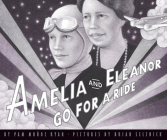 Rachel at Even in Australia posted recently about historical president books. Her post made me realize that I've never written here about the first book you gave Eleanor, sent to us mere weeks after she was born: Amelia and Eleanor Go for a Ride, by Pam Munoz Ryan, illustrated by Brian Selznick.
The Eleanor of the title is, of course, Eleanor Roosevelt; Amelia is Amelia Earhart, and apparently the two women were friends in real life. Ryan draws inspiration from an actual historical episode: an evening when Amelia joined Eleanor for dinner at the White House, and later in the evening the two went flying in an airplane together. In the fictionalized version, the flight is a spur of the moment decision, and Amelia and Eleanor are the only ones in the plane, swooping over Washington DC at night. They return to the White House only to go out again, so that Eleanor can take Amelia for a spin in her new car. The back of the book provides accurate historical information: there were other pilots on the plane, it was arranged ahead of time, Earhart didn't fly it the whole way, etc. I like having the facts laid out at the end, but allowing for a little bit of fantasy in the plot.
Our Eleanor is a big Eleanor Roosevelt fan, and the depiction of Roosevelt and Earhart is compelling. They're both presented as strong-willed, charismatic women who aren't shy about pursuing their interests. And of course, Selznick's drawings are fantastic -- I didn't make the connection until picking the book up again last week that of course these portraits and DC landscapes were penned by the artist and writer who created Hugo Cabret and Wonderstruck. What an awesome man. And what awesome women.
Love, Annie