In which Annie (high school teacher, mother of two young girls and a younger boy) and her aunt Deborah (children's bookseller, mother of two young women in their 20s) discuss children's books and come up with annotated lists.

Showing posts with label Mayer. Show all posts

Sunday, September 15, 2013

East of the Sun and West of the Moon

Dear Aunt Debbie,

I love your suggestions for encouraging Isabel toward chapter books. I've ordered the read-aloud version of James and the Giant Peach for her birthday -- I think Roald Dahl's humor and meanness might work very well for Isabel's sensibility, and Quentin Blake's drawings can only help. She responds so strongly to illustrations.

One of our favorite picture books at the moment is a lavishly illustrated fairy tale: East of the Sun & West of the Moon, written and illustrated by Mercer Mayer. This authorship surprised me a few weeks ago when we picked up my childhood copy of the book at my parents' place (sadly, the book is out of print, though there are used copies out there -- the link above is to Alibris). The only other Mercer Mayer books we own are the not-terribly-interesting Little Critter series.  I'd forgotten that Mayer is also responsible for such extreme strangeness and beauty.

East of the Sun & West of the Moon is a retelling of a Scandinavian fairy tale, and contains elements familiar from other fairy tales as well.  A proud, beautiful maiden, the daughter of a farmer, falls on hard times when her parents lose their money and her father becomes gravely ill.  To cure him, she must bring back a clear drink of water from the spring of the South Wind.  She is helped in this by a frog, who asks her to grant him three wishes in return.  Of course she agrees, and her father gets well again; their fortunes are restored, and the young woman has forgotten the frog by the time he shows up and asks to visit her, then to have her hand in marriage.  She refuses him; when he insists she keep her promise, the maiden throws him against the wall, killing him.  It turns out he wasn't a frog at all, but a handsome youth, enchanted by an evil troll princess.  Death frees him from his frog-body, but he is seized by trolls, who take him away to the kingdom "east of the sun and west of the moon," where the troll princess plans to marry him.

The maiden, racked with guilt, embarks on a quest to save the youth from the fate she helped solidify.  She travels through vivid landscapes, visiting enormous wise creatures from whom she asks advice and receives gifts.  Two of my favorites:

The Salamander who lives in the fiery heart of a mountain of ice, and knows "everything that is in the heart of the world."


The Great Fish of the Sea, who knows "everything that is in the blood of the world."


Finally, the North Wind brings her to the land east of the sun and west of the moon, where she works for the troll princess, cleaning floors while the trolls torment her.


The maiden uses the gifts given to her by the creatures she's met to rescue the youth, who has been frozen in a block of ice, and defeat the trolls.  It's a happy ending, and a somewhat empowering one: the maiden shoots the troll princess in the heart and turns the other trolls to stone with no help from the youth, who looks like he needs a little time to wake up from being frozen.

Mayer's writing is poetic, and the descriptions of the connection between the maiden and the youth pretty sexy at times (Father Forest tells the maiden: "I know what is in your body and in the body of the youth, and I know that your bodies call to each other." Va-voom!). The illustrations are rich and elemental, emphasizing the maiden's smallness in relation to the creatures she meets.  The pictures I've scanned here are the ones which remained ingrained in my memory from my own childhood thirty years ago.  Vivid stuff.

In two days at my parents' place, Isabel asked us to read her this book seven times.  She drank it in.  So this week I'm thinking, if we're not doing so many chapter books just yet, I'm okay with that.

Love, Annie

Sunday, February 26, 2012

The sequel that ate the author

Dear Annie,

Sometimes one or two books that turn out to be commercial successes take on a life of their own and swallow their authors, forcing them into sequel after sequel.  I'm thinking here first of Mercer Mayer, whose Little Critter books you gently criticize.  I am very un-fond of them -- feel they're barely a step up from the dreaded Berenstain Bears.  The driving force behind the series is to give lessons in behavior, rather than to tell a story or engage a kid in other ways.  But Mayer has done some good books, too. 
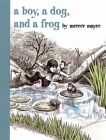
A boy, a dog and a frog
, his first book, is a wordless delight showing a boy and his dog trying to catch a frog, who eventually follows them home.  He did several boy/frog books.
evicting the kangaroo
 And then there's
What do you do with a kangaroo?
  Wasn't that one of the books that lived on the kids' bookshelf at my parents' (your grandparents') apartment?  A series of animals attempts to move into a girl's home, making many imperious demands.  What do you do?  You throw them out!  Except that they keep reappearing....  Mayer wrote that one in 1973, a dozen years before Laura Numeroff launched her series with If You Give a Mouse a Cookie, but there are some parallels in the feel of both books: kid at home intimidated by demanding but ultimately lovable animal interloper.  Repetitive structure, giggles of anticipation.  And Numeroff, like Mayer, got taken over by the form and still can't stop cranking them out.

I completely sympathize with your antsiness at reading and re-reading average stuff.  I have misty memories of evenings when Bob and I would get a choice in the picture book rotation too.  Small relief.  It sounds like you might be moving to a broader range of books that both girls will be happy with these days, even if they keep coming back to a few.  Is this true?  Is Isabel getting into longer stuff?

Love,

Deborah

Friday, February 24, 2012

Enduring the unobjectionable

Dear Aunt Debbie,

I agree with you: it is full-on weird to return a book just because you didn't like it.  Your post got me thinking about my own responses to books I don't particularly like.  As I've mentioned before, I try to keep our shelves free of badly-written, overly commercial, or otherwise obnoxious books.  In keeping with Grandma Helen's advice, I have been known to throw a few clunkers out in the dead of night (or at least, after bedtime).

But what of the perfectly okay?  I'm talking here about books that my kids love, and that I think are...fine.  Totally decent.  Not bad or harmful in any way.  Enjoyable to read in small doses.  Just, well, not all that interesting.

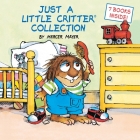
Two series pop to mind: Little Critter, by Mercer Mayer, and the If You Give... books, starting with If You Give a Mouse A Cookie, by Laura Numeroff and Felicia Bond.  Part of the problem with each is the sheer volume of the series.

There are more than 70 Little Critter books, and counting.  In each, Little Critter (an appealingly prickly little hedgehog-like person) focuses on one idea, and repeats it with variations: "When I get bigger, I'll...."; "I wanted to do X, but Mom wouldn't let me.  I was just so mad!"; "I can do X all by myself"; etc.  Each page repeats the same basic formula, and there's always a very slight twist at the end ("I'm not bigger yet!").  The Little Critter book we own is a collection of seven stories, and reading the same formula over and over (which is a requirement -- I have never successfully read only one story from the book and been allowed to put it down) can feel mind-numbing.

Mind-numbing, and depressingly literal.  One of my pet peeves about Little Critter is that Mercer Mayer doesn't do anything interesting with the text he includes in his drawings.  There are often labels on food or toys, or single pages of books Little Critter is reading.  Without fail, they are boring: a shopping bag reads "Best Food"; a toy duck is labeled "Duck"; a book is titled "Read This Book."  Compare this to the fantastic, old-school brand names on kitchen products in In the Night Kitchen ("Kneitel's Fandango," "Phoenix Baking Soda," "Hosmer's Free Running Sugar: It Pours"), or the psychology-related book titles Kevin Henkes sneaks into Chrysanthemum.  Is it too much to ask a kids' author to sneak in a little tidbit for the parents to enjoy?

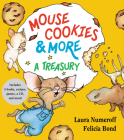
In comparison to the Little Critter juggernaut, the 8 If You Give... books don't seem like so many.  Except that we own them all.  Again, here, we started with an anthology:  Mouse Cookies and More: A Treasury.  It includes four books (...Mouse a Cookie, ...Moose a Muffin, ...Pig a Pancake, and If You Take a Mouse to School), as well as song lyrics, recipes, activities, and a CD.  Again, individually, I like these books.

In each, a demanding animal asks for increasingly elaborate things from the boy (or girl, but mostly boy) he (or she, but mostly he) is visiting.  Many of the requests are domestic: they want a cookie, to draw a picture, to make puppets or a kite.  In the later books (...Dog a Donut, ...Cat a Cupcake, ...Pig a Party), they go farther afield, to the beach, and museums.  The child caring for the animal invariably winds up looking exhausted by the end of the story.  There's a nice wink at parents here -- the animal exhausts the child just as my own child exhausts me!  And Felicia Bond's illustrations are bright and bold, with lots of action.

But it's the same construction, every time: "If you give..., he'll want....  Then he'll ask for..." etc., all the way back to the original item given.

I know that kids love repetition, and that it's developmentally appropriate -- it gives both Eleanor and Isabel great pleasure to be able to predict what's going to happen on the next page, to essentially be able to recite these books.  There is good nature here, and well-aimed humor.  But oh, some nights, I would really rather be reading something else.

Love, Annie

Friday, August 13, 2010

Thirteen motherless princesses

Dear Aunt Debbie,

Before we move on to wonderful parents, I want to write about two more motherless-girl fairy tales that have been getting a lot of play in our house lately.

The first is Yeh-Shen: A Cinderella Story from China, retold by Ai-Ling Louie and illustrated by Ed Young.  According to the author's note, this is a version of the oldest Cinderella story on record, dating from the T'ang dynasty (618-907 A.D. -- the first European version is dated 1634.)  It has many of the traditional Cinderella elements: orphaned girl is worked to the bone by her stepmother and mean stepsister, is eventually helped by a magical figure, gets to go to the ball, loses a precious slipper, finds it again, and marries the prince.  The twists: Yeh-Shen's only friend is an enormous fish she has raised.  After her stepmother discovers him and kills him, Yeh-Shen's magic spirit, in the form of an old man, tells her to find the fish's bones and use their magic.  It is the fish bones which provide Yeh-Shen with food, and eventually a dress and golden slippers to go to the banquet.  The king doesn't actually see her there, but is presented with her lost slipper and falls in love with the idea of the tiny-footed woman who might wear it.  (It's a wonder that Cinderella stories didn't give all the women in our family major complexes about the size of our beautiful large feet.)  He uses the slipper to set a trap for Yeh-Shen, she comes to get it, he falls in love.  Oh, and the last sentence has the stepmother and stepsister being killed in an avalanche.  It's an interesting variation, well-written, and the drawings are gorgeous.

I've mentioned before that Eleanor is, like every other girl in America, really into princesses.  If one princess is good, how much better to have an even dozen, all lushly illustrated in full-scale ball gowns?  The Twelve Dancing Princesses is a strange story, and one I'd forgotten.  This version is told by Marianna Mayer, and illustrated by K.Y. Kraft.  Their mother has of course died, and to keep them out of trouble, their father the king locks them into their bedroom every night.  Yet every morning, they're exhausted, and their dancing slippers are worn through.  What's going on?  The answer lies in the Twilight World, where they go every night for what is essentially a waltzing rave.  They bring a number of princes down with them, and make them drink a potion which freezes their hearts and leaves them only the love of dance.  The princesses' secret is discovered by a poor dreamy farmer named Peter, who becomes the castle gardener and falls in love with the youngest princess.  There's a happy ending for everyone.  I love how weird this book is -- the Twilight World has no explanation, and the princesses seem perfectly happy to live their secret night-time lives; Eleanor adores the dresses.  So we're both happy.

Love, Annie