In which Annie (high school teacher, mother of two young girls and a younger boy) and her aunt Deborah (children's bookseller, mother of two young women in their 20s) discuss children's books and come up with annotated lists.

Wednesday, October 26, 2011

Combat, sharks and justice

Dear Annie,

I'm starting to write this as I listen to your youtube Danse Macabre link.  Halloween music.
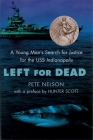
I'm doing one of those radical turns of subject today, veering over to the death-and-macabre side of things for older kids.  I got a note from someone I haven't seen in a few years, the daughter of one of my father's (your grandfather's) oldest friends.  She was wondering about books for her 12 year-old son who's a big non-fiction reader, especially history.  She mentioned war stories, and somehow she made me think of a book I recommend fairly frequently:
Left for Dead
, by Pete Nelson.  I'm sort of stunned I didn't think of this one when we were trying to come up with kid-appropriate combat stories.  The subtitle of the book is "A Young Man's Search for Justice for the USS Indianapolis."  The Navy cruiser Indianapolis delivered components of the atomic bombs to the Mariana Islands in the summer of 1945, and on its return trip was torpedoed and sunk.  Distress calls were not reacted to, and hundreds of men ended up in the water for four days before the survivors were rescued.  880 men died, many of them killed by sharks as they tried to stay afloat.  The captain was court-martialed for his handling of the ship when it was under attack, although the trial was controversial and some saw him as the scapegoat for Navy incompetence.  He eventually committed suicide in 1968.  In the 1975 movie Jaws, one character gives a grim four-minute speech about surviving the ordeal of the sinking (shark attacks being the theme here).

Twenty-two years after Jaws came out, Hunter Scott, a sixth grader in Florida saw the movie and started asking questions about the Indianapolis.  His sixth-grade history project ended up tracking down some of the surviving crew, publicizing the injustices, and four years later, in 2001, leading to the exoneration of the captain. 

The book tells the stories of the ship and sailors, and of Scott's investigation.  Some of it is within the context of Florida conservative politics, but it's an amazing story -- two amazing stories.  It's also well enough written that a fair number of customers have come back to say how much they liked it.  It's got combat and death and scariness; incompetence and accusations and cover-ups; and a kid with curiosity, brains and perseverance.  And in the end, there's justice -- in a too-late (but still triumphant) kind of way.

Love,

Deborah

Monday, October 24, 2011

More music (Bug-Gup!)

Dear Aunt Debbie,

Jim Dale seems to do a pretty good job with Peter and the Wolf.  I'm still stuck on my Bernstein, though -- there's a kind of warmth behind his voice that I find very appealing.  He sounds like he's enjoying himself, and is happy that you know the piece as well as he does.  He's quite encouraging.

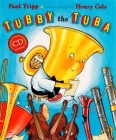
One more book with music: Tubby the Tuba, by Paul Tripp, illustrated by Henry Cole.  I remember the Tubby the Tuba cartoon from my childhood mostly for Tubby's melancholy voice, and I'm pretty sure the CD recording included with this book is the same one.  I'm sure at least that it's not the new recording made by Meredith Viera advertised on the official Tubby website.

The illustrations are new -- nice and cartoony, and a little bit updated.  Tubby wears shorts and a t-shirt in rehearsal, and the orchestra's usual conductor shows up in jeans and Birkenstocks with socks.  Never fear -- when Signor Pizzicato, the guest conductor, arrives, everyone is in a tuxedo.

It's interesting to look back at Tubby the Tuba from an adult perspective.  It's so clearly a story about being an outsider and then figuring out a way to belong: Tubby wants to play the melodies that everyone in the orchestra gets to play, but he keeps squashing the poor little tune, and is relegated to going "oompah, oompah."  Yes, he's the fat kid no one wants to play with, and the violins are mean to him.   Wandering off at night, he meets up with a frog singing by a pond.  The frog's salutation may be my favorite part:

Bug-Gup! Bug-Gup!  Lovely evening!
Bug-Gup! I said, bee-oo-ti-ful evening.  Hello!
Bug-Gup! Hello! Bug-Gup! Hello!

The frog teaches Tubby a frog/tuba melody, and the next day, Tubby impresses Signor Pizzicato and the rest of the orchestra with it.  Everyone wants to play his tune.  Maybe it's a little didactic, but when you include the recording, it's a lot of fun.

Along with Peter and Tubby, my girls have Danse Macabre on repeat these days, and do a terrific dance where they pretend to be witches and are frightened away by sunrise at the end.  I don't think anyone has yet turned that into a children's book, but I expect Neil Gaiman will get there sooner or later.

Love, Annie

Sunday, October 23, 2011

Listen!

Dear Annie,

I offer you one more Peter & the Wolf, although I haven't listened to the whole thing, so I don't know how it comes out.  There's a whole generation that's bonded to anything that Jim Dale says, because he's the voice of the Harry Potter audio books.  I've just ordered a version of Peter and the Wolf read by Dale -- here's a quick sample.  Am curious how it compares to Bernstein.

The music-and-story audios that had a big effect on our family were a handful of CDs from a Canadian group called  Classical Kids.  They're stories combining a young child character with biographical information and music of a major composer.   The first one we hit was Mozart's Magic Fantasy, featuring a girl who wanders into a production of The Magic Flute.  It messes with the plot a bit, given that it's adding a character. 

Then we went on to their best-known recording, Beethoven Lives Upstairs, telling the story of the great composer's life and death from the point of view of a boy whose mother rents a room to the almost-deaf composer.  Great story, lots of funeral scene. 

The girls' favorite, though, was Vivaldi's Ring of Mystery, about La Pieta orphanage in Venice, where Vivaldi taught music to the girls.  The central character is a violinist who goes on an adventure at Carnival time to try to discover her past.  It has a few scary moments, and vivid images of Venice which stuck with our girls until they were high schoolers and we visited the city.

They're good stories, and they implant the music subliminally.  All links above have audio samples attached.  I think some of them may have been turned into movies -- or videos you can find on youtube.  But just sitting at home or in the car listening is a special event.

Love,

Deborah

Friday, October 21, 2011

Books that come with music

Dear Aunt Debbie,

We will have to check out some of those coloring books.  I'm starting my Christmas list now....

I said recently that I'd identify the book that Michael was reading to Eleanor in this picture.  The book itself is new to us, but the story and music behind it have become a staple in our house over the last several months.

Peter and the Wolf came into our lives when my mom told Eleanor (who is now taking ballet classes) about once dancing the part of the wolf in a performance.  The pictures of my mom being caught around the waist by Peter's rope hung for years in Grandma and Grandpa's hallway, and I always found them fascinating.  Eleanor was intrigued, and pretty soon after that, we checked out the Disney cartoon version on YouTube.  The second we put it on, Isabel was hooked.  Amazed by the wolf, entranced by the music.  They were both a little scared, too, mostly by the wolf's slavering jaws, but it's Disney, so there's a happy ending.

Isabel's interest prompted us to buy the Leonard Bernstein version of the music.  Isabel became truly obsessed.  We listened to Peter and the Wolf at least three times a day for most of the summer.  At the beginning of the recording, Bernstein presents the instruments playing each character in the story as a sort of quiz: "And what's that old bassoon doing? Right, it's Peter's grandfather.  You really know this piece, don't you?"  Oh yes, Leonard Bernstein, we do.

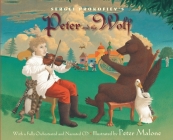
For Isabel's birthday, my parents found a gorgeous illustrated version of the story, which comes with a CD: Sergei Prokofiev's Peter and the Wolf, illustrated by Peter Malone.  The story is largely the classic one: Peter goes wandering out of his house into the fields, though his grandfather tells him not to.  The duck wanders out too, and play-fights with the bird; the cat appears and tries to eat the bird; Peter's grandfather sends him back inside.  Then the wolf appears.  The wolf chases everybody, eats the duck, and is ultimately captured by Peter, with the help of the bird.  Hunters come and march the wolf off, and the whole thing ends with a parade.

I love the illustrations in this version: they have a very Russian feel to them, and remind me of Vladimir Vagin's gorgeous drawings in The King's Equal.  The text has been sanitized a little: the wolf eats the duck here, but at the end he convinces the hunters that he'll be good, and they agree to let him go (!), and then he feels bad, so he coughs the duck up.  Not like any wolf I've ever heard of, but okay.  The grandfather is also a little nicer: in the Bernstein version, he's grumpy to the end, complaining at the parade about what might have happened if Peter hadn't caught the wolf.  Here, he marches along proud of Peter.

I'm a big fan of Leonard Bernstein's voice, and after so many times through it, far prefer his creepy ending, with the duck's quacking still audible from inside the wolf's belly, as well as his slight upper-crust accent, to the narration on the book's CD.  Still, the music is wonderful -- by turns playful, dramatic, and narrative.  It bears listening to five thousand times.

Love, Annie

Wednesday, October 19, 2011

Activity!

Dear Annie,

Do I sell sticker books?  Yes, by the hundreds.  So much so that I can recognize the particular DK Ultimate Sticker Book that's pasted all over Isabel in your hilarious picture.  Sticker books come under the broad umbrella of activity books: stickers, coloring books, paper dolls, mazes, dot-to-dots, hidden pictures, etc.  I have a particular tour of the store I offer people who are looking for travel activities: I ask the children's ages, then we visit various activity book racks, miniature versions of games, audio books, racks of small plastic objects (people, animals, cars...).  Activity books, as I've mentioned, are where I try to contain the junky stuff: Barbie, Disney princesses, TV spinoffs.

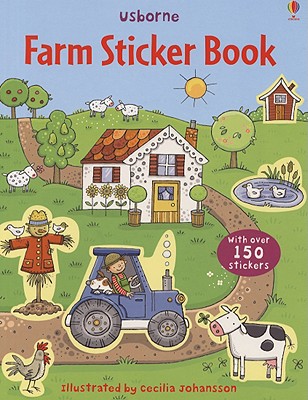
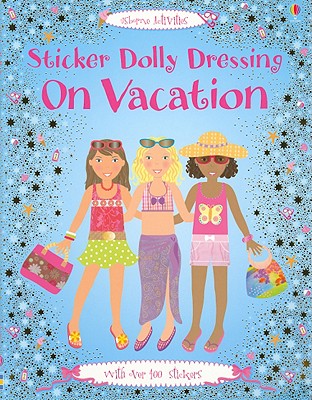
I wanted to add two kinds of sticker books to your list.  There are the paper doll books.  They usually have a punch-out paper doll and lots of reusable sticker clothing to put on the doll.  Illustrated on the left is an Usborne book that's a little less over-the-top than the Princess/Wedding/Fairy ones -- but they've got those too.  Usborne, a British publisher of many different kinds of activity books, also does some good, non-product-driven sticker books.  The farm sticker book is on the right; they have concept ones (numbers, letters, etc.), and lots of vehicles.

I want to put in a good word for coloring books.   There are those who avoid them at all costs, feeling they have nothing to do with the creativity of doing art.  I agree, standard color-between-the-lines books aren't art, but they are a form of more meditative activity that can be engaging on a trip or a quiet afternoon.  Good for fine-motor practice too.

And these days there are also several lines of coloring books which are basically prompts to finish and color drawings.  Taro Gomi, a wonderful Japanese illustrator, has done many along these lines:

Lots more on Gomi's books -- many of which are very large and thick, but fun -- and downloadable pages here.

Yesterday the mother of a ten year-old came in looking for 
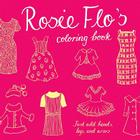
Rosie Flo coloring books
.  They're British, but most are published in the U.S.  The books provide clothing and the child provides the people within them.  These seem to hold interest of kids of many ages.  Sometimes the pictures are whimsical clothing lined up on a page, and other times you get a scene:


Lots to do.

Love,

Deborah

Monday, October 17, 2011

In praise of sticker books

Dear Aunt Debbie,

Our weekend away (and without internet access, hence without blogging) was lovely: the wedding of good friends, and two nights away from our normal life.  I thought about children's books, of course; in fact, I read an excerpt of Home for a Bunny as part of the ceremony.

But what I want to write about tonight are sticker books.  More specifically, sticker books as a great savior on plane rides and long car trips, sticker books as activity and bribe and simple, cheap fun.  They're less messy than drawing with markers while traveling (though we brought those too), don't take up much space, and can occupy Eleanor for a nice long time, and Isabel for at least the minutes it takes for her to take all the stickers out and apply them to her body:

There are all kinds of sticker books, of course, sticker books for every kids' franchise on earth, product tie-ins up the wazoo.  There are the dollar-fifty 6-page sticker books that the girls talk me into buying when we go to the bookstore; those are good for a subway ride, though I find that an inordinate number of them drip glitter.  There are the 8 1/2 by 11 full-size books, some with hundreds upon hundreds of stickers.  I can't claim to be a sticker book expert, but there are two types of books that the girls have particularly liked.

First, there's the Match the Sticker to its Place kind of book.  DK publishes a lot of "Ultimate" sticker books, largely with product tie-ins, and their (now out of print) Disney Animals Ultimate Sticker Book occupied Eleanor for several sittings when she was about 2 1/2.  She would find a sticker, peel it off, then hold it carefully while she turned the pages, trying to find the shadow shape where it fit.  The Disney Animals one had the added benefit of including characters from all kinds of Disney movies, over a period of perhaps 50 years, and sorting them by type of animal: there was a whole page of jungle animals, a page of fish, a page of dogs and cats, etc.  The sorting aspect was very pleasing.  We've tried a few other DK books, never with quite as good results, but still well made overall.

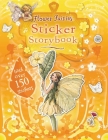
Then there's the Here's a Scene, Paste Some Characters and Things On It kind of sticker book.  On this trip, we brought along this Flower Fairies Sticker Storybook for Eleanor: pages of fairyland scenes on which you can stick extra fairies, flowers, nuts, berries, etc.  The drawings in this one are all from the 1920s, by Cicely Mary Barker, so although the bits of text are dumb ("The picnic turns into a party.  Soon the glade is covered with fairy decorations, and there are Flower Fairies everywhere!"), the stickers themselves are quite nice and old-fashioned.  Eleanor spent about 20 minutes setting up a fairy picnic and giving all the fairies acorn and star hats.

Do sticker books fall under your purview at the book-and-toy store?  Any suggestions for our next big trip?

Love, Annie

Sunday, October 16, 2011

The postseason

Dear Annie,

I hope your weekend away has been good, filled with friends, and relaxing.

Life at the store is starting to speed up, as it is wont to do this time of year.  But before I sink into nothing-but-work, I thought I'd tip the hat to the baseball post-season.  All the teams our extended family roots for have been eliminated long since, but I seem to be obsessively following the dwindling number of games still available.  Baseball is such a pleasure, and the intensity of this time of year is always fascinating.  Tonight could be the deciding game in the NLCS, then on to the World Series.

At the start of the 2010 season, I listed a few good kids' baseball books, but I'm adding two more today.

First, we'll travel back to the summer of 1941.  My mother (your grandma) was home in New York between her junior and senior years at Rollins College in Florida.  She turned 20 that summer, my daughter Mona's current age.  Her 28 year-old boyfriend (my dad, your grandpa) was working for Life Magazine -- that might have been the summer they spent a night sleeping in Central Park (that family legend has always been fuzzy).  Although the Mets eventually turned Helen into a baseball fan, I don't know if she or Frank was paying much attention to the game that remarkable year.

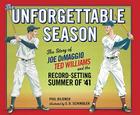
The Unforgettable Season
by Phil Bildner, with illustrations by S.D. Schindler tells the stories of Yankee Joe DiMaggio's 56-game hitting streak (the longest ever), and Red Sox Ted Williams' season of batting .406 (.400 hasn't been touched since).  It's a picture book -- aimed at ages 5 to 9 -- full of illustrations, statistics and suspense.  1941 also had the bittersweet distinction of being the last summer before World War II changed that generation's lives.  By the following summer, my parents were married, your grandpa was in Basic Training, and U.S. involvement in the war was in full swing.  Both Willliams and DiMaggio ended up in the military.

Getting back to the game, I offer a baseball novel that immerses the reader in the love of playing baseball. 
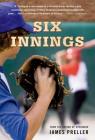
Six Innings
, by James Preller, focuses on the Little League postseason: a regional championship game.  The structure of the novel is the innings of the game.  We get to know all the players, and the announcer, who's a former team member who now is seriously ill.  The book mixes real feelings and character development with evocative description of how it feels to be in the game.  It's one of the best-written sports books I know for middle-graders.  And while poking around online tonight to find more information about the book, I found this lovely and emotional blog entry by Preller, explaining what led him to write the book.

So, on to the World Series.  With whoever's playing.

Love,

Deborah