In which Annie (high school teacher, mother of two young girls and a younger boy) and her aunt Deborah (children's bookseller, mother of two young women in their 20s) discuss children's books and come up with annotated lists.

Sunday, June 3, 2012

... and more dragons

Dear Annie,

I promise I'll get to Tui's request about New York and San Francisco books in the next post (SF especially -- as you pointed out we've hit the NY question before).  But Holly's delightful list of dragon books made me want to add to it.

Reluctant (but loquacious) dragon
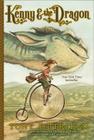
Kenny and the Dragon, which Ian is so fond of, is an homage to The Reluctant Dragon, written in 1898 by Kenneth Grahame of Wind in the Willows fame.  The original illustrations (see left) were by Ernest H. Shepard who drew Winnie-the-Pooh.  The plot is essentially the same: boy, dragon, and over-the-hill dragon-fighter collude to stage a battle and save the dragon.  I love that Tony DiTerlizzi names the boy (Kenny) and the dragon (Graham) after Grahame.

Holly and Ian are probably already familiar with
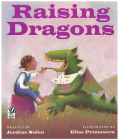
Raising Dragons by Jerdine Nolan, another lovely gentle dragon book.  A farm girl discovers a large smooth rock.  One night there's a very loud crack, and she discovers a baby dragon emerging:
As I stroked his nose, a sweet little purring whimper came from him.  As I touched skin to scale, I knew I was his girl and he was my dragon.  I named him Hank.
Dragon and girl spend lyrical time together as he grows, but soon he makes so much of a sensation in the neighborhood that she feels she must return him to the land of the dragons.  She returns home with more dragon eggs, though, and we are left to wonder what happens next.


There's No Such Thing as a Dragon
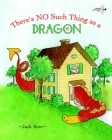
by Jack Kent is a tale about denial.  The books's aesthetic vibrates with the feel of an earlier era -- it's vintage 1975.
Billy Bixbee was rather surprised when he woke up one morning and found a dragon in his room.  It was a small dragon, about the size of a kitten.  The dragon wagged its tail happily when he patted its head.
 He goes downstairs and tells his mother about the dragon.  She tells him there's no such thing as a dragon.  By the time he gets back to his room, the dragon has grown to "almost the size of a dog." Every time it's ignored or denied, the dragon (very friendly) grows a bit bigger.  Grown-ups continue to repeat the title phrase, and it keeps growing (see cover illustration).  After the dragon grows so large that it walks off with the house, the parents finally acknowledge its existence, at which point it shrinks back down to sit-on-your-bed size.  It's a bit of a moral lesson -- don't ignore the elephant in the room! -- but it's also quite entertaining.

On to San Francisco.

Love,

Deborah

Friday, June 1, 2012

Guest blogger: Dragons!

Dear Aunt Debbie,

I haven't thought of The Worry Week in years, but I remember loving it as a kid, especially Alice's dreamy Shakespearean passages.  I modeled a lot of my 4th and 5th grade writing on Anne Lindbergh.

Our first guest blogger for this portfolio-grading season is Holly, who has blogged for us before about outer space, map books, and kid-appropriate adventure and peril.  Here she is:

After all this great discussion of summer books, I am really tempted to write about a book we read just recently (and that I wish I’d read when I was a kid): Gone Away Lake by Elizabeth Enright. However, I have had specific instructions from Ian to write about our favorite dragon books. Dragons are his most recent obsession, but of course all dragon books must be bloodless and have dragons as the good guys. No St George stories for us.

We actually just finished Thomas and the Dragon Queen, which Annie already blogged
about, but before that was Kenny & the Dragon by Tony DiTerlizzi. Like Thomas, the real hero is Kenny, a young underdog (well, under-rabbit). Kenny is a book-loving, somewhat nervous rabbit whose earthy father discovers a dragon while bringing home the sheep (always interesting to me when these anthropomorphised animal books also contain real animal acting animals). Kenny overcomes his fears and befriends the dragon, Graham, who turns out to be a charming poetry-writing intellectual who eats nothing more meaty than creme brulee.

The problem is that the nearby town panics when the dragon is spotted. The king sends a retired knight to exterminate him and the town mobs the hillside to witness the fight. A wonderful team assembles around Kenny to find a way to save Graham and Kenny is the one to come up with a very appealing plan, inspired by Shakespeare! They defuse the mob’s lust for blood by giving them exactly what they really want -- a good performance with a battle between good and evil. All ends well, of course, -- Kenny stands up to the town bully, makes friends, bonds with his dad and gets to be best friends with a dragon!

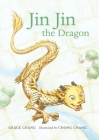
One of our favorite dragon picture books is about a different kind of dragon. Jin Jin the Dragon by Grace Chang begins: “One spring day, when the willow trees had turned green and the wind was softly blowing, a golden creature hatched, unnoticed, from a thousand-year-old egg.”

The gentle curious Jin Jin begins the book not knowing what kind of creature he is, and, in that classic and comforting story way, meets a series of creatures who claim him as one of their own based on one of his physical characteristics. In searching for his own identity, he discovers and learns about Chinese characters hidden in the landscape. At the end, he finds out his own nature and saves the land from a drought by breathing water. All the characters he has met along his journey show up for a big party at the end -- a trope that I happen to use pretty often in my own stories.

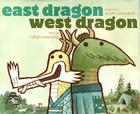
Bridging the dragon gap is East Dragon West Dragon by Robyn Eversole. I love the pictures in this book -- every time we read it we find some new hidden detail that makes us laugh. It is one of those ignorance and prejudice overcome by friendship created in crisis books (you know!).

Here you have East Dragon, golden, revered, and a great swimmer and there is West Dragon, green, harassed by knights, and winged. When West Dragon’s knights attack the East Dragon and are thrown in the dungeon, West Dragon comes to rescue them and ends up being rescued in return by East Dragon. And guess how it ends?

“So they looked at each other, smiled, and offered to take the king and his knights home in style, on the backs of ten leaping, diving, somersaulting dragons to the king’s castle for a festive, friendly, somewhat messy, slightly rowdy, long, dragon visit!”


Holly

And love from me, Annie

Thursday, May 31, 2012

Beach adventures: with and without parents

Dear Annie,

I must research Washington parks with sprinklers before you come to visit, to keep your girls splashing in the manner to which they've become accustomed.  Will also do some digging on books about New York and San Francisco for a two year-old for Tui, who has asked the question on your sprinkler post.

Today, though, as promised, it's time for beach novels.  I discovered
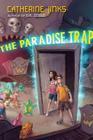
The Paradise Trap
by Catherine Jinks through its very well done audiobook.  This is a beach read in both senses: light entertainment and sandy surroundings.  Marcus and his mum (book is British) buy an old trailer and go the beach she remembers fondly from her own childhood.  She runs into a friend from those days with an inventor husband, children and a robot.  Marcus discovers a basement in the old trailer where one should not exist, and a door which takes the first person who enters to their ultimate "dream vacation."  The vacations all become dark, in the British tradition of magic, and involve everyone needing to work together to escape.  The three parents are equal players in the plot with the three kids -- an unusual occurrence in this genre of kids' lit.  The inventor is hilarious, believing that the magic is all a very clever technological creation, and his wife is constantly demanding better service -- even from six foot tall pink cats who are trying to keep her from leaving the spa of her dreams.  I can imagine a family vacation in which this is the audiobook everyone listens to.  Word of warning, though: the villain, once found, is genuinely scary.  Good for the 8 and up crowd that likes a frisson of creepy -- but lots of laughs too.

I'm bringing
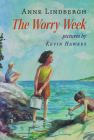
The Worry Week
by Anne Lindbergh to you guys when I see you next week.  The author, who wrote a number of kids' books, was the daughter of Charles and Anne Morrow Lindbergh.  This one is the story of three sisters who contrive to spend a week without parents in their summer house on an island in Maine.  The plan goes perfectly -- except that unbeknownst to them the house has been cleared of all food.  All they have is a book about wild food in Maine, and vague memories of their parents' cooking.

11 year-old Allegra (Sometimes called Legs) narrates the tale.  13 year-old Alice spends much of the summer lost in Shakespeare, and Minnow, at seven, is something of a loose cannon.  Their first day on their own, they work hard to gather and scrape mussels, which Alice cooks.
   "Eye of newt and toe of frog, wool of bat and tongue of dog," Alice sang.
    I had been taking notes on cattail salad, but that caught my attention.   Living off the land is fine, if you have to, but eye of newt is going too far.  What's more, a really weird smell was coming from the stove.  Whatever it was, it wasn't mussels.  It made me feel a little dizzy.
   "Hey, Alice!  What did you put into that pot?" I asked.
   "Gin," said Alice, "and an onion.  I couldn't find any garlic, and there was no more wine, but there was half a bottle of gin left."
   "How much did you put in?" I asked.
   "All of it," said Alice.  "The mussels are ready now.  Could somebody get out the plates?"
   Allegra sees herself as the responsible sister, who tries to get everyone to forage for mushrooms and cattails.  There's a hunt for a rumored treasure.  But the strength of the book is in the relationship of the three sisters.  It's lovely.

 I hope that your students' portfolios are full of excellent surprises.

Love,

Deborah

Tuesday, May 29, 2012

Joy of sprinklers

Dear Aunt Debbie,

This morning, I collected my gorgeous, time-consuming pile of end-of-semester portfolios.  I have some terrific guest bloggers lined up to help me get through the grading load; expect the first one on Friday.

In the spirit of your excellent post on beach books, here's how we spent Memorial Day, beating the heat in an NYC sprinkler:
Good times, even without the sand.  Makes me wonder if there's a subgenre I don't know about: books on the city kid's sprinkler experience?

More on books soon.

Love, Annie

Monday, May 28, 2012

Back to the beach!

Dear Annie,

I've been working Memorial Day weekend at the toy & book store, and I can testify that summer is definitely here.  Outdoors it's disgustingly sticky, and indoors sales of water guns, wading pools and swimming goggles are booming.

So even though we've gone to the ocean more than once (one, two, three, four, five times at least!),  I thought I might add a few more titles to our beach bag.

One of the prolific Robert Munsch's (one, two) more recent books,
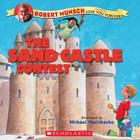
The Sand Castle Contest
, continues his wacky streak.  Matthew and his family go to a beach where a sand castle contest is taking place.  In the background, we see people building sand versions of Big Ben, the leaning tower of Pisa, the Capitol, and more.  He meets Kalita, who is making a kid-size sand castle, and a sand dog.  He builds a wildly realistic sand house, with rooms and furniture.  Two different judges tell him to remove the house.
   "This is my sand house, said Matthew.  "I made it for the sand contest."
   "HA!" said the judge.  "I know a real house when I see one, and there are no real houses allowed on the beach!"
   She went into the bedroom and looked at the sand bed.
   She went into the kitchen, opened the refrigerator, and looked at the sand apples and the sand celery and the sand cartons of milk.  Then she said, "Little boy, you've got to get this house off the beach."
   "This is my sand house, said Matthew, "and I am going to prove it"
   "HA!" said the judges.
Matthew finally proves it by kicking a corner of the house, at which point it collapses into a pile of sand, and he wins the contest.  In the meantime, Kalita's  sand dog has become real, and all are satisfied.  Part of what makes Munsch's stories work so well is his strategic use of repetition.  Love it.

Then there's Traction Man, a much-put-upon square-jawed action figure created by Mini Grey.  In his third adventure,
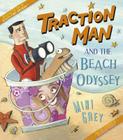
Traction Man and the Beach Odyssey
, he and his sidekick Scrubbing Brush go to the beach with their boy.  They explore a Rockpool -- "Traction Man is wearing his Squid-Proof Scuba Suit, Lightweight Shorts and Aquatic Air Tanks."  It's hard to do justice to Traction Man's manly humorlessness and the complete silliness of his plots.  Traction Man ends up grabbed by a dog and dropped near the Dollies' Castle.  The front endpaper has already introduced Beachtime Brenda, one of the Dollies:
"More Raspberry Ripple, Traction Man?"
"Thank you, Ladies, but no.  One scoop is plenty."
"You can stay in our castle FOREVER!"
"Somehow, Scrubbing Brush, we must escape."
Before they can, however, the dog comes back and destroys the Dollies' Castle, seriously rumpling all in the process.  Traction Man chivalrously offers to rebuild, but they all end up working on another project:
Traction Man, Scrubbing Brush and the Dollies are digging an exploration hole to the Center of the Earth.
   (The Dollies are wearing Safety Jackets, Excavation Shorts and Cave Helmets borrowed from Traction Man.)
   ...
   Tomorrow they are all going to go on an expedition to the Mysterious Cave with their own lunch.
   The Dollies have a dinghy . . . and they are all ready for Anything.
Next time: beach chapter books.

Happy summer.

Love,

Deborah

Friday, May 25, 2012

Is it leftist?

Dear Aunt Debbie,

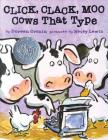
Taking the political message-bearing kids' book modern, I'm reminded of Doreen Cronin and Betsy Lewin's Click, Clack, Moo: Cows That Type.  It's the first in what has become a series of stories about Farmer Brown and the animals on his farm: a rowdy bunch of cows, chickens, pigs, and ducks who he views with suspicion but can never quite outsmart.

It's the cows who start trouble in Click, Clack, Moo.  They find an old typewriter in the barn, and loud typing is followed quickly by articulated demands.  Farmer Brown finds a note nailed to the barn door:

Dear Farmer Brown, 
The barn is very cold 
at night.  
We'd like some electric 
blankets. 
Sincerely, 
The Cows

When Farmer Brown refuses their demand, the cows go on strike ("Sorry.  We're closed.  No milk today."), followed soon after by the chickens, who stop producing eggs because they want electric blankets too.

Farmer Brown counters with his own typewritten note:

Dear Cows and Hens:
There will be no electric blankets.
You are cows and hens.
I demand milk and eggs.
Sincerely,
Farmer Brown

Duck is chosen as the neutral party to communicate this ultimatum (in later books, Duck becomes the animals' ringleader; here, he's just getting started).  The Cows counter-offer to give Farmer Brown the typewriter in exchange for the electric blankets.  He agrees.  In the last two pages, the ducks seize the typewriter for their own use....

There's something deeply pleasing about the total daffiness of the book: electric blankets?  Typewriters?  Cronin's text is deadpan and very funny, and Lewin's big-eyed animals and crotchety farmer incredibly expressive.  But just below the daffiness, it's not hard to find a message about the power of collective bargaining.  The cows, chickens, and ducks work together to make quality-of-life demands from their employer, and they succeed.

This idea hasn't gone unnoticed, on either the right or the left.  Click, Clack, Moo appears as a recommended resource on the Zinn Education Project website with the tags "Labor" and "Organizing."  A couple of months ago, a conservative radio talk show accused elementary school teachers of using the book as part of a larger "left-wing indoctrination." They also found it "anti-creationist," because the animals are depicted as being on the same level as humans, rather than subordinate to them.  (I don't think these guys read very many children's books.)

As with so many books, for children and adults alike, I feel like the message that comes through has to do as much with the context of the reading as the text itself.  We've said it before: the conversations you have with your kids about a book help cement the meaning they take from it.  And we've said it before: sometimes the meaning they take from a book isn't the one the book is promoting at all.  Hard to tell, at this age, what will stick.

Love, Annie


Tuesday, May 22, 2012

Is it political?

Dear Annie,

L. Frank Baum is always interesting on gender issues, but The Marvelous Land of Oz is definitely where he's most out-there.  His wife and mother-in-law were both very strong feminists, which leads critics to believe their influence led to his many strong female characters.  I've never been sure, though, how to interpret those girls with knitting needles and their strange revolution.  Is it a statement about the absurdity of women's political movements?  Or just a good plot device?

As for A Cricket in Times Square, I love that Eleanor picked up on the language variation right away.  Yeah, but for us grownups it sure is wildly uncomfortable.  Sounds like you handled it very smoothly.  One of the many wonderful elements of reading with your children: you get what one of my girls' preschool teachers called "opportunities" to unravel tangles you hadn't anticipated.

I stumbled upon a strange and interesting article last week which found a political message in post-WWII kids' books about construction equipment.  "Unearthing Benny the Bulldozer: The Culture of Clearance in Postwar Children's Books"* by Francesca Russello Ammon argues that massive urban renewal, new building, and the expansion of highways were all preceded by massive destruction: of old structures, terrain and the environment.  The dominant postwar culture, she argues, celebrated this destruction in many forms, including turning construction equipment into anthropomorphized heroes in kids' books.  She cites Benny the Bulldozer, a 1947 book by Edith Thacher Hurd and Clement Hurd (quite recently in this blog for their Mother Animal books) in which Benny agrees to clear the way for a new highway.  He ends up leading a triumphant July 4th parade celebrating the construction.
The simultaneous ascension of both the bulldozer and "bulldozer books" was no accident, but reflected parallels between the landscapes of fact and feeling.  The books reflect the social, political and cultural preoccupations of their era, helping a younger generation to make sense of the world as their environment underwent massive physical upheaval....
By putting a happy face on demolition for their readers, the books subtly endorse the "culture of clearance" -- that is, the ideology, technology, policy, and practice of clearing the landscape of its natural and built environment.
 I haven't managed to find Benny's text online or in the local library.  She also cites the 1952 Buster Bulldozer, from which I found this, which supports her point:

Many of our readers right now are probably screaming, Mike Mulligan! Mike Mulligan!

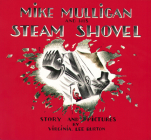
Mike Mulligan and his Steam Shovel
by Virginia Lee Burton tells the story of Mary Anne, a steam shovel celebrated for digging canals, cutting train tunnels through mountains, and "lower[ing] the hills and straighten[ing] the curves to make the long highways for the automobiles."  In the book, she digs the cellar for a new town hall in one day, triumphing over doubters.  The problem with including this one in Ammon's thesis, however, is that it's decidedly pre-war, published in 1939.  But it definitely sees re-shaping the landscape as a sign of progress.

Ammon's article, which seems to be a chapter in her PhD. thesis, reminds me a bit of the analyses that argue the imperialist nature of the Babar books and Donald Duck.  I find them all very engaging, an interesting frame through which to observe the familiar.  But the destructive construction equipment frame cuts off the intrinsic fascination of big machinery for kids.  And in a era when bulldozers were doing destructive stuff like moving hills, a sympathetic bulldozer with eyes and smile isn't necessarily a propaganda tool as much as an object of interest in a child's world.

Fun to think about, though.

Love,

Deborah

* Can't find full text online.  I read it in Technology and Culture: the international quarterly of the Society for the History of Technology. V. 53 #2.