In which Annie (high school teacher, mother of two young girls and a younger boy) and her aunt Deborah (children's bookseller, mother of two young women in their 20s) discuss children's books and come up with annotated lists.

Wednesday, November 30, 2011

Poetry in a nutshell

Dear Annie,

I'd like to point out a lovely comment on the movie Hugo that's just been posted here by your father, my brother-in-law.  Testimony to the fascination of great books and movies for both kids and grown-ups.  Thank you, John.

Now on to Nick's question about more poetry, which got me thinking too.  In addition to the book lists you referred to in your post, we went on a roll about poetry back in June of 2010: there were four posts in a row: here, here, here and here.  Don't know if you found all four of them, Nick -- and they're fun to revisit anyway.
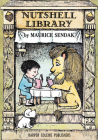
So imagine my surprise when I realized we haven't visited Maurice Sendak's
Nutshell Library
.  It's four small rhyming books: Chicken Soup with Rice (about months), Alligators All Around (alphabet), One Was Johnny (numbers), and
Pierre: a cautionary tale
.  They're all delightful, but for the moment I'll stick with Pierre, a boy who responds to all statements -- including his mother's "You are my darling boy/you are my only joy" --  with, "I don't care." When he stands on his head on a chair:
His father said,
"Get off your head, or I will march you up to bed."
Pierre said,
"I don't care!"
"I would think that you could see --"
"I don't care!"
"your head is where your feet should be!"
"I don't care!"
"If you keep standing upside down -- "
"I don't care!"
"We'll never ever get to town."
"I don't care!"
"If only you would say I CARE."
"I don't care!"
"I'd let you fold the folding chair."
"I don't care!"
So his parents left him there.
They didn't take him anywhere.
The parents go, a lion appears, expresses the intention to eat him, with the usual response.  The lion then says, "Then I'll eat you if I may," to which Pierre replies, "I don't care!" and is eaten.  When the parents come home, the lion is abed and they fear the worst.
His mother asked, "Where is Pierre?"
The lion answered, "I don't care!"
His father said, "Pierre's in there!"
The doctor eventually gets a relieved Pierre out, and now, of course, he cares.  It's another Sendak mix of the absurd with intense feeling.  And it's all wrapped up in great rhythms and rhymes.


Love,

Deborah

Monday, November 28, 2011

Book lists and rhyme, all the time

Dear Aunt Debbie,

I really want to see Hugo.  Going to need babysitting for that one.  We took the girls to their first movie-theater movie this weekend: the new Muppet movie.  It was a total hit, both girls mesmerized by the big screen.  Isabel didn't say a word, and practically didn't move, for more than two hours.  Eleanor had much more active reactions, laughing, squealing, even crying towards the end when it looked like the bad guy was going to win.  She knows a lot of stories, but doesn't yet fully understand that comedy means the good guys are going to come out on top at the end.

While movies are clearly a different medium from books, and what they require from an audience is different as well, I can't help feeling that the sustained attention span Eleanor and Isabel have built up in all our reading time has something to do with their ability to follow the narrative of a full-length movie.  It certainly informs the way they tell stories.  A couple of nights ago, they were in the bath together, each girl playing her own separate narrative game.  Eleanor had a Barbie in the tub with her, who she had cast as Cinderella, and there was a complex dialogue going on, Eleanor voicing Cinderella and herself and a small cast of other characters.  Right next to her, Isabel swam a rubber crocodile through the water, saying, "And the crocodile swam toward the child, and the child kissed the crocodile" (she picked it up and kissed it) "and took the crocodile home to its mother."  I'm a sucker for kids narrating stories about themselves in third-person.

But back to books.  Earlier tonight, Nick left a comment asking about more recommendations for rhyming books for 3-year-olds.  I'll answer that partially by encouraging readers to check out our Book List pages.  Under Picture Books, I have two lists that might be helpful: "Books it's fun to read aloud because of rhythm and rhyme" and "Rhyming books."  I've just added a few titles to each from the archives.

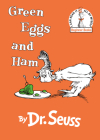
Lately, Dr. Seuss has been circulating heavily in our rotation.  In an earlier discussion of poetry, you mentioned Green Eggs and Ham, one of Isabel's current favorites.  Talk about rhythm and rhyme -- this book has an engine thrumming beneath every page:

I do not like them in a box.
I do not like them with a fox.
I do not like them in a house.
I do not like them with a mouse.
I do not like them here or there.
I do not like them anywhere.
I do not like green eggs and ham.
I do not like them, Sam-I-am.

I didn't realize until I had kids that, of course, this is a book about picky eaters.  How many times has every parent played out this same scenario? "You do not like them.  So you say.  Try them!  Try them! And you may."

Dr. Seuss has so much going for him: the strange, effective creatures, the loopy twisting roads and railroad tracks, the rhyme, the repetition.  It's funny -- I don't feel the same affection for his books that I do for, say, anything by Margaret Wise Brown, but he is classic, worth rereading often, and a natural place to go to when you want some serious rhymes.

Love, Annie

Sunday, November 27, 2011

A book to watch

Dear Annie,

I hope your Thanksgiving was a good one.  We had relatives from Bob's side of the family and our Lizzie here with us.  On Friday night, in part because I was so curious about it, some of us went to see Hugo, the new Martin Scorsese movie based on The Invention of Hugo Cabret, by Brian Selznick, which we've written about here.

The book is a visual feat: the story is told alternately in words and in pictures.  Here are two short sequences:
Both those scenes are in the movie, with the same emotional meaning as in Selznick's illustrations.  The film stays very true to the look and feel of the book -- one feels immersed in it, and I don't think that's because it was in 3-D.  Hugo is a12 year-old boy living hidden in a Paris railway station, and much of the film is shot from the perspective of someone shorter than the adults around him. 

The plot swings around two historical artifacts and the characters' emotions tangled up in them.  One is a damaged mechanical man -- an "automaton" -- which Hugo hopes to make work again.  The other has to do with the films of a very early movie-maker, Georges Méliès.  My recollection of the book was that the suspense surrounding the automaton was primary, and the films secondary.  In the movie, the priorities are reversed.  Scorsese, a master filmmaker, offers a history of early film -- and some hilarious and fascinating clips from  old movies.  The history is wonderful, the plot remains mostly true to the book, and true to Selznick's emotionally powerful main character.

I wonder what your father (my brother-in-law), who's so knowledgeable about film, will think of it.  John?

It's almost always disappointing to see what the movie industry does to good kids' books, but this time I think Scorsese made a film that's both his own, and one true to the book.  My biggest problem with the film was the 3-D.  This may be my inner Luddite speaking, but I really didn't see the point of making gears jump out of the screen, snowflakes appear to fall on the audience, or even the crowd scenes be in-your-face.  The film itself is enough to pull you in.  And it really does.

Love,

Deborah

Friday, November 25, 2011

Animal house

Dear Aunt Debbie,

You make me excited for Christmas (for which I am otherwise woefully unprepared).  I adore Inga Moore.

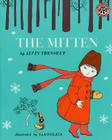
With winter coming, we've been doing a lot of reading of another book about large animals and small animals trying to live together in a space that doesn't quite work for them:   The Mitten, retold by Alvin Tresselt.  It's a traditional Ukranian folktale, and the illustrations by Yaroslava in this version give it a very Easten European feel. 

A little boy out gathering firewood for his grandmother on the coldest day of winter drops his mitten in the snow.  The narrator opines: "Now, how a boy could do this on the coldest day of winter I'll never know, but that's the way my grandfather tells the story."

The boy goes off, and a mouse decides to crawl into the mitten to keep warm.  She is soon joined by a parade of animals who increase in size and absurdity: a frog, an owl, a rabbit, a fox, a wolf, a boar.  The mitten gets more and more snug; seams start to strain.  Then a bear comes along.

"No room! No room!" cried the animals even before the bear had a chance to speak.
"Nonsense!" said the bear.  "There's always room for one more."
And without so much as a please or thank you, he began crawling into the mitten.
He put his paw in first, and the mitten creaked and groaned.
He put his other paw in, and one of the seams popped.
Then he took a deep breath and pushed himself in.

So you think it's going to be the bear who makes the mitten explode -- but it isn't!  The last straw comes in the form of a tiny cricket, who shows up just after the bear in a very pleasing reversal of expectations.  NOW the mitten explodes, and all the animals get tossed out across a double-page spread into the snow.

The boy realizes he's lost his mitten, and comes back to look for it, but all he can find are the ripped-apart pieces.  The book ends, "And my grandfather says he never did know what really happened to his mitten."  The idea that this reveals that the story is made up is lost on my kids -- kind of a complex thing to explain -- but it has led to some interesting conversations.

Eleanor and Isabel love the repetition in the story, the way the mitten-house gets more and more ridiculous.  There's suspense and humor, and Yaroslava draws all the animals in traditional Ukrainian clothing, which is very funny.  I also appreciate that the animals are of mixed gender, pretty much half male and half female.  Half of the pictures are black line drawings on turquoise-blue pages; the other half are on white pages with the color inked in in a pleasingly solid way.  It's high-contrast, and very appealing to the eye.  It's also, after you close the book, a fun game to play with a blanket and couch cushions.

Love, Annie

Wednesday, November 23, 2011

Friendship, homebuilding and peanut butter

Dear Annie,

"Everything!  Everything!"  What a perfect reaction to getting the connections in a series of books.  Such a lovely time you're having reading with your children.

Tonight I'm spilling the beans on a Christmas gift I'll be sending Eleanor and Isabel.  I first read this one as a sample back in the spring, and have been waiting to write about it until it came out last week. 
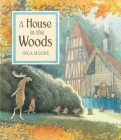
A House in the Woods
is a picture book written and illustrated by the wonderful Inga Moore -- I don't know if this is her first foray into writing.  You've written about her illustrations for Wind in the Willows and The Secret Garden.  She continues to do amazing emotionally descriptive pictures filled with detail.  And her characters are full of body language and personality.

We start with two friends:
One morning the two Little Pigs went out walking together.  One Little Pig found a feather, and the other found an interesting stick.
After the walk, the pigs find that their homes have been unintentionally destroyed by their large friends Moose and Bear, who were only trying to move in:
There they are, in a pickle, with such expressive human-like bodies, the pigs with the feather and stick, and a Narnia-esque lamppost in the woods.

They decide to build a house together and call the Beavers (old-fashioned phone on nearby tree) to help them with the project:

The beavers are so professional -- and so consistently cheerful.  And payment in peanut-butter sandwiches is such a nice touch.  They fell trees in beaver fashion, with cheers from the non-chewers, then everyone gets busy:
This size picture doesn't do the scene justice: there's so much going on!
By lunchtime the walls of the house were up . . . and by dinnertime the roof was on. (The lunch and dinner times were on different days, of course.  Beavers are fast, but not that fast.)
The house is finally finished and furnished, and the bill is delivered.  There's a dash to the local store to buy peanut-butter and bread, and the four friends go to the quite spectacular beaver lodge with six towering plates of sandwiches to which grown-up and child beavers help themselves.  Then then the four head back to their new home, have supper, talk by the fire, and go sweetly to bed.

The tone throughout the book is cozily descriptive.  Toward the end, the author asks if the reader thinks all that hard work has been worth it.  (How could one say not?)  And we get to say goodnight to each of the main characters, snoozing in their beds beneath birds roosting in the rafters.  A really wonderful book.

Love,

Deborah

Monday, November 21, 2011

Fantastic stories parents tell their kids

Dear Aunt Debbie,

Julian sounds like an awesome character.  We'll have to put him on the list.  We've just run through the four linked Edward Eager books that begin with Half Magic, and are back to rereading My Father's Dragon.  The end of The Time Garden, which has the scene in which Katherine and Martha's children travel back in time and meet (and rescue) their mothers as children, was a fabulous reading experience.  As Jeff read the scene and Eleanor realized what was happening, she got incredibly excited, so much so that she started bouncing and jumping on the couch, sputtering, "Everything!  Everything!"  I can't wait for her to discover other linked fictional universes.

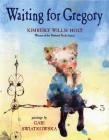
Your descriptions of Julian's tall tales made me think of a picture book which also involves tall tales and strange, elaborate drawings: Waiting for Gregory,by Kimberly Willis Holt, illustrated by Gabi Swiatkowska.  It's a book Aunt Irene and cousin Ona sent Eleanor when I was pregnant with Isabel -- a Preparing for the New Baby book, with a couple of twists.

The book begins:

Aunt Athena is expecting a baby boy.
She says we'll call him Gregory.

The picture is of Iris, the narrator, holding the rendering of Aunt Athena's pregnancy.  It gives you the sense of the lovely, odd combination Swiatkowska achieves in her illustrations: her characters have an 18th-century feel about them, and the pages are filled with intricate line drawings of ladders and angels and strange machines -- it feels a little like an artist's notebook.

Iris is eager for her cousin to be born, and curious about when it's going to happen, but no one will give her a straight answer.  "Soon, Iris, but not too soon," her father tells her.  And then the myths come: Iris's grandfather tells her Gregory will be arriving by stork; her grandmother tells her he's growing under a cabbage in her aunt's garden, her friend Lacey insists it has to do with Aunt Athena eating "a thousand chocolate-chip ice cream sundaes with sour pickles on top."  Finally, Iris asks her mother, who pulls out the most accurate information from each story (while still eliding any actual physical facts of pregnancy), and gives Iris a rough estimate.

Iris goes on in the vein of Babies Can't Eat Kimchee to imagine all the things she wants to do with Gregory:


When Gregory arrives, of course, he can't do any of those things yet, but there is the hopeful, pleased sense that some day he will.

Love, Annie


Sunday, November 20, 2011

Up from the basement

Dear Annie,

Bob has gone through a flurry of Fall Cleaning this weekend, digging boxes out of the basement and reorganizing our storage space.  Several boxes marked, "Children's books -- take to Maine" have surfaced, and he hasn't been able to resist pulling some of our favorites to have back on the shelves.  Some of what we've got on display:
and on and on.  I live with lots of these books at work, but it's so cozy having the dog-eared copies here on the bookshelves in the dining room.

The one I grabbed and happily re-read this evening is
The Stories Julian Tells
, by Ann Cameron.  The cover has been redesigned kind of unimaginatively, but the internal illustrations by Ann Strugnell are still intricate and lovely.  It's an early chapter book -- one of those starter books in which each chapter is a separate short story.

Julian is an older brother who leans toward magical thinking and making up tall tales.  The first story refers to corporal punishment in a way that one could be unhappy about.  Julian and Huey's father makes a pudding for their mother. "A wonderful pudding....It will taste like a whole raft of lemons.  It will taste like a night on the sea."  The pudding is beautiful, the boys are told to stay away from it, and of course they consume almost all of it when no one else is around.  The last part of the story involves the angry father saying that there's going to be some beating and whipping going on, and the boys are clearly scared he's going to hit them.  The beating and whipping turn out to refer to the steps in making a new pudding, which the dad supervises and the boys make.  They're tired from the exertion, but physically unharmed and no longer hungry for pudding.

I'm making this sound bad, but the relationship between father and sons throughout the book is clearly loving and teasing.  The second story, "Catalog Cats," is one that will stay with many readers for years, if not decades.  Dad sends away for a seed catalog, and the younger Huey asks Julian,
"What's a catalog?"
"A catalog," I said, "is where cats come from.  It's a big book full of pictures of hundreds and hundreds of cats.  And when you open it up, all the cats jump out and start running around."
"I don't believe you," Huey said.
"It's true," I said.
"But why would Dad be sending for that catalog cat book?"
"The cats help with the garden," I said.
"I don't believe you," Huey said.
"It's true," I said.  "You open the catalog, and the cats jump out.  They run outside and work in the garden."

When the much-anticipated catalog finally arrives, Huey bursts into tears because there are no cats.  He explains to their confused father about the cats that will help prepare the soil and plant the seeds.  Again we have the apprehension about parental anger.


"Julian!" said my father.
"Yes," I said.  When my father's voice gets loud, mine gets so small I can only whisper.
"Julian," my father said, "didn't you tell Huey that catalog cats are invisible?"
The father goes on to weave a much taller tale about the catalog cats, how they move too fast to be seen, and they only work on gardens if people do half the work too.  By the end of the succeeding chapter, Julian half believes in them.

Our girls were quite fond of this one --  it was lovely to revisit tonight.

Love,

Deborah