In which Annie (high school teacher, mother of two young girls and a younger boy) and her aunt Deborah (children's bookseller, mother of two young women in their 20s) discuss children's books and come up with annotated lists.

Showing posts with label wordless books. Show all posts

Monday, October 11, 2010

Living happily in our cloud of words (and pictures)

Dear Aunt Debbie,

It's funny -- when we started reading chapter books with Eleanor, I had the brief worried thought: Does this mean we're leaving behind our wonderful stash of picture books?  But of course it doesn't.  Even if we didn't have Isabel coming up through the ranks, thrusting her dog-themed board books at me and insisting, "Woof!", Eleanor moves easily among different kinds of books.  Like all readers, sometimes she's in the mood for one thing, and sometimes another.  Me too. 

I can see how, especially in a recession, parents might balk at buying a lot of brand-new hardcover picture books, at close to $20 a pop -- I do.  As I've mentioned several times, we often make the library our testing ground, and then buy the books we've checked out repeatedly.  But have you noticed, as a bookseller, anything like the "trend" the Times is reporting on?
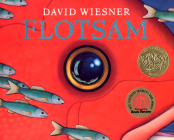
One of the library books Eleanor has fallen in love with this week is a wordless book you wrote about back in May: Flotsam, by David Wiesner.  It's such a gorgeous book, and so rich -- Jeff and I have found ourselves poring over it as well.  Eleanor has been reading it a lot, both talking it through with us and just staring into the pages as she drinks her milk in the morning.  In Flotsam, a curious boy already examining crabs on the beach finds an old underwater camera, develops the film in it, and sees extraordinary underwater scenes: mechanical fish, a family of octopi reclining on living room furniture, giant starfish stretching with islands on their backs, and finally an explanation of the camera's provenance. 


I wonder what Eleanor makes of some of it.  I look at these pictures and tease out what is real and what's fantastical.  But here's Eleanor, for whom magnifying glasses, microscopes, and old-fashioned film developing are just as strange and wonderful as the magical bits are to me.  I think this is one I'll shell out the bucks for, maybe for Christmas.  I'd like to have it around so the girls can easily re-read it as they get older.
 
Your also post reminds me that I need to write at some point about more of the classics: Maurice Sendak, Robert McCloskey.  I'll get on that soon.

Love, Annie

Monday, May 24, 2010

More wordless (and almost-wordless) books

Dear Aunt Debbie,

Oddly, we don't have a lot of wordless books in this household. (Or perhaps, it being this household, it's not odd at all.) We adore Good Night, Gorilla, which I think you gave us when Eleanor was quite small, and which is so rewarding to read and re-read and examine. It's funny; it's not technically wordless, as the zookeeper does say good night to each animal, and towards the end, the animals all say good night as well, but the words don't cover the bulk of the story. We've read it in various different ways. For a while, we had the standard things we'd say on each page ("And now the gorilla is using the blue key to open the blue cage...."), and then once Eleanor was old enough, we'd ask her questions about what was going on in each picture. I don't think she focused on reading this one alone more often than books with words. Of course, with so many of our picture books, she knows much of the text by heart anyway.

Mulling over wordless or almost-wordless books made me think of one of our favorite good night books, which is extremely quiet and simple and includes three page spreads with no text at all.


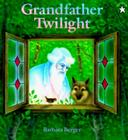
Grandfather Twilight


We received Barbara Berger's Grandfather Twilight as a gift from a colleague of mine shortly after Eleanor was born. This was lucky, because it's not a book I would have bought for myself had I run across it in a bookstore. Flipping through it for the first time, I found the illustrations cloying, rendered in soft-focus, and the story nothing gripping. But I was wrong. Eleanor loved the book immediately. In it, Grandfather Twilight takes a pearl from his trunk each night, then walks through the woods, into open ground, and out to the sea (these are the wordless pages). The pearl grows larger in his hand as he goes, and he lifts it up at the water's edge to become the full moon, then walks back home. It's a slow, gentle story, and the paintings grow on you quickly. We read it often.

A wordless book we discovered this year is by the multi-talented Paul Fleischman (author of a wide variety of children's books, including the terrific Joyful Noise: Poems for Two Voices and Seedfolks -- is there anything he can't do?).


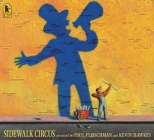
Sidewalk Circus


Sidewalk Circus depicts a girl waiting at a bus stop and looking at the street around her. There are signs and posters advertising the coming circus (they provide the only text), and as she looks around, the everyday activities of the people on the street are transformed into circus acts: a cook in a restaurant window flips pancakes, while her shadow is that of a juggler, etc. It's a fun one to explore with a kid, especially someone who has been to a circus.

It seems to me, thinking about it like this, that often wordless books are good for slightly older kids, so they can talk through them and discover the stories for themselves.

Love, Annie

Sunday, May 23, 2010

Beyond Words

Dear Annie,

A delightful Dutch book arrived from a publisher this week, reminding me just how varied wordless books can be. This one, called
The Surprise
, by Sylvia van Ommen, follows a serious and industrious sheep while it takes a bath, rides a motorbike to go to the store, buys red dye, dyes its wool (while it’s still on), shears itself, etc., all the way through knitting a gift for a friend. It’s both whimsical and very clear and straightforward.

Peggy Rathmann is the queen of toddler/preschooler wordless books, with both
Good Night Gorilla
, a hilarious and simple story about a mass zoo escape (the goal is to sleep in the zoo-keeper's house), and
10 Minutes till Bedtime
about a boy getting ready for bed while a tour group of hamsters complicates the process. It’s all in the details, and there are lots of them. You can spend many minutes, if not hours, discovering all the things going on in each picture. And it has a number of references in it to Good Night Gorilla.

In Quentin Blake's
Clown
, a group of toys is thrown out, and the clown doll sets out to find a new home for all of them. He has setbacks along the way, but ultimately finds a family in need of some cheering up, and they all end up happily together. Blake -- perhaps best-known for his illustrations of Roald Dahl books -- puts lots of emotion into this one.

David Wiesner does more complex, weirder and (sometimes) darker wordless books, but for an older child, they're quite wonderful. In
Tuesday
, frogs float out of a swamp one evening on lily pads and have adventures in town, turning back into their land-based selves at the end of the evening. The pictures are amazing, bordering on the eerie, with details one can keep finding on re-readings. And his
Flotsam
puts a washed-up camera at the feet of a boy exploring the beach. He develops the film in the camera, finding fantastic pictures of magical underwater worlds, and self-portraits of other children who have found the camera. At the end, he takes a picture of himself, and sends the camera back into the waves.

I'll end at the ocean still, on another younger book.
Wave
, by Suzy Lee, shows a girl's day at the beach, with all the wonder and occasional overwhelmingness of the waves. Lovely.

So now that I've listed these, I'm wondering how you as the reader in the parent/child group, feel about wordless books. A welcome change? An extra task (now I've got to make up the story too...)? Something that can be read without you around? What do you think of them?

Love,

Deborah