In which Annie (high school teacher, mother of two young girls and a younger boy) and her aunt Deborah (children's bookseller, mother of two young women in their 20s) discuss children's books and come up with annotated lists.

Showing posts with label Margaret Wise Brown. Show all posts

Sunday, August 17, 2014

Guest blogger: Trippy books

Dear Aunt Debbie,

We're moving on Tuesday, and my life is a swirl of boxes and packing tape, discombobulated children and frustration with contractors. Happily, my dear friend Emily, who most recently guest blogged for us a couple of weeks ago about reading to her newborn, has written another most excellent post for this week:

Hi again Annie, 

One of the pleasures of having a new baby, aside from the tremendous new love in one’s life, is the influx of books from friends and well-wishers. Among the classics we've received – The Snowy Day, Make Way For Ducklings – are a few wingy selections. Three of these trippy, singular books are the subject of today’s post. 
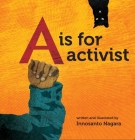
Our friend Bronwen gave us Innosanto Nagara’s
A is for Activist
– a radical left wing alphabet primer sure to have your baby rising up against tyranny in no time. Imagine how rousing it is to read Nagara’s ode to the letter J:


“J is for Justice! 
Yay for Justice! 
Jia-Jing Jiang.
Juanita. Jamal.
Justice for the Janitors,
Justice for all!”

The next letter comes with a thoughtful reminder:

“Kings are fine for storytime.
Knights are fun to play.
But when we make decisions 
we will choose the people’s way!” 

My daughter Alice is still young enough that she inadvertently throws one of her little fists up above her head on occasion. At least I thought it was inadvertent at first; now I suspect she’s preparing to fight the power. 
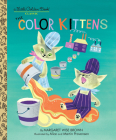

The Color Kittens
, illustrated in bright, pastel hues by Alice and Martin Provensen, is a lesser-known book by the inimitable Margaret Wise Brown. In it, two kittens named Brush and Hush mix buckets of blue, yellow, and red paint to create “all the colors in the world.” The text shifts back and forth from prose to verse, for instance when Brush and Hush try to create green: “Green as cats’ eyes / Green as grass / By streams of water / Green as glass.” At one point the color kittens fall asleep and then things really get trippy. In their dream, their colors rush together as they imagine “a purple land / In a pale pink sea / Where apples fell / From a golden tree / And then a world of Easter eggs / That danced about on little short legs.” The plot of this book is less emotional than the Margaret Wise Brown of, say, The Runaway Bunny, but the linguistic rhythms are as inexplicably mesmerizing as those in Goodnight Moon. It’s a charming addition to Alice’s growing library. 
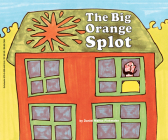

Growing up, our own loopy family favorite was The Big Orange Splot by Daniel Manus Pinkwater, a book originally published in 1977. In it, a mustachioed man named Plumbean lives “on a street where all the houses were the same” until a seagull mysteriously drops a can of orange paint on his roof. Implored by his neighbors to paint over the splot, he decides instead to paint the house of his dreams by night. In the morning, his neighbors come out of their monotonous brown houses and behold Plumbean’s: “It was like a jungle. It was like an explosion.” The neighbors talk among themselves, saying “Plumbean has gushed his mush, lost his marbles, and slipped his hawser” – lines that are a joy to read aloud. One by one, they stay up all night in Plumbean’s garden, trying to convince him to return his house to its original, drab form, and one by one, they decide to paint their own houses to “look like all their dreams.” The results, illustrated in groovy, nineteen-seventies style, are magic. 

 My hope for Alice is, of course, that she will live a life that looks like all her dreams, as weird and wild as they might be. These books will surely encourage her in that direction.

Love, Emily

And love from me, crazed as I am!

Annie

Thursday, December 8, 2011

Rabbits small and large

Dear Annie,

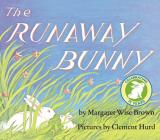
I love The Runaway Bunny with its amazing pictures that one can just climb into.  It's a book for a very young child, describing the world a child sees.  During those toddler stages of exploring the world then wanting to cling, it reassures.  Having said that, I will confess that I didn't read it to my own children when they were that little.  As you know, one of the traumatic moments of my early motherhood was when 22 month-old Lizzie walked out the door in our urban neighborhood, closing it behind her, and toddled happily toward a six-lane major thoroughfare at the end of our block.  I figured out where she'd gone and caught up with her before she got there, but the whole incident was heart-stopping.  Somehow, reading a book where the thrill of running away was so beautifully presented, and the message that mom will always come after you (as I did) led me to fear that the book would encourage her roving tendencies.

 An older fan of another rabbit book came to the store yesterday: a sixth grader who loves
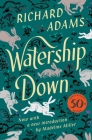
Watership Down
, by Richard Adams.  It tells the story of a group of rabbits who leave their home when one of them predicts its destruction.  They go on an odyssey through several different types of rabbit communities before establishing -- and having to defend -- their new home on Watership Down. It's big and rich in adventure, heroism and competing philosophies of what society should be.  I wonder if it's one of the books that your high school students talk about having loved a few years earlier.  The sixth-grader's father said that in searching for other books she might like as much, he ran into recommendations speaking to the utopian/dystopian themes, like 1984, and Brave New World.  He was hoping for something else --- "not as dark" was his request.

I love this kind of request, but I also often wish I had a few hours and several different people to chat with before I charge into recommendations.  That's not how it works, though -- so I flailed around for a bit and came up with two possibilities.  First I suggested
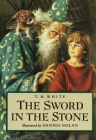
The Sword in the Stone
, by T. H. White (author of Mistress Masham's repose, which we've praised here and here). It's the story of King Arthur's childhood, the first part of The Once and Future King.  It's a big meaty book, full of humor and good writing. Wart, as the boy Arthur is called, grows -- literally and figuratively -- through the book.  I'm particularly fond of the edition whose cover you see here: it has stunning occasional illustrations which stress Arthur's youth.  Merlyn's education of Wart is the element which made me think of it for our sixth grader.  He changes Wart into different animals so that he can experience different societies and attitudes toward the world.  The boy becomes a hawk, a fish, an owl, a goose, an ant, and a badger.

It didn't quite hit the spot with my 11 year-old customer, so we moved on to the epic element of Watership Down.  Next stop: Lord of the Rings.  I think it was attractive for its epic proportions, and for its stamp of you're-not-reading-little-kid-stuff-anymore.  We discussed for a while whether she should just jump right into The Fellowship of the Ring, the first of the Lord of the Rings trilogy, or if she should read
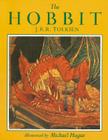
The Hobbit
first.  It was written first, of course, and introduces Middle Earth, some of the characters, and it's where Bilbo obtains The Ring.  It's a slightly easier read, not quite as dark as the trilogy which follows.  She took The Fellowship of the Ring and went off in search of her father to discuss it.  It was late, things were busy, and I didn't talk with her again.  This morning I noticed that the book was back on the shelf, but The Hobbit was gone. 

So there you have it, from rabbits to dragons. 

Love,

Deborah

Monday, December 5, 2011

Have a carrot

Dear Aunt Debbie,

In the context of our discussion about apparently sweet but deeply dysfunctional parent-child love stories, a friend of mine alerted me to Lisa Belkin's Huffington Post slide show about Children's Books Parents Either Love or Hate.  (Belkin gives The Giving Tree a longer treatment, and provides a solid opposing viewpoint from someone who loves it, here.)

The Giving Tree tops the list, and Love You Forever is right up there.  I was surprised, however, to see The Runaway Bunny at #3, as it's a book I've never thought of as hate-able. 

Okay, yes, it's the story of a mother bunny who convinces her little bunny that he can never run away from her, because she'll always find him no matter where he goes.  That might sound grasping.  The combination of Margaret Wise Brown's simple, lyrical text and Clement Hurd's extraordinary pictures, however, has always made me feel that the mother here is firm and reassuring, rather than creepy.

Here's how it begins:

Once there was a little bunny who wanted to run away.
So he said to his mother, "I am running away."
"If you run away," said his mother, "I will run after you.
For you are my little bunny."

I've written before about how much I love Margaret Wise Brown's writing (in Goodnight Moon, Home for a Bunny, Big Red Barn, and Wait Till the Moon is Full).  Her sentences are simple and child-friendly and beautifully crafted -- she's really a poet.  Half of The Runaway Bunny is her text, with Clement Hurd's black and white line drawings.  Every other double-page spread is a giant wordless color painting illustrating how the mother bunny will go after her little bunny. 

"If you become a tree," said the little bunny,
"I will become a little sailboat,
and I will sail away from you."

"If you become a sailboat and sail away from me,"
said his mother, "I will become the wind
and blow you where I want you to go."


(The next line is perhaps the only Margaret Wise Brown line I feel the need to edit when reading aloud: "If you become the wind and blow me," said the little bunny....)

The paintings are surreal and beautiful.  I remember staring at them as a child, finding the bunny in the crocus when he's hiding in a garden, amazed by the mother tree when he is a bird.  There's a playfulness here, a way in which the mother is engaging in her child's imaginative world. 

And finally, Margaret Wise Brown is never heading for the tear-jerker ending.  No, after all of that, here's where the story winds up:

"Shucks," said the bunny, "I might just as well
stay where I am and be your little bunny."

And so he did.
"Have a carrot," said the mother bunny.


That's a mom I can get behind.

Love, Annie

Friday, February 18, 2011

Back to baby board books

Dear Aunt Debbie,

I loved The Queen Who Couldn't Bake Gingerbread -- we've read it recently at my parents' place.  Yes, you definitely gave me Stories for Free Children. That's the first place I read "X: A Fabulous Child's Story," by Lois Gould, which Orenstein writes about in Cinderella Ate My Daughter.  I now use it to open the discussion of nature vs. nurture in my senior Women's Voices class.  It's a good read.  The other major memory I have of Stories for Free Children is a piece about Amelia Bloomer and women starting to wear pants which I remember finding fascinating.  Ironically, at the time, I was refusing to wear pants myself.  So I suppose I have my own history to look back on as I recite the mantra: this too shall pass....

With so much interesting stuff happening on the Big Kid front, I fear that Isabel's reading habits have been getting short shrift.  At 16 months, she is in love with books (she "reads" to the other babies at daycare), and extremely specific in what she will and will not let you read to her.  She refers to a number of books by name: "Munny" ("Bunny") is Home for a Bunny; "Up" is Olivia's Opposites; "Doss" ("Dogs") refers to any of the roughly 5000 board books we now have about dogs.

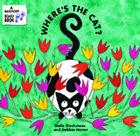
One of her latest favorites came from you: "Meow" refers to Where's the Cat?, by Stella Blackstone and Debbie Harter.  This is a wonderful book.  Each right hand page asks "Where's the cat?" and provides a clue by showing a tiny bit of ear or paw poking out from under something; when you turn the page, the wide-eyed black and white cat reveals itself in an active catlike pose: "on the chair," "up the stair," etc.  The drawings are intense and colorful.  Eleanor often joins in on reading this one too, answering every "Where's the cat?" by pointing to the right place on the page matter-of-factly: "There he is."


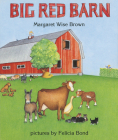
Margaret Wise Brown's Big Red Barn, illustrated by Felicia Bond, is another go-to book right now, so much so that the corners are starting to fray.  I could read pretty much anything Margaret Wise Brown writes a thousand times in a row and not get tired of it -- something about her rhythm and her simplicity which is pitch-perfect for children but never cloying.  (I just tried to refer to her as "Brown," and couldn't do it -- why is it that some authors need to be referred to by their full names?)  Here's a sample:


There was a  big pile of hay
And a little pile of hay,
And that is where the children play.

But in this story the children are away.
Only the animals are here today.

The sheep and the donkey,
The geese and the goats,
Were making funny noises
Down in their throats.

An old scarecrow was leaning on his hoe.
And a field mouse was born...

in a field of corn.

There are lots of animal noises, and, happily, dogs and cats show up a little later.  Everyone goes to sleep at night, under a big beautiful moon.

Love, Annie

Monday, July 12, 2010

True love, picture book style

Dear Aunt Debbie,

Eleanor spent much of the day helping her cousins bake cookies for her Uncle Mice's wedding.  She has her own kid-sized apron, and has recently been fascinated with helping in the kitchen, especially when it has to do with baking.  Pretend Soup gets a good workout in our house, though the most-requested recipe in it is "Homemade Lemon-Lime Soda Pop."  Quesadillas are a big favorite too.

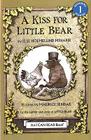
With all this wedding celebration, I've had love on my mind.  Two classic, slightly offbeat takes on true love keep recurring to me, both illustrated by Garth Williams. The first is a book I've mentioned once before: A Kiss for Little Bear.  It's the only one of the Little Bear books that contains a single story (the others each have four).  Little Bear makes a drawing for his grandmother, and asks Hen to take it to her.  Grandmother Bear loves the drawing, and asks Hen to take a kiss back to Little Bear.  But Hen wants to stop to chat, so she asks Frog to take the kiss.  The kiss is passed on until it reaches Little Skunk, who finds another little skunk, and they pass the kiss back and forth until Hen discovers them: "Too much kissing!"  The book ends with the skunks' wedding, and a fine picture of Little Bear as Best Man.

Else Holmelund Minarik's text is excellent, but what makes the book perfect are Williams's dry, funny illustrations.  The text: "Then Hen saw some friends.  She stopped to chat.  'Hello, Frog.  I have a kiss for Little Bear.  It is from his grandmother.  Will you take it to him, Frog?'  'Okay, said Frog.'"

The illustration:


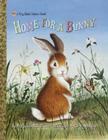
And then there is the marvelous Home for a Bunny, by Margaret Wise Brown.  It is a poem of a book, about the arrival of spring and one little bunny's search for a home.  The opening lines always crack me up:

"Spring, Spring, Spring!" sang the frog.
"Spring!" said the groundhog.
"Spring, Spring, Spring!" sang the robin.
It was Spring.

Amid all this Spring activity, a bunny is looking for a home.  He asks the robin, the frog, and the groundhog about moving into their homes (lots of great opportunities for different voices here: high-pitched for the robin, low for the frog -- "Wog, wog, wog" -- and grumpy for the groundhog).  Eventually, he meets another bunny, who has a home under a rock, under the ground, and it's a happy ending:

"Can I come in?" 
said the bunny.
"Yes," said the bunny.
And so he did.


Love, Annie

Friday, July 9, 2010

Picturing the working mom

Dear Aunt Debbie,

Oh, dear.  Does "working mom" in picture books mean "absent mom"?  Owl Babies sounds lovely, but as a working mom myself, I hate to think that the absent mom is the best we can come up with in that category.

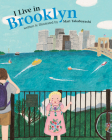
That said, only two picture books spring to mind for me.  The first is I Live in Brooklyn, which we have been given no less than three times because, well, we live in Brooklyn.  (At some point, I'd love to do a post on place-specific books, so many of which are deeply dull.)

Mari Takabayashi wrote and illustrated this book, and the illustrations are often quite appealing and accurate in depicting aspects of Brooklyn life.  My favorite page has pictures of all the different kinds of street food carts.  Unfortunately, the book is plotless.  It's narrated by a six-year-old girl, Michelle, and she walks you through some things she does in Brooklyn throughout the year: "Daddy takes me window shopping on Fifth Avenue every year.  It is fun to see Santa Claus standing in the crowd with his bell....Whenever my mom makes a sandwich, she saves the edges of the bread for us so that we can feed the ducks in the park.  They are always hungry."  It's not horrendous, just flat -- the voice of an adult trying to sound like a child, but losing any shred of personality by making the language too simple.  Eleanor loves it, of course.  But it's one of the books I sometimes hide at the back of the shelf.

Still, Michelle's mother works!  Every morning, she leaves Michelle's sister Lucy with their grandma (who conveniently lives one block away, sigh), and takes the bus with Michelle: "She drops me off at school and then goes on to her office."  No drama, no emotion, just simple fact.

The other book that came to mind after reading your post isn't really about a working mother, but another animal mother who leaves her kid alone to go forage for food.  It's one of my all-time favorite children's books, however, so I'm going to seize the opportunity to write about it.

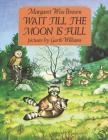
Wait Till the Moon is Full
is Margaret Wise Brown at her best:

Once upon a time in the dark of the moon 
there was a little raccoon.

He lived down in a big warm chestnut tree 
with his mother -- who was also a raccoon.

This little raccoon wanted  to see the night.  He
had seen the day.

So he said to his mother, "I want to go out in the
woods and see the night." 

But his mother said, "Wait."

"Wait till the moon is full."  So he waited, deep
in his warm little home under the chestnut tree.

As the raccoon waits and grows, and the moon waxes, he hears the sounds of the night, and his mother tells him to wait, and sings him songs about the night.  On one page, his mother is late coming home, and the raccoon "sat there wondering to himself."  But then she returns, "skuttle bump, in came his mother, her pointed ears pushed back on her head" (and, in the Garth Williams drawing, in a shawl and carrying a basket of groceries).  And of course, eventually, the moon is full, and the little raccoon gets to go out and play in the moonlight, and the waiting is rewarded.

As ours will be starting tomorrow with our week of family weddings!  See you then.

Love, Annie

Friday, May 7, 2010

More first books for babies

Dear Aunt Debbie,

I've been wanting to write about great first books, the ones I give most often as presents for new parents. As you mention, Goodnight Moon has played a major part in our parenting life, and is one of my all-time favorites.


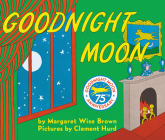
Goodnight Moon


Starting when Eleanor was about 6 months old and we were trying to establish a bedtime routine, I stole a great idea from a mom in my new moms group. Each night, we'd read Goodnight Moon aloud as our last book, and then go around the room saying goodnight to everything: Goodnight books, Goodnight mobile, Goodnight light, Goodnight window. It's calming, and it also makes you aware of some of the weird things you have in your kid's room: Goodnight Teddy Roosevelt (Uncle Dudley's old framed bandanna), Goodnight 50 Foot Woman, Goodnight Buster Keaton (our framed movie posters). The routine faded after a while, but now that we've moved Isabel into Eleanor's room, we've started it up again.

Every night, after Eleanor's teeth are brushed and she's ready for bed, we pick up the board book and read it together to Isabel. Some nights, Eleanor says it aloud with us -- she pretty much has it memorized. Isabel slaps at the pages and tries to eat the book as we go. (The corner of the last page is worn away from Eleanor eating it three years ago.) Isabel loves the book, especially the color pages; she really stares at the pictures. How many times have I read this book aloud by now? Easily three hundred. But Margaret Wise Brown is brilliant, and I never get tired of it. There's something about the rhythm of each line.

We have at least three copies of Goodnight Moon, one the big hardcover with normal paper pages.


Goodnight Moon hardcover (not board)


I'm pretty sure the half-eaten copy we're using now was our second board book version. Do you remember the story about Michael trying to climb into the pictures of Goodnight Moon when he was maybe 1 1/2? I don't think I remember him doing it, but my mom has told us the story so many times I have an image of it in my head: Michael putting the book on the floor, then carefully stepping on the pages, then crying, so frustrated that he wasn't actually in the room. Clement Hurd was a genius too.

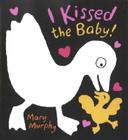
The other two I want to write about tonight were, of course, gifts from you. I Kissed the Baby, by Mary Murphy, is a nearly perfect book.


I Kissed the Baby


It's super-simple. On each page, one animal asks another animal if they've done something with the baby, and the other says yes: "'I sang to the baby. Did you sing to the baby?' 'Yes! I sang to the baby, and the baby sang to me!'" The drawings are high-contrast black and white, with a little splash of color on the edge of each page, and the baby, when it appears, bright yellow. It also allows you to do the things you're reading about ("I tickled the baby. Did you tickle the baby?") as you read. I've given this book as a new-baby gift several times, and my friend Tui recently emailed me that her mom has turned the text of the book into a song, and they sing it to their baby regularly. He, like every other baby I've seen interact with the book, adores it.

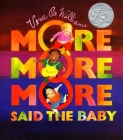
Then there is the joyful and loving "More More More," Said the Baby, by Vera B. Williams, another I've read aloud so many times that I know it by heart.


"More More More," Said the Baby: Three Love Stories


It contains three stories, each about a little kid being fondly chased by an adult: Little Guy and his daddy, who kisses his belly button; Little Pumpkin and grandma, who eats Little Pumpkin's toes; and Little Bird and her mama, who puts a sleepy Little Bird to bed. The three variations are rhythmic and affectionate, with each adult lighting up and calling the child, "Oh my best little baby." Every page is alive with color. The book is also unobtrusively diverse. Little Pumpkin (whose gender is never specified) is black, while grandma is apparently white and blonde. Little Bird and her mama might be Hispanic, might be Asian, and when Little Bird falls asleep, her mama makes her a bed out of the couch. Little Guy and his daddy are white, but his daddy is hanging out at home in shorts and flip-flops. There is total joy and love on each page.


And so many favorites I've left out! I will definitely be revisiting this theme.

Love, Annie