Though I never went through a horse phase myself, and so far my kids haven't caught that bug, your horse book recommendations may be the beginning of a new interest in our house. I've requested a few from the library, and the way Eleanor is burning through books these days, I'm pretty sure I'll be requesting more.
Today's reader question comes from Jean, the mom of Eleanor's good friend Casey. During a recent playdate, Jean and I got to talking about our kids' experiences with reading. Casey (also in 2nd grade) is reading some, but it's been a bit of a struggle for her, and she doesn't generally pick up books on her own. Here's Jean:
I think she's resistant to reading on her own for a couple of reasons. 1) You've known Casey since she was 2. She is a very energetic kid. Running around and playing active games is when she is happiest. So she's not a natural bookworm....2) Something you said at your house really resonated with me and it makes sense for Casey: she LOVES when we read to her, which we do every day. And we'll read The Wizard of Oz, or Harry Potter, Magic Treehouse, Jenny and the Cat Club. Books that are (with the exception of maybe the Magic Treehouse books) well beyond her level. She likes a good story, but can't read at the level of a good story yet.
Jean would like to find books that Casey really wants to read:
She loves a good battle, especially when the good guy pulls through at the end. She loves adventures and mystery. She's not a fan of anything with princesses or those kind of stories (unless, perhaps, if the princess is wielding a sword). But she loves magic. And cats, as you know. Anything with cats....We are trying not to force it too much because she'll come into it in her own time. But it would be great to have books around that she may just want to pick up on her own!
Given my kids' recent reading history, it should come as no surprise to anyone that I recommended Casey and Jean check out some graphic novels. Graphic novels have bridged a gap for us, allowing for a variety of different kinds of reading. For both Isabel (who can read very few words, but will pore over pictures for hours on her own) and Eleanor (who reads all the words and doesn't dwell as much on the pictures, but enjoys them), they encourage an independent reading experience, while still making room for reading together.
With this in mind, I scoured our posts and created a new page to add over there on the right: a list of all the graphic novels we've discussed on the blog, by theme and by appropriate age range.
Here are a few I think Casey would love, many with links to previous blogs we've written about them:
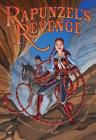
Rapunzel's Revenge, by Shannon and Dean Hale. This is the present we've bought for Casey's upcoming birthday: Rapunzel reimagined as an active, braid-whipping heroine. She's awesome and has a sense of humor, and the way the Hales play with the original story is great fun.
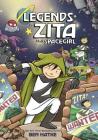 Zita the Spacegirl, by Ben Hatke. Zita is a girl from earth whose curiosity and impulsiveness cause first her best friend (a quiet boy named Joseph) and then Zita herself to shoot off to another galaxy. Zita has to find and rescue Joseph, teaming up with a ragtag bunch of aliens and robots. There's a real emotional punch here, too. Sequels Legends of Zita the Spacegirl and The Return of Zita the Spacegirl are also excellent.
Dragon Girl: The Secret Valley, by Jeff Weigel. Alanna, the 11-year-old heroine, finds and protects a nest of baby dragons, dressing up as a dragon herself so that they won't become accustomed to humans and be in later danger. Alanna is another active, strong heroine -- I think Casey would like her. There are clearly more Dragon Girl books coming, but this is the only one out so far.
Ottoline and the Yellow Cat (and other Ottoline books), by Chris Riddell. Though the yellow cat in the first title turns out to be a bit of a villain (sorry, Casey!), these books are quirky and tremendous fun. They contain terrific characters, both human and animal, and each has a not-scary mystery as a central part of the plot. Strictly speaking, I suppose they are only half graphic novel -- many of the pages contain typed text as well as comic book-style illustration.
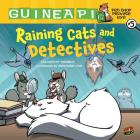
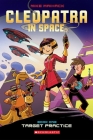 This week, we discovered Cleopatra in Space, by Mike Maihack. The premise: 15-year-old Cleopatra, who will grow up to be ruler of Egypt, touches a magic tablet and is zapped into the space-age future. It turns out that the future is governed by highly intelligent talking cats (!), who tell her the galaxy is in great danger, and a prophesy says that Cleopatra will come to save them all. In this telling, Cleopatra is uninterested in schoolwork, but highly energetic and a terrific fighter. Like many of the other heroines mentioned here, she is impulsive and stubborn, but ultimately good-hearted. There's not as much emotional depth here as in Zita the Spacegirl or Dragon Girl, and some of the vocabulary in the expository parts feels a little dry/advanced for kids, but overall it's a fun read.
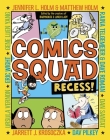 For an early-reader taste of several of the big names in contemporary graphic novels, try Comics Squad: Recess! This is an anthology of eight stories, each centered around something that happens at school recess. It includes a story from Gene Luen Yang (whose American Born Chinese is awesome but won't be appropriate reading for our kids for several years); a story starring Babymouse, by Jennifer L. Holm and Matthew Holm; a story starring Lunch Lady, by Jarrett J. Krosoczka; a story by Raina Telgemeier (whose Smile and Drama will be accessible to our kids in just a few years), and more.
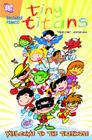 Both of the previous books, along with Dragon Girl, were recommended to us by Holly, frequent guest blogger and mom of Eleanor's best friend Ian. Another of Ian's favorites which has become a hit in our house is the odd little series Tiny Titans, by Art Baltazar and Franco Aureliani. In it, DC Comics characters appear as elementary school-age kids, with appropriately kid-friendly plots. Perhaps "plots" is too strong a word: most of the stories are 2-4 pages long, short sketches, often with punchlines. I'll confess I'm not captivated by them, but Ian, Eleanor, and Isabel certainly are.
I'll close with recommendations for two long, intense series, and another great web resource.
Everything you say about Casey's love of a good battle, magic, and princesses only if they are sword-wielding makes me think she might love Jeff Smith's Bone books. This is the series that completely obsessed Isabel for several months. They are wild, wonderful books, which our entire family ended up reading several times through. Fair warning: the action, especially in the last couple of books, gets violent, and a few characters you come to care about deeply don't survive (though all the main ones do). Characters include the Bone cousins (strange rounded little white people), the sweet and ultimately fighting awesome secret princess Thorn, her tough cow-racing Gran'ma Ben, and a couple of rat creatures whose attempts to chase Fone Bone down are a fabulous excuse for slapstick. Try the first book: Out from Boneville.
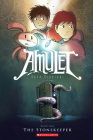 The Amulet series, by Kazu Kibuishi, is another captivating read. Where Bone starts on the mellow side and gets progressively darker, Amulet leads with what I find to be its darkest episode.
In Book One: The Stonekeeper, Emily and Navin's father is killed in a car accident from which Emily and her mother escape. Mom, Emily, and Navin move to an old creepy family house, which turns out to contain all kinds of secrets left by Emily's great-grandfather. The greatest of these is the stone bequeathed to Emily: she becomes a Stonekeeper, possessed of great power but unsure whether the force animating the stone is good or bad. As if their father's death wasn't bad enough, Mom is kidnapped by a scary alien thing, and Emily and Navin set out into another world to rescue her.
The ensuing story (which covers six books so far, and isn't over yet) contains a wide variety of animal and robot characters, elves, both good and evil, and people who seem to be real but turn out to be animated by magic. The visuals are spectacular.
Finally, if this isn't enough for you, check out the graphic novel recommendations at A Mighty Girl (which is a pretty great website for other kinds of books, too).
And to think, back in my day we subsisted on Archie comics! Times have changed for the better.
Love, Annie