In which Annie (high school teacher, mother of two young girls and a younger boy) and her aunt Deborah (children's bookseller, mother of two young women in their 20s) discuss children's books and come up with annotated lists.

Wednesday, July 11, 2012

The strongest woman in the world

Dear Annie,

Reading with one's children just keeps on giving us all little magic moments.  Here's a text conversation I had yesterday with soon-to-be-21 Mona, who's living in San Francisco this summer:
   Mona: A homeless man called me Pippi Longstocking today.  I ignored him but he did get points for children's book knowledge.
   Me: Love it! Although Pippi's hair is red [Mona's a blonde].
   Mona: I know -- I think it's because my hair was in a braid.  He also said something about the strongest woman in the world which could have been a reference too.
   Me: Picks up horse with one hand!
   Mona: Very impressive!
And here's a quote from  Pippi Goes on Board: a hypothetical stranger is watching Pippi's odd living arrangements from her front gate:
If the stranger stayed after Pippi had said good night and gone away from the gate, and if he saw Pippi go up on the porch and pick up the horse in her strong arms and carry him out into the garden, he would certainly rub his eyes and wonder if he were dreaming.
   "What an extraordinary child this is!" he would say to himself.  "Why, she can actually lift that horse!  She's the most extraordinary child I've ever seen!"
   He'd be right, too.  Pippi was the most extraordinary child -- in that town, at any rate.  There may be more extraordinary children in other places, but in that little town there was no one to compare with Pippi Longstocking.  And nowhere in the world, in that town or any other, was there anyone half so strong as she was.
first edition (in Swedish)
 Here's to extraordinary children everywhere.

Love,

Deborah

Monday, July 9, 2012

Mellow mysteries

Dear Aunt Debbie,

I love your suggestions, and will be sure to check them out.  Our nightly vacation reading of Nancy Drew is getting Eleanor so excited that she literally cannot sit still -- she's up and down, sitting on the floor and on the arm of the chair, moving closer to and farther away from the book with the intensity of the suspense.  I look forward to more mysteries with her.

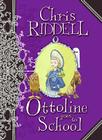
I'm realizing, thinking back on it, that a few of our favorites have also been mysteries of a comic sort, so disguised that I don't think of them as mysteries first.  I wrote a while back about the fabulous Ottoline and the Yellow Cat, by Chris Riddell; in the year and a half since we first read it, we have acquired the other two Ottoline books: Ottoline Goes to School, and Ottoline at Sea (sadly out of print).  All three books are graphic novels, extremely quirky, mysteries of a sort but mostly just tremendously, enjoyably odd.  In Ottoline Goes to School, Ottoline and her friend/caretaker/tiny hairy Norwegian bog-person, Mr. Munroe, enroll along with Ottoline's new friend Cecily in the Alice B. Smith School for the Differently Gifted.  There are very few pupils, each astoundingly rich and odd, and each with a unique pet (the son of the Invisible Man, for example, has an Invisible Dog).  Ottoline tries to determine what her Different Gift is; meanwhile, the school appears to be haunted by the ghost of the Horse of the Hammersteins, who Cecily has a lot of stories about.  While that ghost is revealed by the end not to be real, there are some friendly true ghosts who wander through the pages, and can be great fun to pick out as you go along.  The story is about neediness and friendship -- Ottoline has to navigate her new exciting friendship with Cecily, who tries to pull her away from Mr. Munroe; ultimately, Cecily's loneliness for her parents turns out to be a major cause of her unhappiness.  (A funny moral, given that Ottoline never seems to see her parents, the Roving Collectors, but oh well.)  Ottoline at Sea contains a trip to Norway, a bog monster, and a pair of "bog-goggles" you can use to see hidden pictures in the book.  Eleanor will pore over these books for long periods of time.


For the early reader set, there's the Cynthia Rylant series The High-Rise Private Eyes, more humor than mystery, as I've written about before, but pretty great.


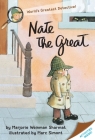
And speaking of great, let's not leave out Nate the Great, those odd little meandering books by Marjorie Weinman Sharmat.  Nate's mysteries always involve him eating a lot of pancakes, and at least in the several we've read, usually also involve slightly odd female friends and a number of cats.  The stakes are low -- a drawing disappears, and Nate figures out that his friend's little brother drew over it -- and the tone is thoughtful.

None of these make Eleanor squirm in her seat, but they do keep her interested.

Love, Annie

Sunday, July 8, 2012

Figuring it out

Dear Annie,

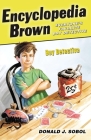
My girls were briefly into Encyclopedia Brown, but some stories were satisfying and others frustrating, requiring arcane knowledge to solve the mystery.  I gave up after reading "The Case of the Hidden Will," in which Encyclopedia Brown exposes the culprit because he knows that only one king in a deck of cards is without a mustache.  (See a funny critique here.)  I prefer the old-fashioned logic-it-out mysteries.

Meg Mackintosh
To that end, I offer two other step-by-step series.  Meg Mackintosh, written by Lucinda Landon,  has been solving mysteries since 1986.  The books are short chapter books -- they run around 40-50 pages apiece.  Every few pages, Meg figures something out, and the reader has the option of doing the same, or turning the page.

In
Meg Mackintosh and the Mystery on Main Street, Meg helps her brother Peter find an old family diamond ring that he lost while running errands. He had put it in his mitten for safekeeping.  During the day, he took some pictures in a toy store (and developed them in a home darkroom -- explainable moment!).  Peter shows the photos to Meg (we see illustration).
"Hmm, every picture tells a story," said Meg.  "I'm not sure how the story turns out.  I do know that you took your mittens off."
    Do you see anything unusual in Peter's photos?
    Why would Peter have taken the mitten off?
[turn page]
"Peter, if you took pictures in the toy store, you probably took your mittens off so you could press the buttons easier," said Meg, as she examined the photos.
She goes on to find a clue or two in the pictures.  The questions at the bottom of the page offer the chance to figure out the answer oneself, or just to get on with the story.  The plots all have a few red herrings to throw the unvigilant off the trail.  Meg carries a notebook with her and keeps careful notes throughout the stories.

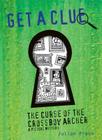
The "Get a Clue" series by Julian Press (originally published in Germany) are the same idea, but rely more heavily on illustration.  Every page has a picture -- usually it's full of detail -- and there's a question at the end of each page. In "A Four-Legged Mystery," one of three stories in
The Curse of the Crossbow Archer
, three children go into a hair salon in their search for a missing dog.  There's a full-page illustration of the salon.
..."Do you also do dog grooming?" Josh asked awkwardly.
The stylist looked at him stonily.  "No. Animals are strictly forbidden in the salon.  And that goes for your bird -- he needs to wait outside."
"She's charming," David muttered under his breath.  "And what a liar!"
    QUESTION: How does David know the stylist is lying?
[turn page]
  The dog bone on the floor by the back door made David doubt the stylist.  Unless the woman ate dog bones herself, it was a pretty clear indication that she's had a canine visitor recently.  They had to figure out what was behind that door before the stylist became suspicious.
I think of these books as great for the first-to-third grade set who are getting increasingly comfortable reading on their own.  But as you know well, they also work as read-alouds for the mystery-minded soon-to-be-kindergartener.

Love,

Deborah

Friday, July 6, 2012

Young sleuths

Dear Aunt Debbie,

We just read the dramatic department store scene tonight!  I'm interested to see where it goes, and will report back when we finish our first full Nancy Drew mystery.  So far, Eleanor is totally engaged, but there's a lot to explain, starting with what it means to make a will.

I've been thinking about your point about Nancy Drew (and the Hardy Boys, who I've never read -- in my experience, people read one series or the other, but not both) being models of clear deductive reasoning.  I've written before about my love of mysteries, and have pinpointed Nancy Drew as the beginning of that love, or close to it.  But around the same time, perhaps slightly later, I also read a lot of Donald J. Sobel's Encyclopedia Brown.  


The Encyclopedia Brown stories had a very different feel than Nancy Drew.  From what I remember, the stakes were always much lower, and most of the mysteries focused on kids and their interactions with each other.  The stories were short -- ten to a book -- and offered the same kind of teasing, almost-solvable pleasure that Christie's Poirot mysteries played with later.  You could almost figure these things out, and sometimes maybe you could, but most often you'd just get enough so that when Encyclopedia announced the answer you'd feel a little bit smarter.  The feeling wasn't so much following a train of thought as experiencing or observing a moment of insight.


I still remember a number of random facts gathered from the solutions to these mysteries: a hard-boiled egg spins better than a raw one; the word "bookkeeper" has three consecutive sets of repeated letters; you can use peanut butter to remove chewing gum from hair; tears fall from the inner corner of your eyes, not the outer one, because that's where your tear ducts are.  The first three of these solutions had to do with contests: an egg-spinning contest, a contest at a library, a bubble-blowing contest.  Lots of contests in Idaville, apparently.  The fourth had to do with a girl pretending to cry and using eye drops to fake it, but I forget over what.


I don't feel the same visceral love of Encyclopedia Brown as I do of Nancy Drew, but he was a lot of fun to read, and gave me a taste for puzzling that has served me well.


Love, Annie

Wednesday, July 4, 2012

Bygone eras

Dear Annie,

I'm quite fond of those yellow-spined Nancy Drew volumes: more than 60 of them, still in print.  They weren't part of my childhood -- Cherry Ames (Student Nurse/Visiting Nurse/Flight Nurse/Camp Nurse/Cruise Nurse/etc) was the only one of those series that hooked me.  Nancy is the keeper, though: every so often at the store someone will come searching for #34, which she has to read before #35, because she's doing them all in order.  I listened to The Secret of the Old Clock (#1) a while ago and was captivated on many levels.  Nancy goes through a clear process of deductive reasoning -- they're a good introduction to sleuthing.  She really figures stuff out.  Nancy's male counterparts, the blue-spined Hardy Boys books, also have that step-by-step thinking.

I love the Nancy articles you linked to -- my favorite quote was from an Atlantic reviewer:
The real allure of Nancy Drew is that, almost uniquely among classic or modern heroines, she can follow — is allowed to follow — a train of thought.
A bit of an overstatement, but a lovely sentiment.

Those yellow Nancy Drews also give parents the opportunity to explain An Earlier Era.  I often point out that Mr. Popper's Penguins, in addition to being a delightful book, calls on grown-ups to explain iceboxes and vaudeville.  There's a stunningly dated scene in The Secret of the Old Clock when Nancy goes to a department store -- buying a dress is a crucial part of the plot -- and has to wait until the saleslady finishes showing another customer some dresses before she can look at any.  Made me think of when I was a suburban 15 year-old shopping by myself at Saks Fifth Avenue in The City, carrying a note with my mother's letterhead (remember Grandma's stationery?) instructing the saleslady to put my purchases on her account.  No account number -- they didn't even keep the note.  Ah, a bygone era. 

Happy Fourth of July to you & yours.

Love,

Deborah

Monday, July 2, 2012

Following the clues to the Nancy Drews

Dear Aunt Debbie,

It's interesting to hear what's stuck with you from the Gregor books, and to think about them as homage to Alice in Wonderland as well as A Wrinkle in Time -- of course, the fall down the laundry room grate is like that old rabbit hole.  But no, Gregor and Boots remain their same human size, and it is the animals who are truly enormous -- six-foot tall cockroaches, giant vicious rats.  At the beginning of the second book, Gregor takes Boots to go sledding in Central Park, and she's kidnapped by giant cockroaches there (one of the other entryways to Underland is under a large stone slab in the park).  Gregor figures out what's happened when he sees a dog going crazy barking at what looks like a stick, but turns out to be an enormous articulated cockroach leg that snapped off during the kidnapping.  (To clarify: the roaches kidnap Boots for her own safety, so the rats won't get her first.  They're still good guys.)  Oh yes, I'll be reading all five of these.
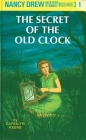
We're gearing up for our own vacation, and I've been stockpiling books to read with Eleanor during the week we'll be away with my in-laws in a cabin by a lake in Wisconsin.  The second Borrowers book is waiting for us, and we're already halfway through Ramona the Pest.  The book Eleanor was most excited to pick up from the library, however, was The Secret of the Old Clock, a.k.a. the first volume of the Nancy Drew mysteries, by Carolyn Keene.

Eleanor's interest in Nancy Drew was sparked by our recent reading of The Worry Week, which was a total joy.  Jeff began it with Eleanor, but it was her first week of vacation, so my mom and I were commuting with her around the city, and we all took a turn reading.  What a good book!  I knew I'd read it, but didn't realize until we started again just how many times I must have reread -- so many places throughout the book where I knew lines by heart, after more than 20 years....

It's a book full of references.  Alice, the oldest sister, quotes Romeo and Juliet throughout, so I had to explain the plot of that story.  Allegra, the narrator and middle sister, refers several times to her "pile of Nancy Drews," and Alice at one point twists her ankle and stays in the bath and on the couch reading "all the Nancy Drews."  Eleanor picked up on it: "What's a Nancy Drews?" and I dredged up what I could remember of the many, many Nancy Drew books I sped through in 2nd grade.  I have an image of the shelf they all sat on in my elementary school library: a bottom shelf, filled gloriously from one side to the other with the worn permabound covers, their yellow spines fraying a little at top and bottom, each front cover bearing an image of Nancy finding something amazing or sinister, usually surrounded by darkness.  I remember Nancy was motherless, and lived with her wealthy father and a motherly housekeeper.  She drove a blue roadster, dated the totally forgettable Ned Nickerson, and was best friends with plump, girly Bess and short-haired, tomboyish (ahem, butch) George.  I don't remember a single complete plot.  Elements, yes: a broken locket, lots of running to gazebos at night, close calls.  I have no idea what to expect when Eleanor and I crack this one open.

But apparently I'm in good company in having been a huge fan.  Three years ago, when Sonia Sotomayor was being confirmed as a justice of the Supreme Court, someone dug up the fact that all three (at that point, pre-Kagan) female Supreme Court justices cited Nancy Drew as a major influence.  The New York Times published two articles digging into Nancy Drew's appeal: one focused on the justices, and one expanding the pool of fans to include all kinds of high-powered women.  She's been a lot of things to a lot of girls and women over the years.  I'll report back on her impact in this house.

Love, Annie

Sunday, July 1, 2012

Summer reading

Dear Annie,

I've only read the first Gregor, although we sell a fair amount of all of them.  One of the indications of a good series is when readers keep coming back for more.  I think I read it during one of those intense times in ordering season when I read half a dozen books a week and place orders that will arrive six months in the future.  Gregor hasn't stuck with me.  That said, the one vivid image I hold from the first book is the laundry room, which is the portal to Underland.  In my mind, I see the cavernous laundry room in my parents' -- your grandparents' -- basement on West 77th Street.  So I guess my belief about Underland is that it's beneath the Upper West Side, probably below the Museum of Natural History.

The other element I've held onto is the into-the-rabbit-hole nature of Gregor's fall.  It was my impression not that the cockroaches (great comic relief!) and other animals were huge, but that the humans shrank as they fell.  Am I making this up?

You so deserve some relaxed reading time!  Around this time of year, I start packing some books I haven't read into a going-to-Maine box.  I'll dig through the box when we get there in August and work my way through a number of them while lying in the hammock.  Some are books I've ordered and know I need to read before they arrive.  And others are ones I just really want to read because I hear they're exceptional.

Here are the three YA books that I really want to read by Labor Day:


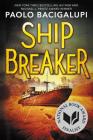
Ship Breaker
, by Paolo Bacigalupi. It won the Printz Award for best YA book two years ago.  Dystopian future with environmental breakdown in full swing.  About a boy who works mining beached oil tankers for their scrap metal.  Into his world sails a perfect clipper ship.  Sounds dark and fascinating.


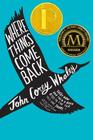
Where Things Come Back
, by John Corey Whaley -- the winner of this year's Printz award.  Nothing futuristic or magical.  A high school boy whose brother disappears, and whose town becomes the focus of the search for a rare woodpecker.  I have high hopes for this one.

And
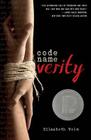
Code Name Verity
by Elizabeth Wein, which just came out.  It's a World War II drama.  Two young women -- one a pilot, one a spy, each other's friends -- crash in Nazi-occupied France.  The intelligence agent is captured -- her interrogation and confession make up a large part of the book.  The other things I know about this book are that it's full of twists and surprises -- so the reviews are a bit squirrely -- and the writing is riveting.

Anybody out there read any of these?

Love,

Deborah