In which Annie (high school teacher, mother of two young girls and a younger boy) and her aunt Deborah (children's bookseller, mother of two young women in their 20s) discuss children's books and come up with annotated lists.

Monday, July 2, 2012

Following the clues to the Nancy Drews

Dear Aunt Debbie,

It's interesting to hear what's stuck with you from the Gregor books, and to think about them as homage to Alice in Wonderland as well as A Wrinkle in Time -- of course, the fall down the laundry room grate is like that old rabbit hole.  But no, Gregor and Boots remain their same human size, and it is the animals who are truly enormous -- six-foot tall cockroaches, giant vicious rats.  At the beginning of the second book, Gregor takes Boots to go sledding in Central Park, and she's kidnapped by giant cockroaches there (one of the other entryways to Underland is under a large stone slab in the park).  Gregor figures out what's happened when he sees a dog going crazy barking at what looks like a stick, but turns out to be an enormous articulated cockroach leg that snapped off during the kidnapping.  (To clarify: the roaches kidnap Boots for her own safety, so the rats won't get her first.  They're still good guys.)  Oh yes, I'll be reading all five of these.
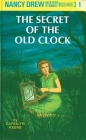
We're gearing up for our own vacation, and I've been stockpiling books to read with Eleanor during the week we'll be away with my in-laws in a cabin by a lake in Wisconsin.  The second Borrowers book is waiting for us, and we're already halfway through Ramona the Pest.  The book Eleanor was most excited to pick up from the library, however, was The Secret of the Old Clock, a.k.a. the first volume of the Nancy Drew mysteries, by Carolyn Keene.

Eleanor's interest in Nancy Drew was sparked by our recent reading of The Worry Week, which was a total joy.  Jeff began it with Eleanor, but it was her first week of vacation, so my mom and I were commuting with her around the city, and we all took a turn reading.  What a good book!  I knew I'd read it, but didn't realize until we started again just how many times I must have reread -- so many places throughout the book where I knew lines by heart, after more than 20 years....

It's a book full of references.  Alice, the oldest sister, quotes Romeo and Juliet throughout, so I had to explain the plot of that story.  Allegra, the narrator and middle sister, refers several times to her "pile of Nancy Drews," and Alice at one point twists her ankle and stays in the bath and on the couch reading "all the Nancy Drews."  Eleanor picked up on it: "What's a Nancy Drews?" and I dredged up what I could remember of the many, many Nancy Drew books I sped through in 2nd grade.  I have an image of the shelf they all sat on in my elementary school library: a bottom shelf, filled gloriously from one side to the other with the worn permabound covers, their yellow spines fraying a little at top and bottom, each front cover bearing an image of Nancy finding something amazing or sinister, usually surrounded by darkness.  I remember Nancy was motherless, and lived with her wealthy father and a motherly housekeeper.  She drove a blue roadster, dated the totally forgettable Ned Nickerson, and was best friends with plump, girly Bess and short-haired, tomboyish (ahem, butch) George.  I don't remember a single complete plot.  Elements, yes: a broken locket, lots of running to gazebos at night, close calls.  I have no idea what to expect when Eleanor and I crack this one open.

But apparently I'm in good company in having been a huge fan.  Three years ago, when Sonia Sotomayor was being confirmed as a justice of the Supreme Court, someone dug up the fact that all three (at that point, pre-Kagan) female Supreme Court justices cited Nancy Drew as a major influence.  The New York Times published two articles digging into Nancy Drew's appeal: one focused on the justices, and one expanding the pool of fans to include all kinds of high-powered women.  She's been a lot of things to a lot of girls and women over the years.  I'll report back on her impact in this house.

Love, Annie

Sunday, July 1, 2012

Summer reading

Dear Annie,

I've only read the first Gregor, although we sell a fair amount of all of them.  One of the indications of a good series is when readers keep coming back for more.  I think I read it during one of those intense times in ordering season when I read half a dozen books a week and place orders that will arrive six months in the future.  Gregor hasn't stuck with me.  That said, the one vivid image I hold from the first book is the laundry room, which is the portal to Underland.  In my mind, I see the cavernous laundry room in my parents' -- your grandparents' -- basement on West 77th Street.  So I guess my belief about Underland is that it's beneath the Upper West Side, probably below the Museum of Natural History.

The other element I've held onto is the into-the-rabbit-hole nature of Gregor's fall.  It was my impression not that the cockroaches (great comic relief!) and other animals were huge, but that the humans shrank as they fell.  Am I making this up?

You so deserve some relaxed reading time!  Around this time of year, I start packing some books I haven't read into a going-to-Maine box.  I'll dig through the box when we get there in August and work my way through a number of them while lying in the hammock.  Some are books I've ordered and know I need to read before they arrive.  And others are ones I just really want to read because I hear they're exceptional.

Here are the three YA books that I really want to read by Labor Day:


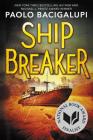
Ship Breaker
, by Paolo Bacigalupi. It won the Printz Award for best YA book two years ago.  Dystopian future with environmental breakdown in full swing.  About a boy who works mining beached oil tankers for their scrap metal.  Into his world sails a perfect clipper ship.  Sounds dark and fascinating.


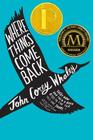
Where Things Come Back
, by John Corey Whaley -- the winner of this year's Printz award.  Nothing futuristic or magical.  A high school boy whose brother disappears, and whose town becomes the focus of the search for a rare woodpecker.  I have high hopes for this one.

And
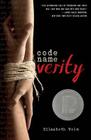
Code Name Verity
by Elizabeth Wein, which just came out.  It's a World War II drama.  Two young women -- one a pilot, one a spy, each other's friends -- crash in Nazi-occupied France.  The intelligence agent is captured -- her interrogation and confession make up a large part of the book.  The other things I know about this book are that it's full of twists and surprises -- so the reviews are a bit squirrely -- and the writing is riveting.

Anybody out there read any of these?

Love,

Deborah

Friday, June 29, 2012

Escapist reading

Dear Aunt Debbie,

Since finishing up my grading and saying goodbye to another school year, I've found myself craving YA lit as an entry into summer.  I'll get to some of my bigger must-reads in later weeks; for now, give me a good page-turner (or two, or three, or four).

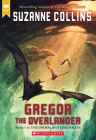
I started at the end of last week with Gregor the Overlander, book #1 in Suzanne Collins' five-book series, The Underland Chronicles.  I knew Collins only from The Hunger Games, her best-known series, about which you and I have both raved here.  It's no surprise that this earlier series is both gripping and filled with compelling characters.

The series skews a little younger than The Hunger Games.  Our hero, Gregor, is an 11-year-old boy living close to poverty in an apartment building in New York with his mother and two younger sisters, Lizzie (7), and Boots (2), and grandmother.  Their father, an engaging and involved parent and excellent science teacher, disappeared without a trace two years before the beginning of the first book -- homage to A Wrinkle in Time?  Gregor and Boots are down in the laundry room one day when they fall into an open grate, are caught by misty currents, and land impossibly far down below New York City in Underland.

It turns out there's a whole world down there, populated by very pale humans, descendants of a British explorer from centuries earlier, and giant talking bats (friendly, bonded with humans), cockroaches (keep to themselves) and rats (bad, at war with the humans).  Bartholomew of Sandwich, the original settler, was also a prophet of sorts.  In Regalia, the gorgeous stone-carved capital city of the humans, he left a room filled with prophecies carved into the walls.  Soon after Gregor's arrival, the people of Regalia decide that Gregor is "the warrior" mentioned in a number of prophecies, and he and Boots embark on a quest to find and save their father, and possibly all of Underland.

It's a fine exploration of the "Who, me?  I'm no hero.  Okay, well, maybe I am" theme.  Gregor is appealing as he tries to resist the prophecies but starts to realize he might actually be something special, and Boots, the two-year-old, is a hoot.  She's totally fearless, and bonds immediately with the giant cockroaches, who revere her as a princess.  Speaking of princesses, one of the other major characters is Luxa, the underage queen of Regalia.  She's strong and at first quite cool -- her parents were killed by rats, and she's in training to take on the full powers of the throne when she turns 16.  She and Gregor don't like each other at first, but come to have a grudging respect, which develops into real caring as the series goes on.  (As of early in book 3, no romance yet.  They're only 11.)  There are many adventures and hairsbreadth escapes -- Collins is a master of the cliffhanger chapter ending -- and semi-major characters die in the fighting.  It's a good read.

After finishing Gregor the Overlander in a day, I quickly updated my library hold list to request the second and third books in the series: Gregor and the Prophecy of Bane and Gregor and the Curse of the Warmbloods.  While I waited for them to come in, I took a more realistic turn with a book you'd recommended a while back, Will Grayson, Will Grayson.  The alternating chapters by John Green (The Fault in Our Stars) and David Levithan (Boy Meets Boy) worked together well, and I found myself speeding through it with great enjoyment.

I like summer.

Love, Annie

Thursday, June 28, 2012

Pointing out the obvious

Dear Annie,

I'm in the middle of ordering books that will arrive in the store this fall, and as usual feel deluged with a lot of average stuff, with the occasional really wonderful book poking its head above the waves.  I'm noticing a mini-trend: the anti-digital gadgets picture book.  A child is surrounded by shades of gray and boredom, moving from one digital object to another. "Loading... Loading.... Loading," says one. "Game Over," says another.  Finally she leaves the house and discovers color -- first in a flower, then in fields, and in wonderful adventures galloping across the countryside.  In another book, a girl rejects a friend's gadgets in favor of lying outside watching pictures in the clouds.  And yet another shows a child having increasingly outlandish adventures while trying to attract a phone-centric parent's attention.

Some of these books have wonderful art and funny scenes, but I find it hard to imagine anyone other than an irritated grandparent buying them.  They're a better illustrated version of preachy behavior books, making their points with thinly concealed lectures, rather than with good stories.  Many wonderful books about using your imagination exist -- it's not necessary to say, use your imagination this way before introducing them. 

I re-offer three, all listed under "imaginative play" on our picture books list:
Roxaboxen
The Queen of France
Even Firefighters Hug Their Moms

Somehow this feels parallel to books about books.  Picture books which sing the praises of reading -- with dancing animals, endearing siblings, or engaged students -- also tend to strike me as one step removed from the heart of reading.  It's easier to internalize that books offer huge ranges of emotion and experience simply by reading them, rather than reading books which tell you that's what they do.

Those are the thoughts rattling in my sample book-addled brain. 

Love,

Deborah

Sunday, June 24, 2012

For the graduate...

Dear Annie,

Yes, I'm totally with you on Oh the Places You'll Go!  I think of it as a gift shop kind of book, as opposed to anything that goes deeper.  It sells like crazy at this time of year, though.  To all ages, from kindergarten to college grads.  There's that desire to say, you've done well, go out there and strut your stuff.

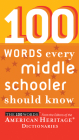
We usually have a whole display of Dr. Seuss this time of year, but we also keep a supply of 100 Words books next to the register for people looking for something different.  They're spinoffs from the American Heritage Dictionary, which of course has great resonance in our family.  My father, your grandpa, worked for American Heritage, and when they were creating the first of the AH Dictionaries, I remember his bringing home the questionnaires they sent to their usage panel.  The results were eventually boiled down to one and two sentence analyses of different words.

I carry three of these small and lovely books:


100 Words Every Middle Schooler Should Know
-- here is the list -- gives definitions and pronunciations for 100 words, and at least one quote from literature for each word.   Philip Pullman, J.K. Rowling, Beverly Cleary, Sherman Alexie, Gary Schmidt, and many others are there.  Here's a quote for "A place in which to live, a residence.":
Late in the  evening, tired and happy and miles from home, they drew up on a remote common far from habitations, turned the horse loose to graze, and ate their simple supper sitting on the grass by the side of the cart.
-- Kenneth Grahame, The Wind in the Willows
It's a vocabulary list, but it's got personality.  And it's another way to say, hey, you know a lot.  Even if the recipient doesn't know every one -- they'll know a significant number.

Moving up the grades, we have
100 Words Every High School Freshman Should Know
(list is here), which ventures into science as well -- I'll never manage to retain what a xylem is.  This one abandons the quote-for-every-word format, but it still includes some wonderful ones.  "Sharing the same opinion; being fully in agreeement":
Cecil Jacobs, who lived at the far end of our street next door to the post office, walked a total of one mile per school day to avoid the Radley Place and old Mrs. Henry Lafayette Dubose.  Mrs. Dubose lived two doors up the street from us; neighborhood opinion was unanimous that Mrs. Dubose was the meanest old woman who ever lived.
-- Harper Lee, To Kill a Mockingbird
And for the college-bound, 100 Words Every High School Graduate Should Know, gets tougher: abjure, jejune, moiety, orthography, and quasar all show up on this list.   Again, the quotes appear every few pages, but they're great: Willa Cather, Charles Darwin, James Joyce, Virginia Woolf, and more.  "The use of unnecessarily wordy and indirect language":
There lives no man who at some period has not been tormented, for example, by an earnest desire to tantalize a listener by circumlocution.
-- Edgar Allan Poe, The Imp of the Perverse
Language -- ain't it grand?

Love,

Deborah

Friday, June 22, 2012

Oh, the graduations you'll attend!

Dear Aunt Debbie,

The school year is winding to its slow, hot end here in New York.  I turned my grades in today, and graduation is on Monday.  This afternoon, the girls and I went to get summer haircuts at our lovely local hair salon.  While waiting for our turn, Isabel picked a book out of the basket of kids' books the owner keeps waiting on the floor: the perennial graduation-gift favorite, Dr. Seuss's Oh, the Places You'll Go!

About which I feel -- eh.  There's a lot of Dr. Seuss I love: Green Eggs and Ham, The Cat in the Hat, Hop on Pop, The Lorax, to name a few we've touched on.  But I have to admit, aside from the pleasurably wacky Seussian drawings, Oh the Places You'll Go! is a pretty boring book.

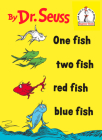
Which is funny, because even when Dr. Seuss is plotless and random, as in Hop on Pop or One Fish Two Fish Red Fish Blue Fish, he's always quirky and specific as well.

Probably my favorite page in One Fish Two Fish is a brief stand-alone scenario, accompanied by this illustration:

Look what we found
in the park
in the dark.

We will take him home.
We will call him Clark.
He will live at our house.
He will grow and grow.
Will our mother like this?
We don't know.


 Compare that to the banality of Oh, The Places You'll Go!:

Out there things can happen
and frequently do
to people as brainy
and footsy as you.

And when things start to happen,
don't worry.  Don't stew.
Just go right along.
You'll  start happening too.
 
I talk to my creative writing students a lot about avoiding general statements, understanding that often, it's the most specific details that pull a reader in and lead to an emotional response.  Too many generalizations, and your book starts to read like a long-form greeting card.  And, apparently, to sell like hotcakes.

So, any other suggestions for graduation-appropriate kids' books?

Love, Annie

Wednesday, June 20, 2012

Number the Stars

Dear Annie,

I'm so glad you wrote about the poem scene in Anastasia Krupnik -- that's the one I always think of with that book.  And as you say, the parents are wonderful -- and very deadpan, as I recall.

Before we leave the multi-talented Lois Lowry, I have to sing the praises of her first Newbery winner:
Number the Stars
.  Horrifying times in history are sometimes presented in kids' books through their heroic moments, rather than through the experience of cruelty.  We've talked about that in relation to slavery, and this book by Lowry builds on an amazing piece of Holocaust history that took place in Denmark in October 1943.  Just as the Nazis were about to start deportations, non-Jewish Danes hid that country's Jews, transported them to the coast, and ferried more than 7000 of them to safety in Sweden.  Only 5% of Danish Jews were caught by the Nazis.

Number the Stars is the story of 10 year-old Annemarie Johannesen and her friend Ellen Rosen.  Ellen's parents go into hiding and Annemarie's family tells the Nazis Ellen is their child. They take her to an uncle's home on the coast, where she's smuggled to a boat and then to Sweden.  There are several terrifying moments when Nazis confront the family, but they manage to deflect the attention.  The feeling of constant threat opens the story, when Annemarie and Ellen race each other home from school and are stopped by German soldiers:
Annemarie stared up. There were two of them. That meant two helmets, two sets of cold eyes glaring at her, and four tall shiny boots planted firmly on the sidewalk, blocking her path to home.... And it meant two rifles, gripped in the hands of the soldiers. She stared at the rifles first. Then,finally, she looked into the face of the soldier who had ordered her to halt.... "Why are you running?" the harsh voice asked. His Danish was very poor. Three years, Annemarie thought with contempt. Three years they've been in our country, and still they can't speak the language.
The book stays with Annemarie's point of view throughout.  In Lowry's 1990 speech accepting the Newbery medal, she talked about trying to show the events from a child's perspective.  She told the story of a Danish friend who had been a child during the Nazi occupation.  "When I asked Annelise to describe, through the eyes of her own childhood, the German soldiers themselves, she said: 'I remember the high shiny boots.'"  Lowry emphasized the boots in the book, to the extent that her editor suggested she cut out some of the references.  During the time she was trying to decide how to deal with his suggestion, she met a Dutch survivor of the era, who as a very young girl had been hidden under floorboards while her mother was taken away by Nazis.
I asked her, as we sat there talking, if she remembered any of it.  She said the memory was very vague, because she had been so very young.  There was only one thing, she told me, that she recalled clearly from that day when she had peeked out through a crack in the floor.
   She said: "I remember the high shiny boots."
   So when I went back [to my editor], I asked him to leave the boots there in the book -- every reference -- again and again and again.  I decided that if any reviewer should call attention to the overuse of that image -- none ever has -- I would simply tell them that those high shiny boots had trampled on several million childhoods and I was sorry I hadn't had several million more pages on which to mention that.
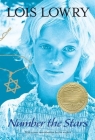
Over the years, Number the Stars has been published by two different companies, but it's always had that cover photo of the blonde girl and the Star of David necklace.  At the dinner I attended with Lowry two weeks ago, she told us that she had taken the photo.  The girl was the daughter of Swedish diplomats who were friends of the Lowrys.  She was 21 by the time the book was published, and gave her permission for its use.  Although Lowry stayed in touch with the parents, she lost touch with the daughter over the following decades.  This spring the daughter came to an event where Lowry was speaking, and there was a cheerful reunion.  She pulled out her iPhone at the restaurant and passed around the picture she'd taken.  It was of a very attractive 45 year-old blonde woman, wearing makeup and a dress which showed off her curves.  She looked like someone I might enjoy meeting, and one could see the girl on the book in that woman's face.  But the iconic photo had definitely grown up.

Love,

Deborah