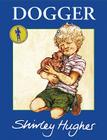
In which Annie (high school teacher, mother of two young girls and a younger boy) and her aunt Deborah (children's bookseller, mother of two young women in their 20s) discuss children's books and come up with annotated lists.

Showing posts with label Shirley Hughes. Show all posts

Thursday, June 20, 2013

Life imitates Shirley Hughes

Dear Annie,

I had a lovely encounter walking home this afternoon, worthy of a blog entry.

It was a gorgeous day here today: sunny and not too humid.  I ran into a neighbor on a walk with her two sons, ages 1 and 4.  She commented about hoping for rain, and I realized the 4 year-old was wearing a pair of bright yellow rain boots.  We all stood quietly admiring them for a moment, then his mother realized that they were on the wrong feet.  "That's why you've been walking that funny way," she said.  It took a little twisting, wiggling, and bracing himself against the available grown-ups, but he managed to switch boots without sitting down.  "Ah," I said, "do you know Alfie's Feet?"

They didn't.
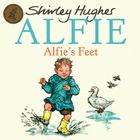


Alfie's Feet
is one of several excellent picture books by Shirley Hughes, whose praises we've sung on more than one occasion.  Alfie loves to splash in puddles, so his mother gets him a  pair of lovely yellow Wellingtons (he is, after all, British).  He puts them on and heads out into the world:
Alfie stamped in a lot of mud and walked through a lot of puddles, splish, splash, SPLOSH!  He frightened some sparrows who were having a bath.  He even frightened two big ducks.  They went hurrying back to their pond, walking with their feet turned in.
His father notices that Alfie is walking a bit like the ducks, and realizes that his boots are on the wrong feet.  Alfie sits down and remedies the situation.  Satisfaction all around.  It's Shirley Hughes immersing herself in a pre-schooler's point of view, savoring small details.

It was such a magical moment for me, watching a pre-schooler realize his yellow Wellies were on the wrong feet.  It felt like a gift from the book gods. 

I'm getting the neighbors a copy of Alfie's Feet as soon as I get to work tomorrow.

Love,

Deborah

Tuesday, May 14, 2013

Hero on a Bicycle

Dear Annie,

Bitterblue sits on my shelves -- clearly it's time for me to read it soon.  I really liked Graceling, then felt Cashore had lost her touch completely with Fire, so I'm glad she came back to form with the third.

As long as we're on the subject of of moral culpability in difficult circumstances, I'll bring up an excellent new middle-grade book by Shirley Hughes, author of Dogger and many other wonderful picture books.  She has just published her first novel at the age of 84.

Hero on a Bicycle is set in Florence during the Nazi occupation --  siblings Paolo (13) and Costanza (16) are living in the city with their English mother; their Italian father has left, apparently to join the Resistance.  Paolo rides his bike after curfew, longing for the excitement of war, wishing to be heroic.  His sister spends vaguely uncomfortable time at the home of a family of collaborators, listening to records with a friend and meeting German officers.  When Paolo tries to find and join the Resistance, fighters ridicule him and steal his bicycle.  A commander stops the theft but growls at Paolo:
"Take it -- go home -- presto! -- as soon as you can.  And remember, you say nothing about this little adventure to your family -- nothing -- understood?"  Then he turned to go and gestured to the others to follow him.
   "But I want -- " said Paolo weakly.
   "Just get going -- now!"
   Paolo could resist no longer.  Forlorn, dejected, and utterly humiliated, he set off, bumping dangerously down the path on his bike and praying that the sharp stones wouldn't wreck his tires.
When he gets home, the Resistance has pressured his mother into hiding escaped Allied prisoners of war.  She tries to keep it from her children, but Costanza says, "Oh, Mamma -- we're not kids anymore.  Of course we can guess what's happening."  The story progresses through heart-stopping action -- saving a wounded Canadian soldier from the Nazis, aerial bombings, searches of their home, a near-execution in a town square, constant fear and confusion.  As the family comes under suspicion of helping the Resistance, it's clear someone has informed on them, and others are warning them.  A Nazi officer's genuine fondness for Costanza saves the family in one situation; a friend's need to save his own family endangers them.   Hughes even deals with that how-do-you-live-near-them-afterwards question that you brought up.

Both brother and sister have their moments of exceptional courage in terrifying situations.  Paolo and his bicycle help to save a man's life.  Later that day, as Germans are retreating in a chaotic scene, Costanza hears her name called on the road, thinking it's a soldier she's helped.
Then she realized that it was an even more familiar voice.
   "Paolo!" she shouted back.
   She could see his head bobbing along some way off.  He was waving.
   "Oh, Paolo -- thank God!"
   They struggled toward each other.  Paolo looked every bit as exhausted as she was, and he was clearly so close to tears that she stopped crying and hugged him.
   "Paolo -- where have you  been all this time?  Where's your bicycle?"
   "I lost it.  I mean, I gave it to someone."
It's a novel, they're teenagers, there's a war on -- but their reunion on the road made me think of the much younger David and Bella in Dogger.  In Dogger, Bella gives up a bear that she's won in order to retrieve her little brother's beloved stuffed animal.  It's an act of sibling caring and sacrifice that always brings a tear to my eye when I read it.  Hughes lets the reader feel the depth of caring between brother and sister.  And in Hero on a Bicycle, we feel the deep connection between Paolo and Costanza.  They start out on parallel tracks -- each in a separate internal world.  But having to face the realities of the war brings out what's been there all the time: intense caring and family feeling.  I feel these brave Anglo-Italians show us how sweet British David and Bella could have turned out.  A lovely reading experience.

Love,

Deborah


Friday, November 9, 2012

Another problematic cover

Dear Annie,

It's so cheering that there are lots of books out there that we have yet to introduce to each other.  I'm so glad Moomintrolls are new to you.  You guys are in for a treat.  I'm curious what part of the Moomintroll oeuvre your friend Mark is particularly fond of.  I only recently learned about the comic books; in our household the chapter books were everything.

And I want to hear the family verdict on Wind on the Moon after you finish it.  It will continue to veer into new plot elements.

Lately I've been reading lots of books which are due out mostly between February and May of next year.  They include a first novel by the wonderful Shirley Hughes (creator of Alfie and Dogger and many more), a riveting account of a plot to steal Lincoln's body in the 1870s, and wonderful parallel-worlds story.  I plan to write about all of them as we approach their publication dates.  But your headline about not judging books etc made me want to vent a bit about one particular cover.

A Corner of White by Australian author Jaclyn Moriarty comes to the U.S. in April under the auspices of Arthur A. Levine, the editor who obtained rights to both The Golden Compass and Harry Potter.  He knows how to spot a good book.  This one has little whispers of The Golden Compass: it entails communication between two parallel worlds; the characters in our world live in Cambridge, England.  The worlds once had easy access to each other, but the medieval plagues led the Kingdom of Cello to sever the connection.  We focus on three teenagers (two girls and a boy) in Cambridge who are are studying, among others, Isaac Newton and Lord Byron.  Newton's theories of light become important to Elliot Baranski, the teenager who is the center of the story in Cello: colors occasionally form themselves into storms that can alter moods and sometimes injure and kill.  Elliot's father has disappeared from his village -- maybe voluntarily, maybe carried off by a Purple.  In Cambridge, Madeline, whom Elliot refers to as the-girl-in-the-World, has run away from her father.  Madeline and Elliot discover a crack between their two worlds: it's just big enough to wedge a piece of paper into it, and they start a correspondence.  Madeline thinks Elliot is a guy who's inventing a magical world, not someone who's in one.

There are plots and sub-plots.  Friendships evolve, kids deal a lot with loss and the uncontrollable aspects of their lives.  It's intelligent fantasy -- and by no stretch of the imagination would I put it in the chick lit category.  I would like to think that Arthur A. Levine was out sick the day they designed the cover of the American edition:

How am I going to be able to sell this to a 12 year-old boy who's looking for a good fantasy book?  A few guys might go for it, but the vast majority will glance at the cover and go on to the next offering.  This screams chick-lit: dreamy-eyed girl, flowing hair, breezy day.  I carried this galley with me to Maine and back again before I picked it up to read -- there's nothing in this cover that hints at the originality of the content.

Tonight, while trolling for a good quality image of this cover, I discovered what the book looks like in Australia, where it came out last month:
Hmm.  Can't say this makes my heart beat faster, even though it's more literally true to the story: lots of discussion of the light spectrum and rainbows.  And the crack between worlds is right there.  Will this encourage a 12- (or 16-) year-old to pick it up?

We'll have to see what they do with the paperback cover...

Love,

Deborah

Friday, June 8, 2012

Guest blogger: Rule Britannia

Dear Aunt Debbie,


It was lovely to see you!  The girls and I haven't stopped reading the books you brought, chief among them the two princess and the pea retellings you blogged about recently.  Good stuff.


Our guest blogger tonight is my cousin-in-law Fabienne, who has written for us before on the books of Julia Donaldson and Axel Scheffler.  Fabienne lives in London, and writes tonight's post with a British flair.  Here she is: 

Last weekend we Brits celebrated Queen Elizabeth II's Diamond Jubilee. 60 years in any job is worth some praise, right?


And feeling quite patriotic, as one does at such times, I thought I'd write today's guest post about some British talent. British vintage talent to be exact...

My son Sebastien is two and  a half tomorrow and L-O-V-E-S books. His insatiable appetite together with the dearness of new books has meant that 98% of those I've bought for him have all been from various good will stores in our local community. Averaging about 60p (95¢) a pop means I can pick up 3 or 4 in one go and pay for our loot with loose change from my purse. Sweet. You come across a lot of tat of course, but I have been fortunate enough to come upon some real gems that you may not know of over on your side of the pond.

Is everyone ready? Then I'll begin...

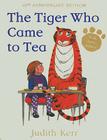
The doyenne of today's bunch is Judith Kerr. Born 1923, Kerr is most famous for writing the much  loved British classic "The Tiger Who Came to Tea" as well as 17 volumes in the "Mog" series.

The Tiger Who Came to Tea
is an enchanting book about Sophie and her mummy who have a tiger over for tea and how he ate everything he could find leaving nothing for their supper, not even a drop of water in the tap. The tale and its illustrations are very much of their era (1960's) and include the old social stereotypes of mummy at home with the children, with dinner ready for when daddy gets home from work. So if you're fiercely feminist, you may object to this one, but to be honest, what with the cost of childcare incessantly soaring a lot of families have had to revert back to this kind of model in the UK. Either way it doesn't bother me and most importantly, it doesn't bother Seb, who loves the cheek of this wild yet very polite beast who invites himself in and helps himself to... well everything, only to leave and never return.

"Sophie's mummy said, "Would you like a sandwich?"
But the Tiger didn't take just one sandwich.
He took all the sandwiches on the plate
and swallowed them in one big mouthful. Owp!

And he still looked hungry,
so Sophie passed him the buns."

Next up is Shirley Hughes [Annie's note: We love Shirley Hughes!  We've written about her books before here, here, here, and here]. Like Kerr she started out as an illustrator, but went on to write and illustrate 50 stories or her own. You're most likely to know of "Dogger" a book that won her many awards and the first to be published abroad. But two of my favourites are "Out and About" and"Let's join in". Not so much stories but a series of anecdotes following Katie and her baby brother Olly. They have a vivid, real quality about them and depict childhood as it is: not manicured, tidy and fairy-tale-like, but scruffy, dirty and most of all funny. All in all her work is very English and evocative of carefree, simpler times.

"A lot of things seem to hide-
the moon behind the clouds...
and the sun behind the trees.
Flowers need to hide in the ground in wintertime.
But they come peeping out again in the spring.
Buster always hides when 
it's time for his bath,
and so does Mum's purse when we're all ready to go out shopping."


And finally the wife and husband team, Janet & Allan Ahlberg. Janet passed away much too early some years ago now following a battle with cancer, but she was the illustrator to Allan's text, making them an amazing prolific partnership. I'm sure "Peepo" and "Each peach pear plum" are as well known and loved in the USA as they are over here in Blighty. But our favourite these days is "Cops and Robbers", a rip-roaring rollicking tale about a band of robbers stealing children's toys on Christmas night and how they were caught by "upstanding Officer Pugh". The rhyming verse is detailed and funny and and as a whole resembles the structure of a song with many verses. In fact, my father does not read this to Seb, but sings it to a simple little tune he made up especially!

"Here are the robbers of London town:
With crowbars and skeleton keys.
They prowl and creep
When you're asleep
And take... whatever they please.

Ho ho for the robbers
The cops and the robbers Ho Ho!"


Many wonderful children's books are written every year, but let us not forget those little gems that will never go out of fashion... Three cheers for Blighty: Hip hip horray!

Fabienne


And love from me, Annie

Wednesday, February 29, 2012

Amazon wars

Dear Annie,

Wow -- both your girls are moving right along on the reading front.  And having a good time doing it.

We also loved the Golly Sisters and their distinctly juvenile form of sibling bickering.  There are three Golly Sisters books, two of them now sadly out of print.  In Hooray for the Golly Sisters,  May-May and Rose encounter a river separating them from a town where they're scheduled to perform that evening.  The opening lines provided us with another of those family literary references:
"Big river," said May-May.
"Very big river," said Rose.
It comes in handy when faced with any large body of water.

Some interesting developments are afoot this week in the world of bookselling.  You eloquently discussed some of Amazon's predatory practices back before Christmas.  Now they're putting the squeeze on some book publishers to cut the prices at which they sell to Amazon.  Last week, Amazon stopped selling e-books from Independent Publishers Group because it refused to cave to Amazon's demands.  "It wasn't reasonable.   There's only so far we can go," said the head of IPG, a distributor which sells books for hundreds of small publishers.  Our store gets many titles, including the wonderful Alfie books and Dogger by Shirley Hughes, from IPG.

Amazon-free
On Monday, Education Development Corporation, which publishes Usborne and Kane-Miller books in the U.S., announced it will no longer sell its 1,500 titles through Amazon.  They're an all-kids' book publisher -- we've talked about the Usborne activity books here and their First Experience series here.  Their publications which are nearest to my heart, though, are Atinuke's amazing Anna Hibiscus books.  Those come through Kane-Miller, which specializes in kids' books from around the world.  EDC started experimenting with going Amazon-less back in 2009 when it pulled its Kane-Miller titles -- at last I know why Anna Hibiscus was only intermittently showing up on Amazon.  They satisfied themselves that they could stay profitable -- Kane-Miller's sales are way up since then -- so they pulled the plug on the larger Usborne list this week.  The EDC president said Amazon is trying to "gain control of publishing and other industries by making it impossible for other retailers to compete effectively." And he concluded the announcement with a statement which has cheered many independent booksellers:
 From my point of view as an editor and publisher, this is also about supporting the connection between booksellers and book buyers. Hand selling has always been a necessary, integral part of the business, particularly with children's books. And it's still the hand selling, the independent booksellers and word of mouth that can create a best seller. Amazon might sell them, but independent booksellers are the ones who create them.
This is all cheering because from my point of view Amazon has seemed so unstoppable in its efforts to monopolize book sales in all forms.  Smart people are figuring out how to keep bookselling a varied and open marketplace.

Love,

Deborah

Wednesday, September 7, 2011

Community in action

Dear Annie,

Here we are, back to school once again.  Mona flew off to her junior year in college today; Lizzie's already in her second week of classes.  Eleanor's in a new pre-school.  And you must be in full swing at Stuyvesant. 

I've had a nice little reminder of the store's connection to its community in the past week.  Our local  middle school assigned a book on the first day which I was able to order quickly.  Someone posted on a school listserv that we had it, and we've had a parade of folks coming in to buy it.  It's very satisfying to have that connection to a nearby school and its parents.

So I've been thinking about community and neighbors, and yet another Shirley Hughes book seems appropriate here.  Four of them, actually, collected into Tales of Trotter Street, currently out of print, alas.  Each story focuses on a different family living on the same block, but members of the other families have minor parts.  I've written about one of them, Angel Mae, which is both a Christmas book, and (since you asked) the only book that pops into my head which presents school as part of life, rather than an anxiety-provoking task.

The Trotter Street Tale that was read and re-read in our house was The Big Concrete Lorry.  It's about the five-person Patterson family, who decide to add a room onto their house rather than move to a bigger house away from Trotter Street.  They shop for plans, buy supplies, and, with the neighbors' help, dig a foundation.  The next day, when they're still recovering from all the digging, the Jiffy Ready-Mix Concrete Co. lorry appears:
Out jumped jolly Joe Best.  "Load of concrete you ordered!" he called cheerfully.
"Not this morning, surely?" said Mum.  "I'm sure we didn't. . . "
But it was too late.  Jimmy had already pulled a lever and the big drum poured out a load of concrete, all in a rush.  Slop!  Slurp! Dollop!  Splosh! Just like that!  It landed in a shivering heap right outside the Pattersons' front door.
The concrete has to make it to the foundation in the back yard of the rowhouse before it sets.  Dad wakes up.  Mum starts wheeling loads through the house, and the kids run for the neighbors:


Everyone runs to help, there's a frenzied paragraph of "labouring and struggling," and the concrete gets moved.  A small hill remains on the front sidewalk: "it was great for sitting on and racing cars down.  And if you climbed up and stood on the top, you could see right to the very end of Trotter Street!"

So here's to neighbors and helping each other out: one of those lessons best absorbed in the context of a good story.

Love,

Deborah

Sunday, June 19, 2011

Summer approaches!

Dear Annie,

Thank you to Denise for her lovely list of summer books.   Now that she's started, I don't want to stop.  I'll add a few to the list.

The
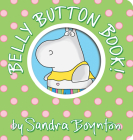
Belly Button Book
is a cheerful Sandra Boynton board book for little ones, explaining why hippos go to the beach:

BELLY BUTTON BEACH
Where Tons of Hippos Stand Around
In Bathing Suits Too Little
Because They Hope You Will Admire
The Button On Their Middle


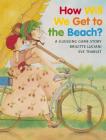
How Will We Get to the Beach?
by Brigitte Luciani tells the story of Roxanne who has a baby, a ball, a book, an umbrella and a turtle, all of which she wants to take to the beach.  She goes through a series of conveyances -- a bus, a bicycle, a skateboard, a kayak, and a hot-air balloon -- each of which can't fit one thing, and so is rejected.  The reader has to figure out which thing doesn't fit each time.  Eventually a solution appears and all is well.  It's quite delightful, and full of I-spy and counting elements.

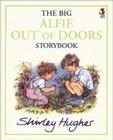
And the wonderful Shirley Hughes, about whom we've written more than once, does a lovely series of summer stories in 
The Big Alfie Out of Doors Storybook
.

It has four stories about being in the outdoors: playing in the back yard, camping out near the house (with a local farm pig wanting to join in), trying to get a lost sheep home, and the best of the bunch: a beach story called "Bonting."

Alfie creates a pet rock from a stone he finds.  His mother gamely makes Bonting a wardrobe, including a bathing suit.  So when the family goes to the beach, Bonting comes along.  The day at the beach is lovingly described, and when it's time to go home, Bonting is nowhere to be found.  All ends happily.  Parents: read at your own risk: just a couple of weeks ago, a customer told me about her own child's Bonting, whose clothing was a challenge to create.  It brought back memories of splicing together fashion for my own children's rocks.

We avoided taking them to the beach, though.

Love,

Deborah

Sunday, December 5, 2010

The Angel Gave-you

Dear Annie,

How lovely to get a comment from an author of the book you posted about!  I look forward to being able to carry When You Were Small when it's republished.

I suspect that the store that told you Anna Hibiscus is out of print was using the same data base I use for quick look-ups of customer questions.  Amazon, much as I dislike it as a force in the bookselling  industry, has a better listing of books and what's in print than any other free site.  However, especially with smaller publishers, they can be wrong.  They also have been known to banish publishers' products from their listings when they have disputes with them (see Macmillan kerfuffle some months ago).  Anna Hibiscus is not out of print; I just received 20 copies of it from the publisher last week, and their website lists it as in stock and available, so don't despair!  And feel free to tell your local store about it.


Speaking of out of print books, I'll be referring to a few this month.  We have a family tradition of reading a pile of books together on Christmas Eve.  They're a funny mix of books we've accumulated over the years, all of which have a special aura for the four of us, so a number of them will make it into the blog.

I wrote a bit about one some months ago: Angel Mae, by the wonderful Shirley Hughes.  I was referring to Mae's endearingly irritating whine, "Carry me!"  Angel and her big brother Frankie are anticipating the arrival of a new baby in the house: Mum is large and exhausted.  Their school is putting on a Christmas play and roles are assigned: Frankie gets to be one of the three kings.  Mae volunteers to be the baby Jesus, but her teacher says the part is already taken by a doll.
She said that Mae could be a cow or a sheep if she liked, but Mae certainly didn't want to be either of those.  She stuck out her bottom lip and made a very cross face.
"What about being an angel?" asked Mrs. Foster.
Mae didn't want to be an angel either.
"You could be the angel Gabriel," Mrs. Foster told her.  "That's a very special angel, a very important part."
Mae thought about this.  Then she nodded her head.
"I'm going to be the angel Gave-you!" she told Frankie later.
"Angel who?" said Frankie.
"Angel Gave-you!  A very special angel," said Mae proudly.
Mum of course goes into labor just before the play, but Dad makes it to the performance at the last minute, leading Mae to shout from the stage, "Hello, Dad.  I'm being the angel Gave-you," and fall off her chair.  Courage triumphs, and despite a bump on her arm, Mae keeps singing Away in a Manger, and the show is a success.  There's a new baby too, and Mum and the babe make it home for Christmas.

Love,

Deborah

Monday, October 25, 2010

Dogger

Dear Aunt Debbie,

Like you and Rachel, I adore Dogger.  You sent it to us last year, and it quickly became a household favorite.  We've gotten a couple of other Shirley Hughes books out of the library: Alfie's Feet, which you mentioned in your last post, and  Alfie and the Birthday Surprise, which is very good at dealing with the death of Alfie's neighbors' beloved cat (though the jacket copy didn't prepare me for what was going to happen inside.  Surprise!)  But Dogger is the best.

It's the story of Dave, a little boy who has a stuffed dog named Dogger, which he loves to pieces.  One afternoon, on the way home from picking up his big sister Bella at school, Dave somehow loses Dogger.  There are a wonderful few pages of the household search for Dogger (a scene familiar to all parents, I'd wager):


"But Dogger was quite lost."  Dave is bereft.  The next day, the family goes to the School Summer Fair (lots of great, highly-detailed pictures of fair activities: a costume parade, different kinds of races and games).  Bella wins both a three-legged race and a raffle, and gets a giant stuffed bear.  As Dave pouts around, he discovers Dogger on a toy sale table, with a price tag on him.  Horrors!  He doesn't have the money to buy Dogger back, and can't get the lady's attention, and can't find his parents, and sees another little girl come to buy Dogger, and it seems for a few pages that Dogger will be irretrievably lost, but Bella reunites them in a moment of selflessness.

Hughes's writing is beautifully understated.  As you say, her characters behave well in a way that feels totally natural: no one is being taught a lesson in these books, but there is real goodness here, and a careful attention to what is most important to small children.  And there is the lovely British-accented text:

Bella ran up with her satchel flying.
"Mum, can we have an ice cream?"
Mum gave her the money for two cones.  Joe didn't have a whole ice-cream to himself because he was too dribbly.

I really need to find myself more Alfie books too, don't I?

Love, Annie

Sunday, October 24, 2010

Wonderful Alfie

Dear Annie,

Hmm, well, birds and bees and four year-olds. One of the many challenges of parenthood. I remember Lizzie asking, when she was about three years old, "How did I come to be?" It was such great phrasing. I talked about Mommy and Daddy loving each other and deciding to have a baby. We got into more of the nitty-gritty later.

I'll come back to this question -- probably in my next post -- after I go comb through my shelves in the store and find the good books.

I thought I'd spend most of this post on the amazing Shirley Hughes and her Alfie books, which Rachel mentioned in a comment last week.   I seem to have mentioned her only once, in relation to Angel Mae, a great Christmas book that's part of her Trotter Street series, now out of print.  She's a British author and illustrator.  The children in her books seem very multi-culturally British, fresh-faced and sweet.  The stories take the daily tribulations of pre-schoolers' lives very seriously, and they tend to have children who behave well, with courage, without being preachy.  There's always a sense of having succeeded at something.  They're lovely.

Rachel, the British versions of the Alfie books are currently in distribution in the U.S. -- I carry them at Child's Play.  You just need to find the right independent book store which carries them.

My favorite Alfie books are: Alfie's Feet (about getting new boots and figuring out which feet to put them on), An Evening At Alfie's (about a ceiling leak when the babysitter is there), Alfie Gets in First (Alfie unintentionally locks his mother out of the house), and
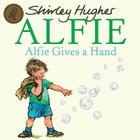
Alfie Gives a Hand
.  In this one, Alfie goes by himself (for the first time) to a birthday party.  He's apprehensive, and brings along "his old bit of blanket" to feel more secure.  He politely declines the hostess's  invitation to put it down.  Bernard, the birthday boy, does some major acting out -- throwing Alfie's gift in the air, being wild with his food, playing games while wearing his scary mask -- disconcerting Alfie, but scaring his friend Min.  When it's time to play ring-around-the-rosy, Min won't join unless she can hold onto Alfie, but Alfie can't hold Bernard's and Min's hands and his blanket too.
Then Alfie made a brave decision.  He ran and put down his blanket, very carefully, in a safe place underneath the table.  Now he could hold Mind's hand, too, as well as Bernard's.
 Alfie is center top in the picture.

The party ends happily and Alfie's mum and baby sister come to collect him as promised.

All the Alfie books are full of detailed illustrations which one can linger over.  Most of them also feature Alfie's toddler baby sister Annie Rose, a pre-verbal forceful personality.  They're great.

Best of all the Shirley Hughes books is Dogger, which I'll save for another post.

Love,

Deborah

Sunday, August 22, 2010

Family Literary References

Dear Annie,

We've left the hammocks of Maine and are back in DC, at least for a few days -- until we see you at yet another amazing cousin wedding on Friday. 

While the four of us were together, we realized how many times we use little phrases among ourselves that come from books we read years ago.  I think many families have these mutual reminders of things that resonate in books.  Here are some of ours:

"Wick-ee, wick-ee!"
 Not your usual conversational gambit, but it comes up surprisingly often around here.  It's from a long-out-of-print reader called Webster and Arnold and the Giant Box, by P.K.Roche.  It has to do with resisting an overly-controlling older sibling:
"You will be Rocket Mouse," said Arnold. "And I will be Chief.  Now let's get ready to blast off."
"Okay, said Webster.  What does Rocket Mouse do?"
" Rocket Mouse helps the Chief," said Arnold.  "Sh-h! Here's the countdown."
"But what do I do?" yelled Webster.
"Nothing!" yelled Arnold.  "That's what you do! 10...9..."
"Listen," said Webster.  "What is that funny noise?"
"Sh-h!" said Arnold.  "There is no funny noise.  8...7..."
"The rocket is going wick-ee, wick-ee," said Webster.
"The rocket is not going wick-ee wick-ee, said Arnold.  "6...5..."
"I think the rocket is going to explode," said Webster.
"No," said Arnold.  "It is not going to explode.  4...3... "
Webster listened closely.  "Yes," he said.  "I feel sure it is going to explode.  The wick-ee is getting louder."
"It is not!" yelled Arnold.  "The wick-ee is not getting louder!  2...1... blast --"
"WICK-EE!  WICK-EE!  KA-POW!" yelled Webster.  "The rocket is exploding!"
"That does it!"  shouted Arnold.  "I'll never play with you again!  Never! Never! Never!"   And he stamped out of the box.
They eventually reconcile and keep playing, of course. And we keep using wick-ee wick-ee when we hear something that sounds a little off, or during a countdown, or when Ka-pow on its own just isn't quite enough.

"Carry me, carry me!" (in whiny tone)
From one of our favorite Christmas books (also out of print, alas): Angel Mae, by the excellent Shirley Hughes. Mae is a pre-schooler who lives in a walk-up flat with her very pregnant and frequently tired mum:
"Mae got tired too.  She wished she could be carried like a shopping bag.
'Carry me, carry me,' she moaned, drooping on the banisters at the bottom step.  But Mum couldn't carry Mae and the shopping.  Mae was much too old to be carried anyway."
Even when your children are taller than you are, they can get great satisfaction in expressing fatigue with Mae's eloquent moan.


"Don't call me darling -- I'm a driving instructor."
A great line from Saffy's Angel, and one which we've used more in the post 16 year-old years.  It's said with a British accent.

"Sorr-eee, Harr-eee" (British, accent on second syllable)
This is from the great Jim Dale recordings of the Harry Potter books -- a phrase Hermione uses in sing-song inflection throughout all seven books.  Used when apologies come up.  This one escapes my lips most frequently when I'm in public, leading to the occasional funny look.

Another of the joys of reading a lot with one's children.

Love,

Deborah