Apologies for the longer-than-usual grading hiatus! I somehow managed to miss the fact that my seniors' grades were due today until late last week, so further paper grading on top of the portfolios took away the Friday night I was saving for you and Lois Lowry.
I have been meaning to write about my deep and abiding love for Lois Lowry for over a year, since we had that foray into "first loves": the YA authors whose books I read and reread until their cheap pages wore down, whose entire canons I owned, the books I can still practically quote from now, more than 20 years later. I wrote about Madeline L'Engle as sci-fi and as chick lit, Cynthia Voight, and Paula Danziger, but the list would be sadly incomplete without Lowry.
Now, I'm not talking about the serious, dystopian, later Lowry that you covered in your excellent post last week, though she is the Lois Lowry my students know -- they've all read The Giver, and it blew their minds in 5th and 6th grade and set them up for a good time with Ursula K. LeGuin and her ilk later in life. No, the Lowry I adored was the creator of the Anastasia books.
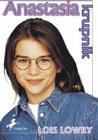 In the first Anastasia book, Anastasia Krupnik, our heroine is 10 years old. She has freckles, big owl glasses, and a name too long to fit across the front of a t-shirt: middle-grade outsider, and thus someone I instantly identified with. She lives in Boston with her father (an English professor and poet) and mother (a painter), and early in the book finds out that her parents are expecting a baby boy. She's not thrilled about the news. The third-person text of the book is interspersed with Anastasia's changing lists of "Things I love" and "Things I hate," which she keeps in a private green notebook, and which provide a commentary on the action.
Anastasia had a small pink wart in the middle of her left thumb. She found the wart very pleasing. It had appeared quite by surprise, shortly after her tenth birthday, on a morning when nothing else interesting was happening, and it was the first wart she had ever had, or even seen.
"It's the loveliest color I've ever seen in a wart," her mother, who had seen others, said with admiration.
"Warts, you know," her father had told her, "have a kind of magic to them. They come and go without any reason at all, rather like elves."
I love those parents.
The action in the book is episodic, and contains the requisite number of cringe-inducing middle grade experiences and rebound moments. Anastasia writes a poem for homework, a lovely free verse poem about small quiet sea creatures, which her teacher Mrs. Westvessel rewards with an F because it doesn't follow the rhyming structure she's been taught. Her father (who keeps drafts of his poems in the refrigerator crisper drawer so they won't burn if there's a fire) reads it aloud, and changes the F with his red pen to "Fabulous." Rereading it tonight, I got all choked up.
The episode I hated most as a kid because it made me cringe so badly, but which interests me now, involves Anastasia's crush on Washburn Cummings, a boy in her school. Washburn is black, and has an Afro (the book was published in 1979); in order to express her admiration for him, Anastasia rats and teases her normally straight hair to mimic his, and goes to school that way. Mortal embarrassment. But it's such a straightforward treatment of race and not fully understanding difference, it's kind of fabulous, too.
When faced with the knowledge that she's getting a younger brother, Anastasia threatens to run away from home. One of the ways her parents dissuade her from doing so is by giving her power: her father says Anastasia can name the baby. Because she is planning to hate him, Anastasia chooses the worst name she can think of, and writes it in her notebook. The name? One-Ball Reilly. (Weirdness!) Of course, when she first sees him, she falls in love, and the last scene has her giving him the name which will carry on through the rest of the series, and into his own series: Sam.
There were several other Anastasia books, and a whole Sam series I've never read. I stayed with the series through Anastasia Again, Anastasia at Your Service, Anastasia, Ask Your Analyst, Anastasia on Her Own, Anastasia Has the Answers, and Anastasia's Chosen Career.
In the second book, which might have been my favorite, Anastasia and her family move to the suburbs of Boston. Anastasia is at first totally resistant to the move, made because the family needs more space and her mother wants a studio for her painting. She makes Sam promise to pretend to be allergic to every suburban house they visit, and her one request is to have her room in a turret. Of course, the house the Krupnick family finds contains a turret for Anastasia, a huge library for her father, a light-filled studio for her mother, and a grassy neighborhood filled with interesting people. Sam starts to pretend to sneeze, and Anastasia shuts him up. As a kid growing up in a one-bedroom apartment with my family of four, I found the description of the house both compelling and foreign. As an adult, I recognize it as Lowry's foray into real-estate wish fulfillment.
Okay, yes, I want the house too. But I'll settle for a good reread of a great, strange little series.
Love, Annie