Things aren't getting any slower at the toy/book store these days. Every time I turn around, I see huge gaps in the shelves (oh no! No more Jan Brett books! We're down to two Grinches! And today someone bought out all five of our copies of A Wrinkle in Time! Must reorder!). There are a few more irritating customers than usual: grandparents who have no idea what their grandchildren are like, people with too much money and not enough time, parents who have little interest in communicating with their kids.
 But they're definitely in the minority. There's that lovely moment of wondering, who will this person be, before I offer to help someone. A quite wonderful woman was in yesterday, to whom I sold a very fine list of books. She's the mother of a nine and eleven year-old: one of each gender. She had bought the
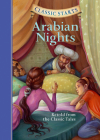
 Classic Starts Arabian Nights a while ago. It's part of the series that has a Peter Pan edition you wrote about. She said her husband was stunned that she'd bring home such an abridged edition, but he started reading it with the kids and everyone really liked it. It was a little young for them, and they wanted to wander into more magical/folklorish books.
So here's what we ended up with:
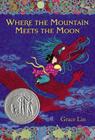
Where the Mountain Meets the Moon, by Grace Lin. This was the first one I thought of. I'm surprised that I've never written about it here: it's so wonderful, and appeals to kids of many different ages. It's the story of Minli, a girl who runs away from home to find The Old Man of the Moon, who determines everyone's fortunes. She wants to ask for prosperity for her parents. They're poor farmers, but her father tells lovely folktales to his daughter. On her quest, Minli meets many characters, human and not: a talking goldfish, a wingless dragon, travelers on the road, a king. Each new character tells his or her own story, which appears in a lovely old-fashioned typeface. Lin has also done gorgeous illustrations. While Minli is searching for the solution to her family's problems, we cut back from time to time to her parents, who are missing her achingly, but they're also reassessing the role of stories in their lives. Slowly, all the internal characters' stories knit together into one story, which is the one that Minli is in. The ending has a very satisfying reunion between child and parents.
 Since we were looking at fantastical fiction, the next title that came up was
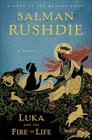
 Luka and the Fire of Life, by Salman Rushdie. Luka has just been published, the sequel to Haroun and the Sea of Stories, which Rushdie wrote back in 1990. Luka was written for his younger son and tells the story of a boy who journeys through a magical world to steal and bring home the Fire of Life to revive his dying storyteller father. It's full of a magical cast, governed both by ancient rules of storytelling and by conventions of video games. Every now and then Luka must hit a gold button that appears in the air in order to save the progress he's made toward reaching the fire. It has wonderful wordplay and is beautifully written.
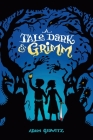
So there we were with two very well-written books about storytelling. How do the kids feel about scary?, I asked. They were mostly cool with that. So A Tale Dark and Grimm by Adam Gidwitz (link is to last month's blog entry), also about the role of stories in kids' lives, became the next on the list.
How about something different, the mom said. Sticking with the very good writers, we went on to A Long Walk to Water by Linda Sue Park, a very realistic story about children surviving under very hard circumstances in Sudan. She decided to take that one too.
I was ready to quit: what a satisfying list. But she wanted one more, and asked for one I thought was really special. Given that this is a family that clearly cares about language, the last book on this pile was one I loved as a kid: The Wonderful O, by James Thurber.
I hope I hear what they thought of all those books.
We miss you, Annie, but I know this is the end of the semester and an incredibly busy week for you. I hope there's some fun in all that grading.
Love,
Deborah